Climate Matters
Fastest-Warming U.S. States and Cities
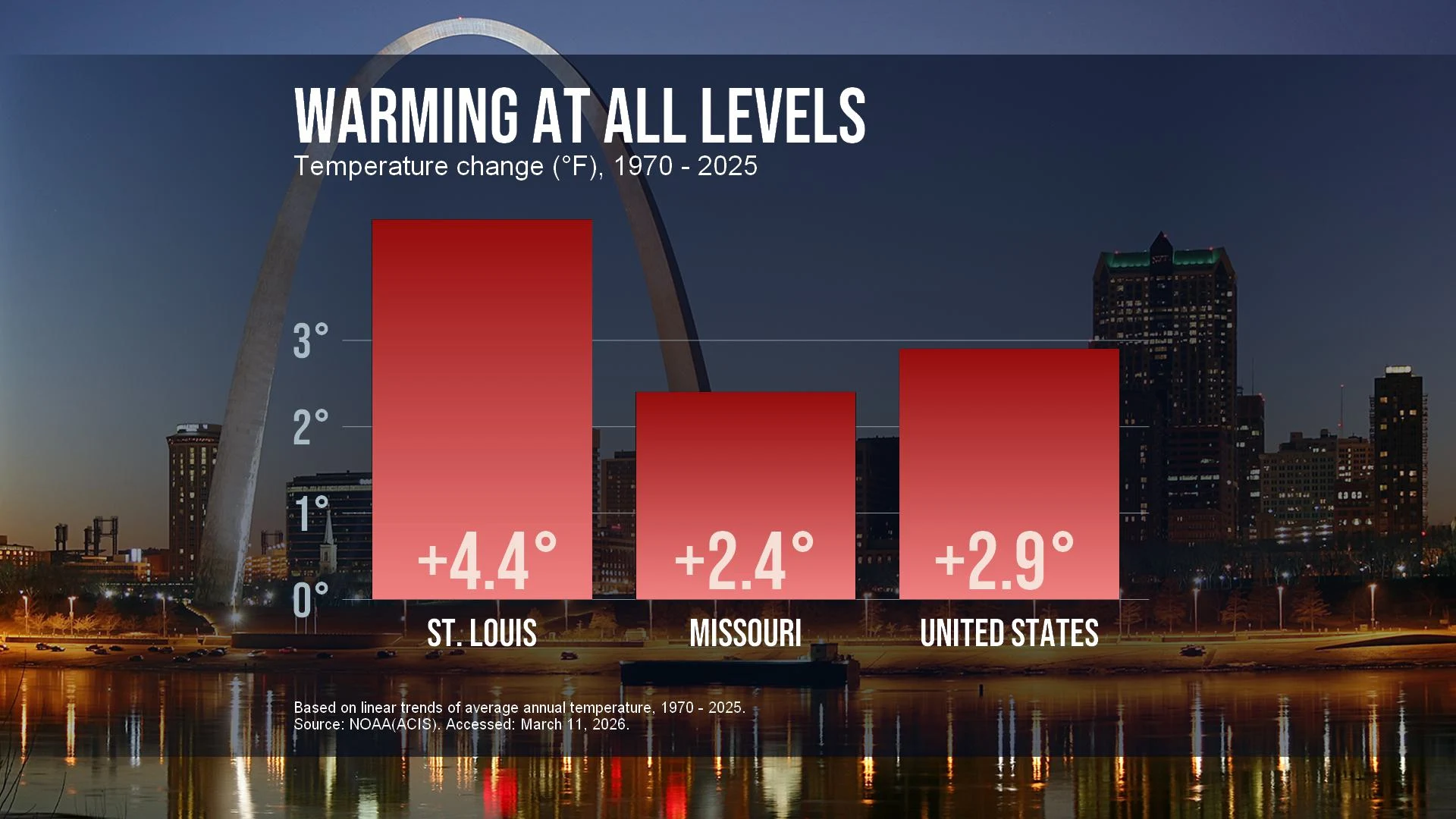
All 50 states and 99% of 242 major U.S. cities analyzed have warmed since the first Earth Day in 1970.
Dr. Zachary Labe, climate scientist at Climate Central, said:
“Climate change is shifting the timing of spring across the United States. Many regions saw plants bloom more than two to three weeks earlier than normal this past April, disrupting ecosystems and showing how human-caused warming is already altering the rhythms of the natural world.”
April 2026 Highlights: Temperature
April 2026 was the fourth-warmest on record globally (for land and ocean temperatures combined). The last time April’s global mean temperature was cooler than normal (compared to the 20th century average) was in 1976. Records have been kept since at least 1850.
Global average temperatures over land areas were the seventh-warmest on record in April.
Global average temperatures over ocean areas were the second-warmest on record in April.
Both hemispheres experienced one of their warmest Aprils on record, ranking fifth-warmest in the Northern Hemisphere and second-warmest in the Southern Hemisphere.
Ocean temperatures in the Southern Hemisphere experienced their warmest April on record.
April 2026 Highlights: Other Climate Indicators
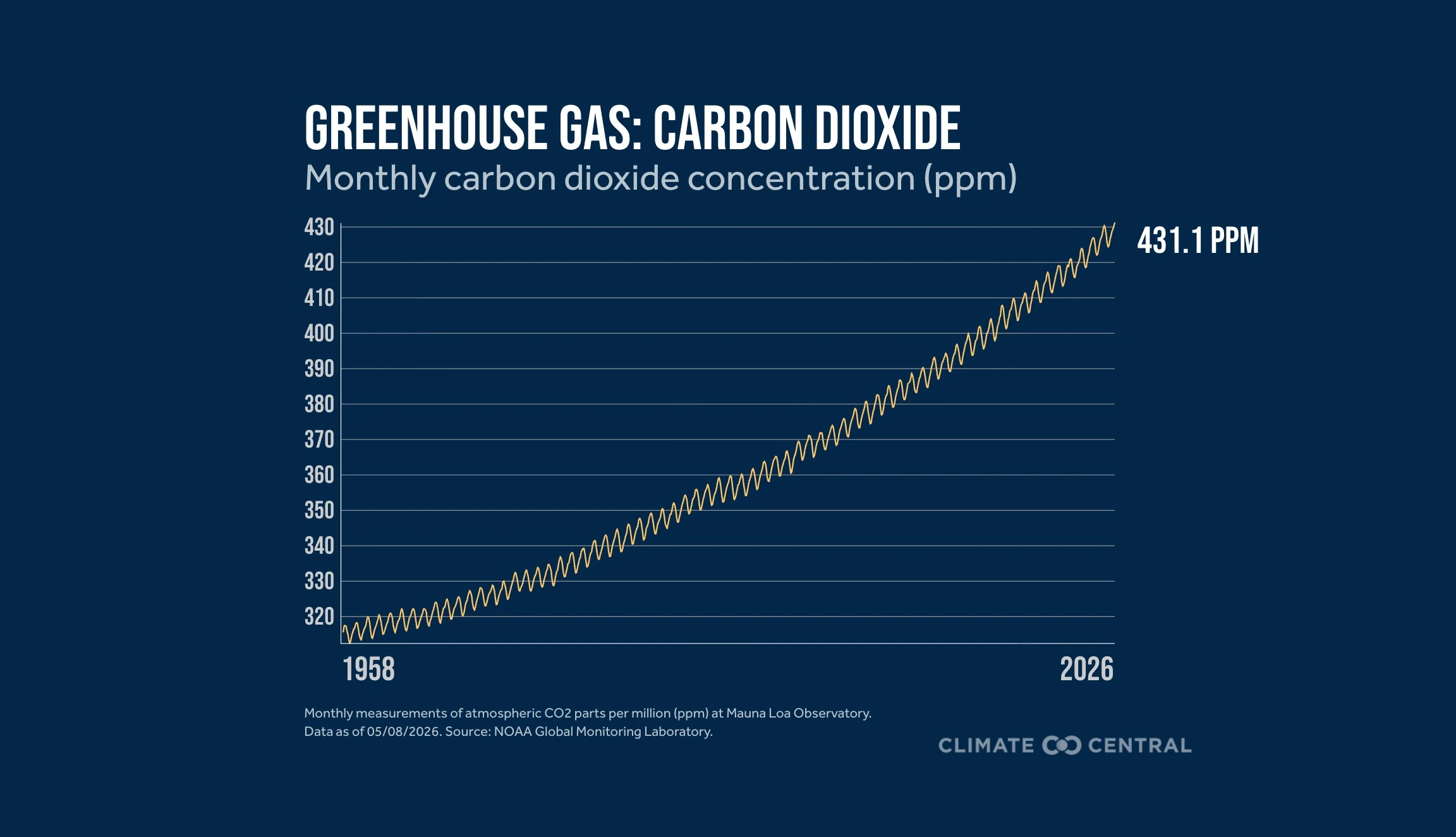
The average April carbon dioxide level measured at Mauna Loa, Hawaii, was 431.1 ppm. The annual levels typically peak in May.
Arctic sea-ice extent ranked as the second-lowest on record for April. This was 1,120,000 square kilometers below the 1981-2010 average.
Antarctic sea-ice extent ranked as the 11th-lowest on record for April.

April 2026 Highlights: Temperature
April 2026 ranked as the third-warmest April on record for the contiguous U.S.
April was the ninth-warmest for average maximum temperatures and third-warmest for average minimum temperatures.
Eight states recorded their warmest April on record: Illinois, Indiana, Kentucky, Missouri, Ohio, Tennessee, Virginia, West Virginia.
Ten states recorded their warmest April daytime maximum temperatures on record, while five states experienced their warmest April nighttime minimum temperatures.
Alaska recorded its 35th-warmest April on record (tie), and Hawaii recorded its second-warmest (tie).
Recent Temperatures from a Climate Perspective:
The average temperature so far in 2026 is the warmest on record for the contiguous U.S. (January-April 2026).
The West, Southwest, and South climate regions all experienced their warmest January-April period on record in 2026.
The average temperature over the last twelve months was the warmest on record for the contiguous U.S. (May 2025 to April 2026).
The average temperature over the last 60 months was the warmest on record for the contiguous U.S.
April 2026 Highlights: Precipitation
April 2026 ranked as the 46th-wettest April on record (tie) for the contiguous U.S.
Alaska recorded its 34th-wettest April on record, while Hawaii had its seventh-wettest April on record (tie).
Across the contiguous U.S., the last four months (January-April 2026) were the second-driest on record.
The Southeast climate region saw its driest January-April period on record in 2026.
The first four months of 2026 are the wettest on record for the state of Hawaii. Statewide records have been kept there since at least 1991.
April 2026 Highlights: Drought
As of May 7, 2026, at least 75% of the contiguous U.S. is experiencing abnormally dry or drought conditions.
The Southeast U.S. is experiencing the largest extent of severe or worse drought on record. Data has been kept since the U.S. Drought Monitor started in 2000.
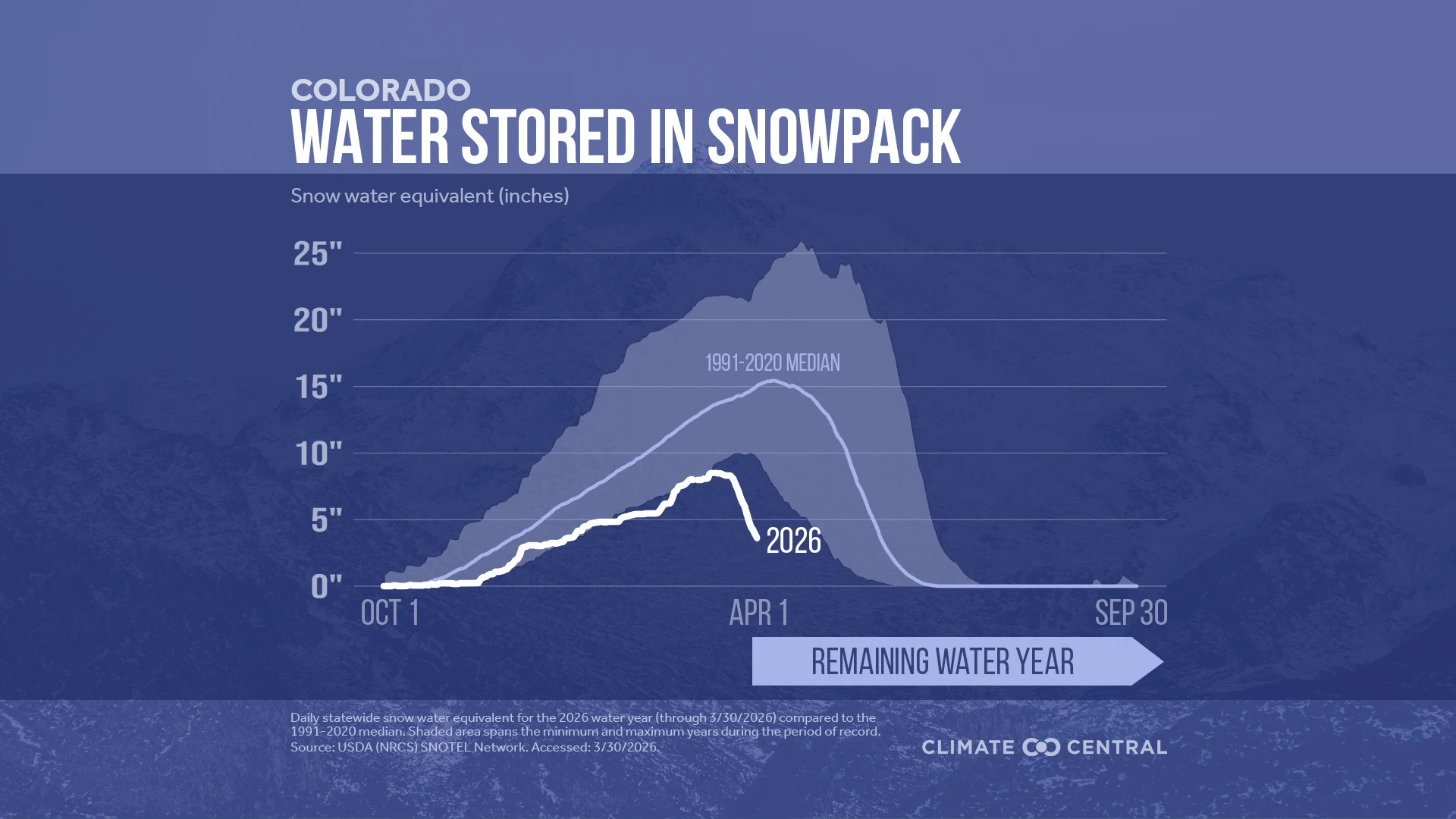
Snow water equivalent remains below 50% of the 1991-2020 median in most watershed basins from Washington to New Mexico.
The amount of water stored in Western U.S. snowpack was the lowest on record for April 1, which is typically near the annual peak (halfway through the water year).
By Dr. Zachary Labe, climate scientist at Climate Central
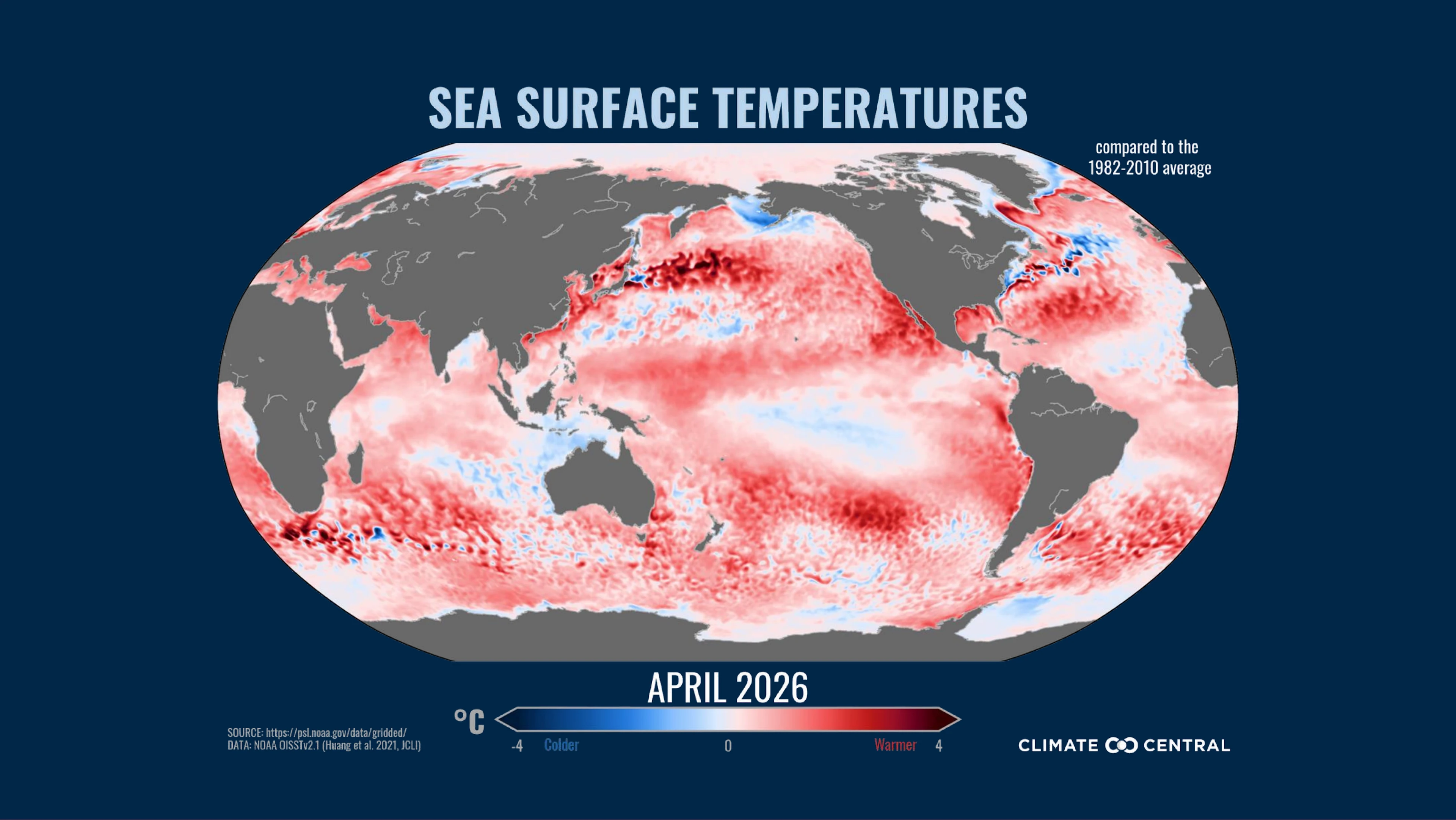
Global sea surface temperatures are again approaching record-high levels. Since March 2026, multiple days have tied or exceeded previous daily records for global mean sea surface temperature, with this exceptional warmth continuing into early May. Climate Central’s daily-updating ocean temperature graphics, based on NOAA Optimum Interpolation Sea Surface Temperature version 2.1, can be downloaded and embedded to track these conditions in near real-time. Other datasets also show persistent global ocean warmth. NOAA’s Extended Reconstructed Sea Surface Temperature Version 5 ranked April 2026 as the second-warmest April on record for global mean sea surface temperature, effectively tied with April 2024 for the warmest on record, with a difference of less than 0.005°C.
In April 2026, most of the global ocean was warmer than the 1991-2020 climatological baseline, with the largest anomalies concentrated in the North Pacific near the Kuroshio-Oyashio Extension and across the south-central Pacific. Over the past 30-days, parts of the northwest Pacific Ocean have experienced category five (beyond extreme) marine heat wave conditions. Another persistent hotspot remains off the coast of California and Mexico, where parts of the region have experienced near-continuous marine heat wave conditions since mid-2025. As discussed in a recent Climate Central alert, some areas have recorded 200 to 300 days with sea surface temperatures above the marine heat wave threshold.
Ocean warming has far-reaching impacts, including stress on marine ecosystems and fisheries, increasing acidification, more widespread coral bleaching, stronger hurricanes, and worsening coastal flood risks as sea levels continue to rise. Seasonal climate forecasts show ocean surface warmth building across the tropical Pacific as a strong El Niño is expected to develop later this year. These forecasts also indicate that unusual warmth may persist across many of the same current regions of exceptional ocean warmth, which could prolong local impacts on marine ecosystems and coastal communities. As a reminder, surface temperatures tell only part of the story. Deeper ocean heat content also set another record high in 2025, as the ocean has absorbed about 90% of the excess heat from greenhouse gas-driven warming.
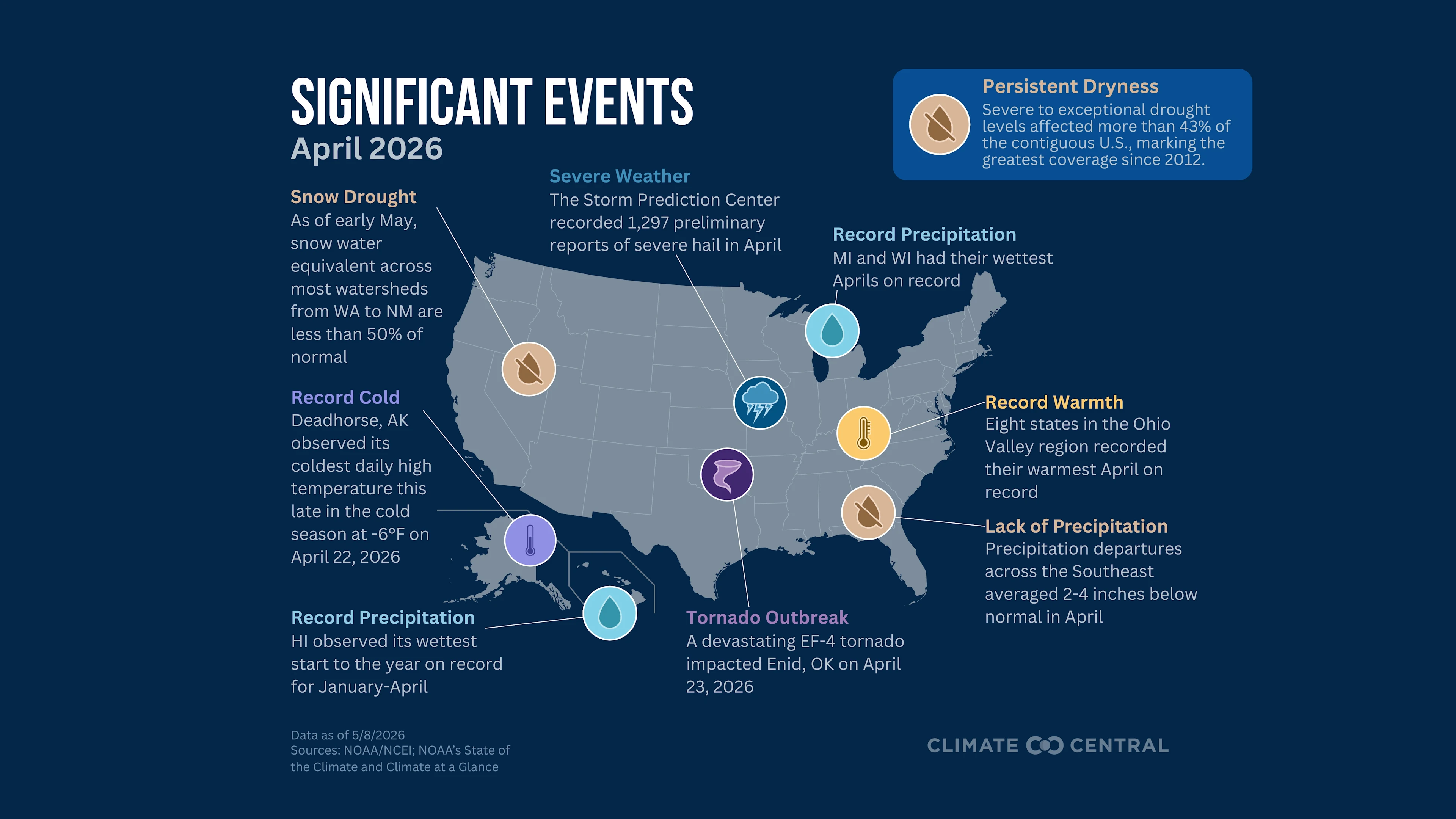
Notable temperature event: West Virginia experienced one of the largest temperature anomalies in April 2026, surpassing its previous warmest April record from 1896 by 1.5°F. This was also 8.1°F above the twentieth-century average. Over the full record since 1895, the long-term warming trend has been 0.2°F per decade. West Virginia also shattered its previous record for the warmest average April maximum temperatures by 2.1°F, surpassing the previous record set in 2010. Parts of eastern West Virginia even experienced average daytime maximum temperature anomalies exceeding 13°F above the twentieth-century average, marking the largest departures anywhere in the U.S. during April.
Notable precipitation event: Since the beginning of 2026, much of the Southeast climate region, (including most of North Carolina, South Carolina, Georgia, and Florida) has received only 6 to 12 inches of rainfall, or roughly 25% to 50% of normal precipitation. Unusually dry conditions especially began late last summer across the region. The National Integrated Drought Information System reported that during the six-month period from October 15, 2025 to April 15, 2026, 50 monitoring weather stations with at least 75 years of records experienced conditions ranking among their top five driest for this timeframe. During the overall month of April 2026, very little precipitation fell across these same areas. For instance, parts of the Florida Panhandle, southeastern Georgia, and southern South Carolina that typically receive 3-4 inches of rain in April only received less than 0.5 inches this year.
Long-term April temperature trends have warmed since 1970 in nearly all major U.S. cities.
A new Climate Central analysis using the Climate Shift Index (CSI) shows that human-caused climate change is a key driver of these springtime (March, April, May) warming trends in 98% of U.S. cities analyzed.
Cities in the western U.S. experienced the most April days with temperatures at least twice as likely due to human-caused climate change (CSI 2), led by Colorado Springs, Colorado, and San Diego, California (14 days each).
Arizona, Colorado, and New Mexico all saw more than 10 average days statewide with a CSI level 2 or higher in April 2026.
The cities that experienced the most days with CSI 5 in April were Honolulu, Hawaii (14 days), and San Juan, Puerto Rico (12 days). This indicates exceptional warmth driven by climate change.
A persistent, high-impact marine heat wave continued off the coasts of California and Mexico in April. A Climate Central assessment finds that roughly 30% to 45% of the affected ocean area experienced conditions at least six times more likely due to human-caused climate change.
The month ended with a summer-like heat wave forming across the Pacific Northwest and into Canada, with CSI level 3 conditions expected to impact nearly 67% of the land area across Washington, Oregon, and British Columbia.
Learn even more about how climate change altered April’s temperatures in our latest monthly attribution overview. Climate Central also has an explainer on attribution science and how it works.
Global Temperature: The newest forecasts from the North American Multi-Model Ensemble (NMME) show global temperature departures steadily increasing over the next six months, with the multi-model mean projecting anomalies above 1.8°C relative to the 1850-1900 pre-industrial baseline by early 2027. However, there is unusually large spread across the models, with global temperature anomalies at that lead time ranging from about 1.3°C to more than 2.5°C. Despite this uncertainty, the forecasts point to continued excessive global warmth, largely driven by the potential development of a strong El Niño in the tropical Pacific later in 2026. The latest NMME outlook also shows temperatures at least 1°C above normal across most of the U.S. during the upcoming summer season (June-August), although forecast skill is lower across the Mississippi River Valley and Southeast. One of the strongest signals in forecast skill is in the Pacific Northwest, where the NMME models indicate at least a 90% chance of above-normal temperatures by July in areas such as British Columbia and Washington.
El Niño-Southern Oscillation (ENSO): According to the NOAA Climate Prediction Center, El Niño is likely to develop during June-August 2026 and persist through at least the end of the year, with a 62% probability. Since mid-April, above-normal sea surface temperatures have continued to expand across the central Pacific Ocean, with the strongest warming over the last seven days observed in the Niño 1+2 region off the coast of Peru and Chile. To better characterize the potential strength of this event, we use the Relative Oceanic Niño Index (RONI), which accounts for the influence of long-term ocean warming. ENSO forecasts from the NMME still show a large spread in the strength of the potential El Niño later in 2026, ranging from near 0°C to more than 4°C above the 1991-2020 average across individual model ensemble members. The NMME multi-model ensemble mean RONI forecast reaches 2.2°C for winter 2026-2027. For context, El Niño conditions are typically defined by a positive RONI of at least +0.5°C. Without adjusting for the effects of long-term climate warming, the traditional Oceanic Niño Index (ONI) forecast is substantially higher, with the NMME multi-model mean reaching approximately 3°C above normal. Given the strong links between El Niño, global temperature variability, and regional climate extremes, we will continue closely monitoring forecasts in the coming months. However, caution is still warranted when interpreting the projected strength of this event until forecast confidence improves later in the year.
U.S. Drought: As of early May, more than 60% of the contiguous U.S. is in at least moderate drought conditions, and about 19% of that region is seeing extreme or exceptional drought. One of the areas experiencing the most extreme drought conditions is the Southeast, where the entire region is at least abnormally dry and more than 80% is in severe to exceptional drought. The dryness has continued to deepen, with parts of southern Alabama now more than 20 inches below average precipitation over the last nine months. These conditions are placing severe stress on agriculture, irrigation, and water resources, while elevated fuel loads are increasing wildfire risk. Soil moisture is also at record-low levels through the 0-100 cm layer, further reflecting the severity and persistence of the drought. In addition, the lack of widespread precipitation has contributed to unusually low streamflows across many areas of the contiguous U.S. Flows below the 10th percentile are especially widespread from the Mid-Atlantic into the Southeast, including Maryland, North Carolina, South Carolina, and Virginia. Other hard-hit areas include parts of the Rockies, especially Colorado and Utah, and the Pacific Northwest, particularly western Oregon and Washington. The monthly drought outlook indicates some improvement across parts of the south-central U.S., including Alabama, Louisiana, Mississippi, and southern Texas, while conditions are expected to worsen further in the northern Rockies.
U.S. Temperature: As of early May, the next two weeks are predicted to be unusually warm, with the latest NOAA Climate Prediction Center outlook showing elevated odds of above-normal temperatures across nearly the entire U.S., including Alaska and Hawaii. The highest probabilities are initially centered over the central U.S. before shifting toward the Southeast by the end of May. A slight risk of hazardous heat is also forecast by mid-month, stretching from Indiana to Texas.
U.S. Precipitation: Over the next two weeks, above-normal precipitation is most likely across Texas and the south-central U.S. Wetter-than-normal conditions are also favored across much of Alaska and Hawaii. In contrast, drier-than-normal conditions are likely to persist across the eastern U.S., which could prolong or worsen ongoing drought conditions. This general pattern is expected to continue over the next month, with New Mexico and Texas having the highest likelihood of above-normal precipitation.
U.S. Energy: Rising heat across much of the U.S. over the next few weeks is expected to increase cooling demand. This follows record-high cooling degree days so far this year (January-April 2026) in the Northwest, South, Southwest, and West climate regions. During this period, 15 states also either tied or set records for cooling degree days, while another six states recorded their second-highest values. For April 2026 alone, cooling degree days reached record highs in the Ohio Valley and South climate regions. Cooling degree days provide a rough measure of energy demand for air conditioning, with higher values indicating hotter conditions and greater cooling needs. Earlier spring warming and unusually early heat waves are already increasing cooling demand and extending the length of the cooling season.
Our team of scientists can help interpret these findings and answer your questions. Contact us here.
To request a media interview with a Climate Central scientist about this briefing, please contact Abbie Veitch, aveitch@climatecentral.org.
Global and U.S. climate statistics are provided by NOAA’s National Centers for Environmental Information (NCEI), including through the Climate at a Glance tool. All climate regions and divisions follow the standard definitions established by NOAA NCEI. Data is also provided by the Applied Climate Information System (ACIS) using ThreadEx, which is developed, maintained, and operated by NOAA’s Regional Climate Centers. We recognize that climate ranking statistics can vary slightly between datasets, and there are higher uncertainties in temperature data prior to 1900.
Drought information is available through the U.S. Drought Monitor, western U.S. snowpack data is provided by the USDA National Water and Climate Center, and streamflow information is from the National Water Dashboard by the U.S. Geological Survey. Weekly and seasonal temperature and precipitation outlooks are from the NOAA Climate Prediction Center. Sea ice data statistics are from the National Snow and Ice Data Center’s Sea Ice Index v4. Carbon dioxide concentration data is from the NOAA Global Monitoring Laboratory.
Learn more about Climate Services at Climate Central.
Learn more about the Monthly Climate Brief.