
Climate Shift Index Alert•April 24, 2026
A severe marine heat wave, intensified by climate change, is growing off the coast of California and Mexico
April 24, 2026
A large and persistent marine heat wave is impacting the northeast Pacific Ocean, with notable intensification and expansion throughout March and April, particularly off the coasts of Central and Southern California and along the Pacific Coast of Mexico.
A marine heat wave is defined as sea surface temperatures exceeding the 90th percentile of a 30-year climatology for at least five consecutive days.
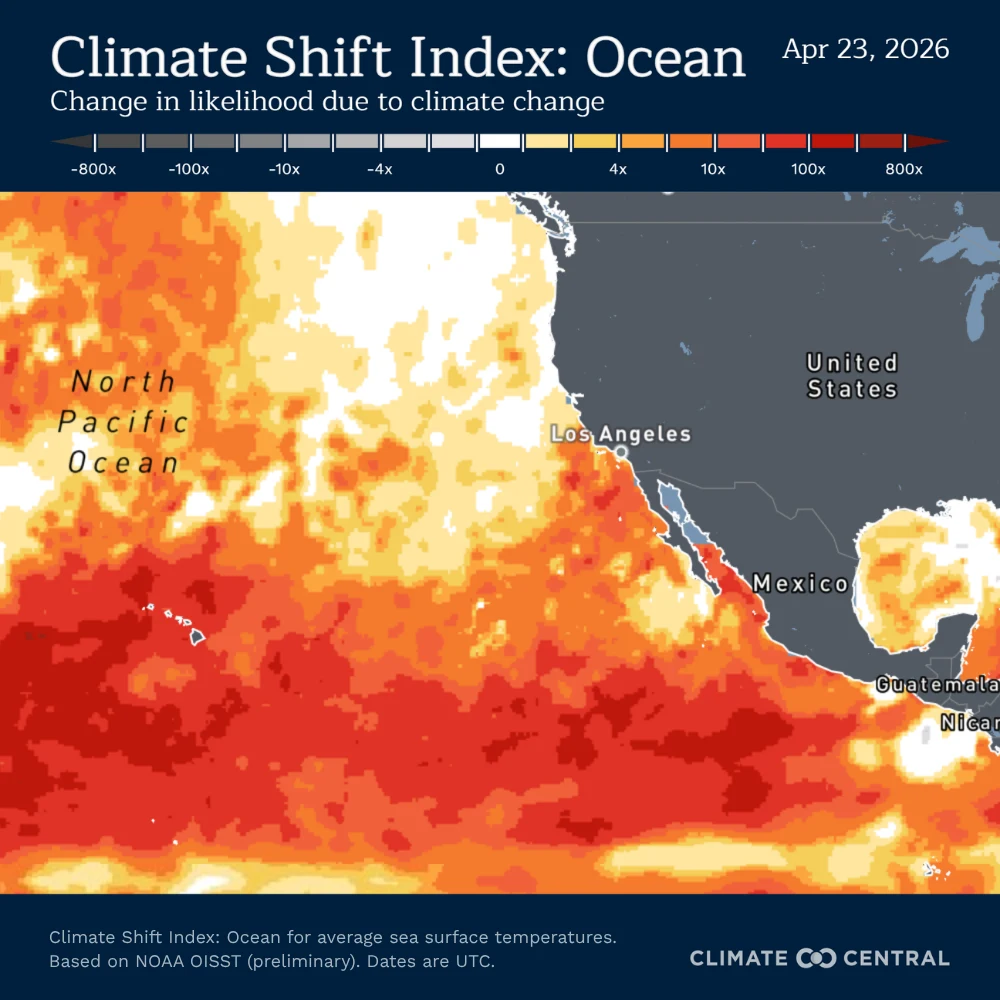
For more information on the Climate Shift Index: Ocean, refer to the FAQs.
Sea Surface Temperatures:
Ocean temperatures across the northeast Pacific Ocean are well above average, within the last week, increasing to 2-5°F above normal, with localized hotspots exceeding 7°F.
Over the full event, peak anomalies have reached approximately 11°F in some regions.
Marine Heat Wave Conditions:
Extent: Marine heat waves currently affect roughly 45% to 55% of the ocean area in the region analyzed by Climate Central (see figure below).
Persistence: Parts of this region have been in near-continuous heat wave conditions since mid-2025, with 200-300 days having temperatures above the marine heat wave threshold.
Intensity: Much of the affected region is experiencing Category 2 (strong) to Category 3 (severe) marine heatwave conditions, with localized areas reaching Category 4 intensity (extreme).
Climate Influence:
A substantial portion of this marine heat wave is strongly influenced by climate change.
Approximately 30% to 45% of the affected ocean area is experiencing conditions that are at least 6 times more likely due to human-caused warming.
Over the full duration of the event:
Without climate change, the total marine heat wave footprint would be approximately 36% smaller. About 13.7 million km² of the affected ocean area would not have experienced heat wave conditions.
The average location would experience about 18 marine heat wave days instead of about 115 days, highlighting a substantial increase in duration and exposure.
Impacts:
Ocean wildlife is already experiencing impacts. According to marine ornithologists, seabirds are unable to locate their typical food sources as fish migrate towards cooler waters. This is indicative of a broader food chain disruption.
How do we know climate change is influencing this heat?
The Climate Shift Index: Ocean is grounded in peer-reviewed methodology and high-quality data. It quantifies the influence of climate change on sea surface temperatures.
The Ocean CSI indicates how human-caused climate change has influenced the likelihood of daily sea surface temperatures occurring at nearly any location around the world’s oceans.
To request an interview with a Climate Central scientist, please contact Abbie Veitch at aveitch@climatecentral.com.