Climate Matters
Snowfall Trends
Snow keeps our planet cooler, feeds water supplies, and underpins regional economies and cultures. Here’s how snow is changing across the U.S. with our warming climate.
Climate Matters•April 1, 2026•Reuse this content
Widespread western snow drought, worsened by a record-shattering March heat wave following a record-warm winter, is raising concerns about water supplies and wildfire risks in the months ahead.
The amount of water stored in western U.S. snowpack is currently the lowest on record for April 1, when it's usually near the annual peak.
Most western U.S. states that rely on snow-fed water supplies currently have record-low — and rapidly dropping — levels of water stored in snowpack.
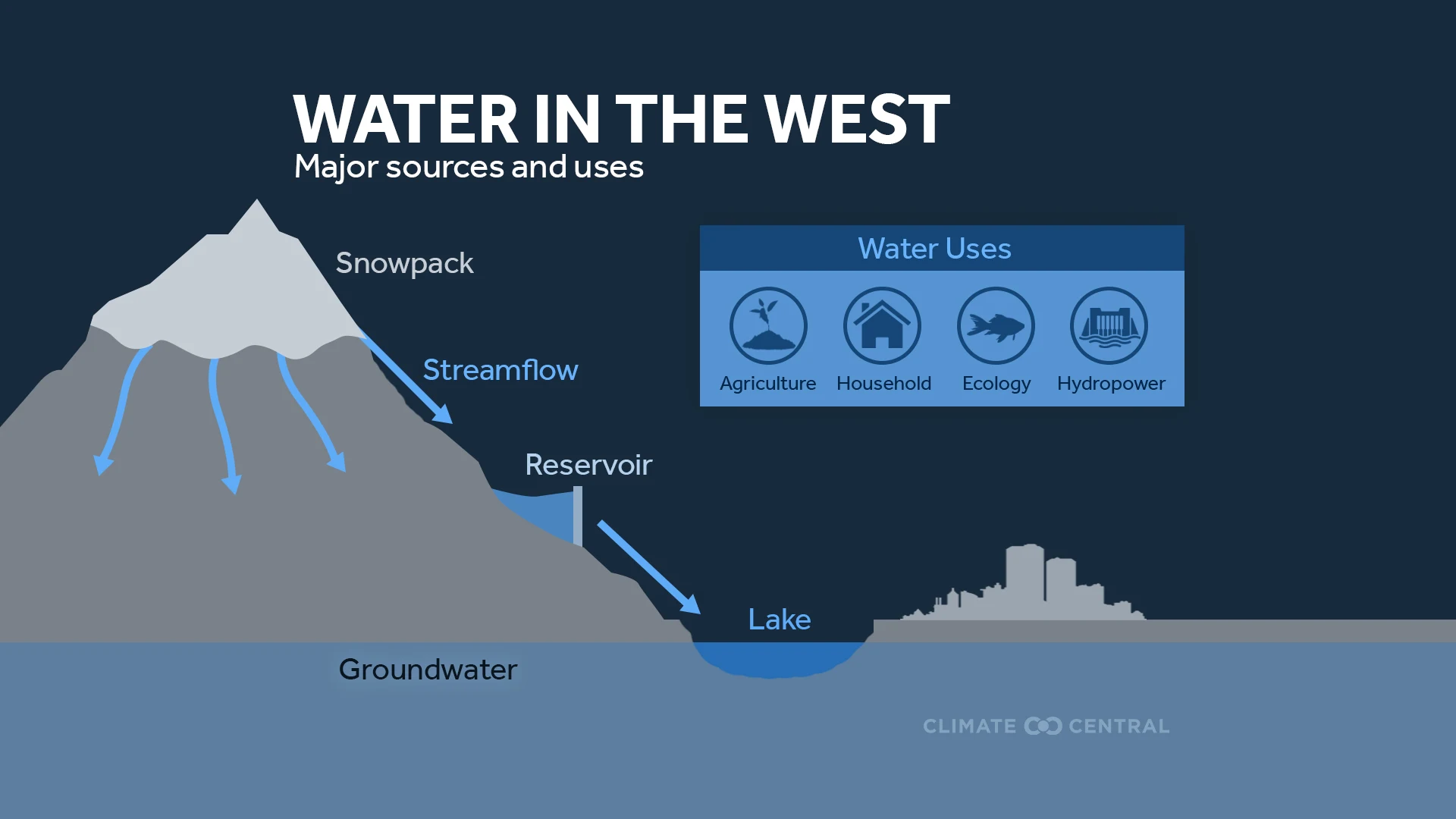
Western mountain ranges act as natural water towers. They store snowpack each winter that later melts to recharge reservoirs and supply water to communities, farms, and ecosystems across the region.
But warmer winters lead to smaller snow reserves that melt earlier and need to stretch longer into the summer when the region’s water demands peak.
For decades, western snowpack has been shrinking, peaking earlier, and accumulating over a shorter season — trends that are likely to continue as the climate warms.
This Climate Matters analysis is based on open-access data from the U.S. Department of Agriculture (USDA). See Methodology for details.
A record-shattering March heat wave is following a record-warm winter across the western U.S. Both of these events were fueled by heat-trapping pollution, according to Climate Central’s Climate Shift Index system.
The exceptionally warm conditions have led to rapid melting of what snow has fallen across the region, resulting in a historic and widespread snow drought stretching from Washington to the entire Southwest.
Snow drought is a period of abnormally low snowpack, either due to dry or warm conditions.
The current snow drought took a toll on western ski towns that rely on winter tourism — and is raising concerns about water supplies and wildfire risks (due to drier and more flammable vegetation) in the months ahead.
That’s because snow is a critical source of water out west. Western mountain ranges act as natural water towers — storing snowpack each winter that later melts to recharge streams, reservoirs, and groundwater aquifers that supply water to communities, farms, ecosystems, and hydropower plants across the region.
The status of snowpack in early April — particularly snow water equivalent, or the amount of liquid water stored in mountain snowpack — indicates how much snow-derived water will be available through the summer as the region’s water demands and wildfire risks peak.
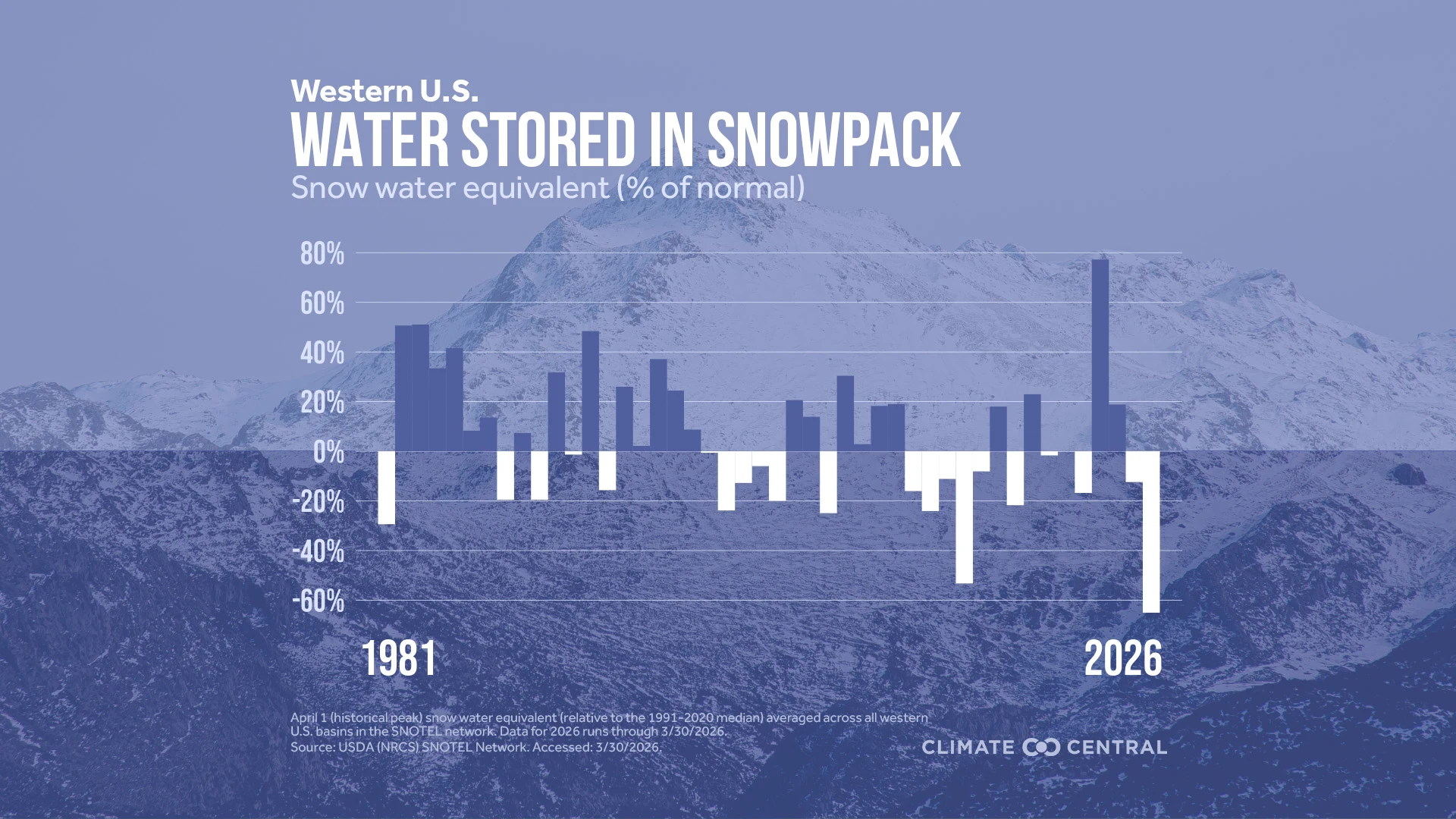
As of March 30, 2026, the snow water equivalent for the western U.S. was the lowest on record for April 1, when it's usually near the annual peak. The amount of water stored in western U.S. snowpack is currently 65% below the 1991-2020 normal — the lowest by far since 1981.
These historic low snowpack conditions are already rapidly deteriorating amid a March heat wave bringing July-like temperatures across the region.
This small and shrinking snow-fed water supply needs to stretch longer into the months ahead to meet the region’s water demands.
The outlook is even more acute for individual watersheds, most of which currently have snow water equivalents far below 50% of their long-term average.
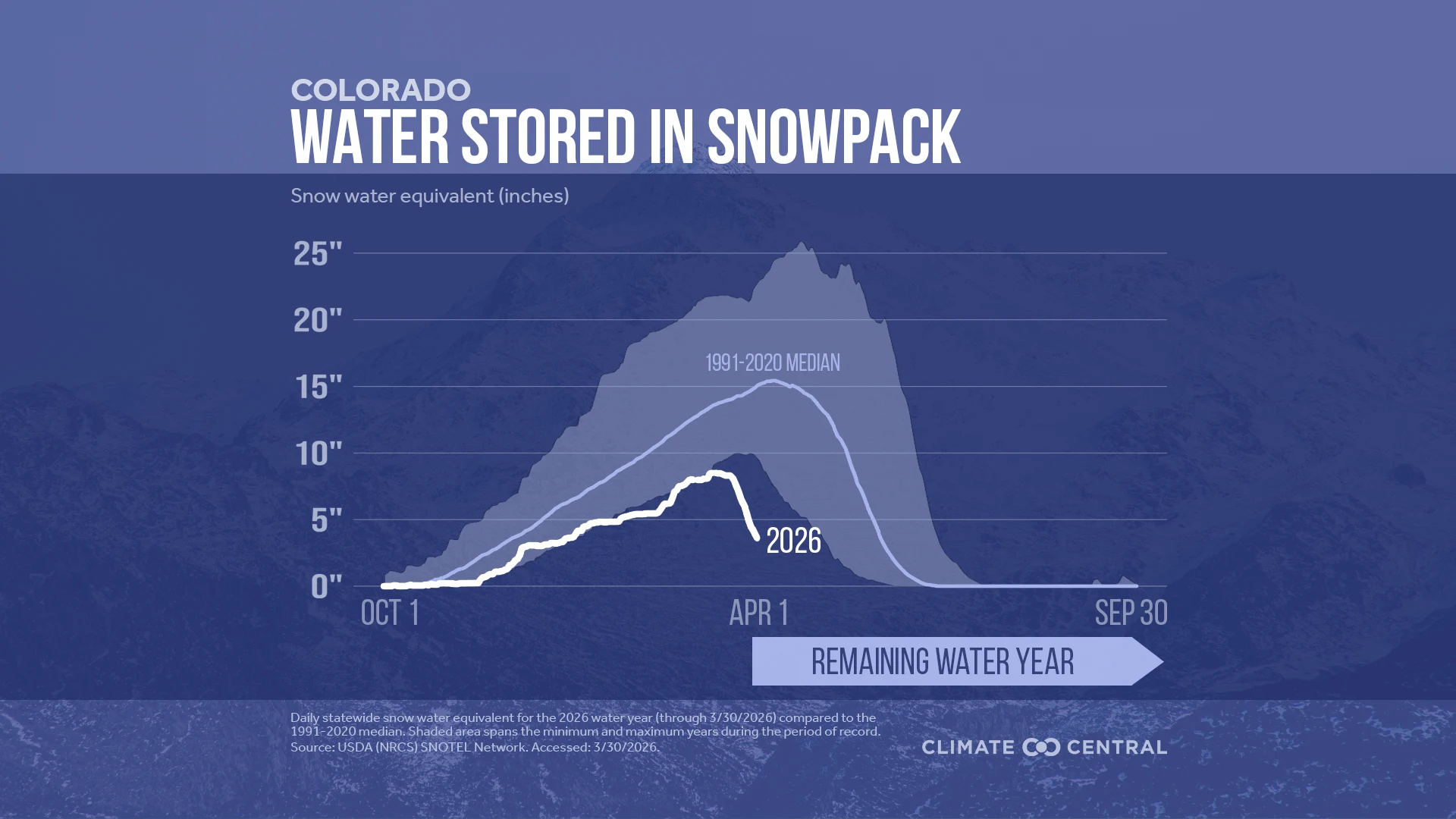
As of March 30, 2026, snow water equivalent was at record lows and in many cases rapidly declining in: Arizona, Colorado, Idaho, Nevada, New Mexico, Oregon, Utah, and Wyoming. Meanwhile California had near-record low amounts of water stored in snowpack.
Conditions are particularly concerning in the Colorado River Basin, a critical water source for the Southwest — parts of which have had an exceptionally dry winter in addition to record warmth. And drought is forecast to continue or develop across the Southwest and Northwest through June 2026.
For water in the west, timing is everything and April snowpack conditions are key. Snow makes up more than 50% of the water supply across the entire western U.S., and more than 70% in mountain regions.
But there’s a mismatch in timing between when snow accumulates and when snow-derived water is most needed to meet peak water demands.
Water managers track these seasonal cycles using the water year: a 12-month period starting every October 1 as snow begins to accumulate. Snow surveys on April 1 (halfway through the water year) are an important indicator of the water supply available for the remainder of each water year.
But April 1 snowpack readings have increasingly been a bust in our warming climate. For decades, western snowpack has been shrinking, peaking earlier, and accumulating over a shorter season.
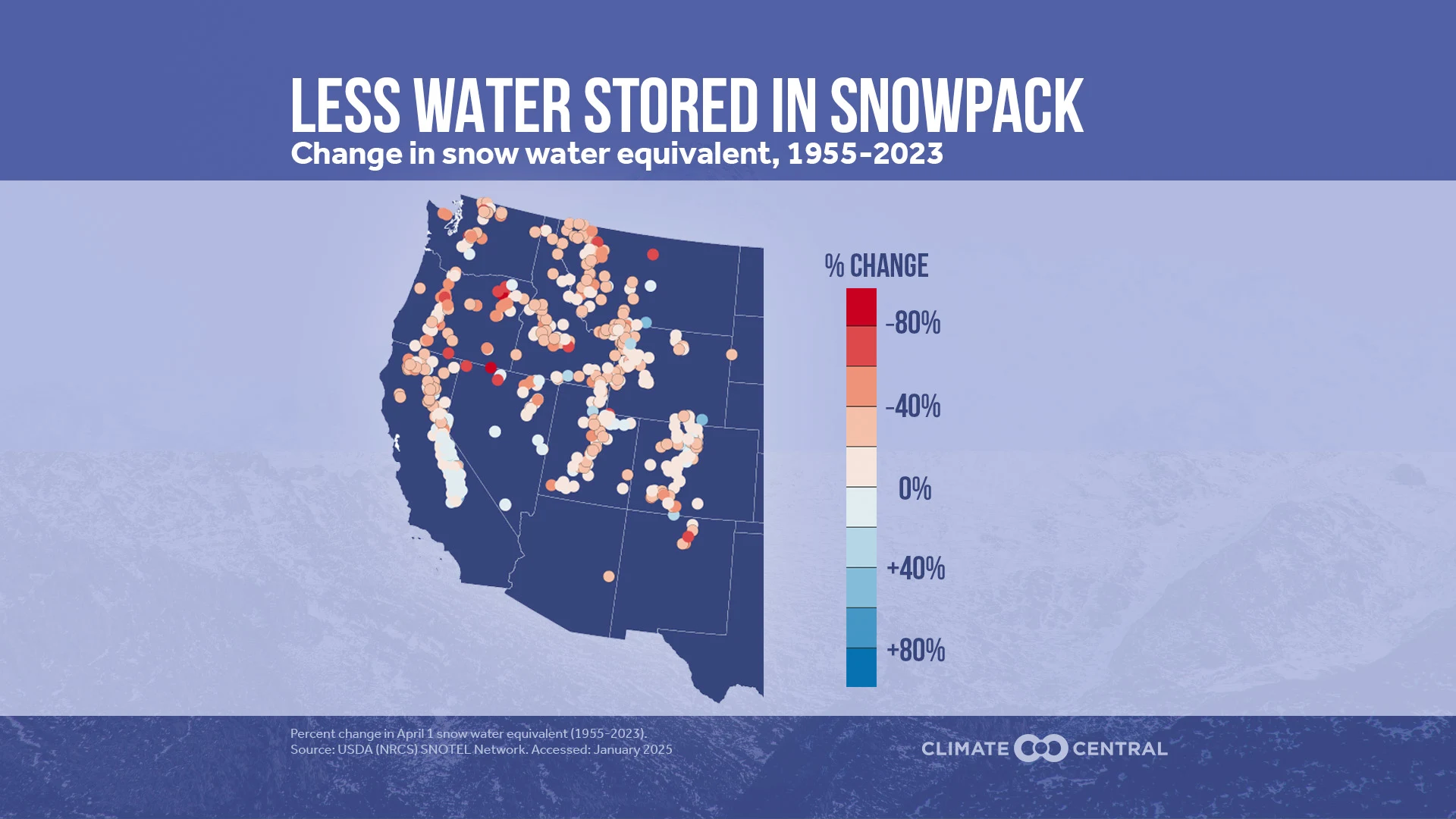
From 1955 to 2023, April 1 snowpack across the western U.S. has declined 18% on average across 652 monitoring stations.
This means that smaller snow-fed water supplies need to stretch longer into the year, squeezing water budgets and putting additional pressure on other water sources like groundwater aquifers.
Climate change can affect the timing, location, and amount of snowfall, as well as the dynamics of snowmelt. But these changes and their wide-ranging impacts are complex and vary among regions. Here’s how snow-fed water supplies in the western U.S. are changing in our warming climate:
A shift toward less precipitation falling as snow across the western U.S. (1951 to 2014) due to warming has contributed to snowpack decline.
Decades of shrinking snowpack has already reduced the amount of water stored in snowpack (snow water equivalent) in the western U.S. by 15% to 30% since 1955.
With continued warming, the amount of water stored in snowpack is projected to decline further across the western U.S. — especially in the mountain ranges of California and the Northwest.
A 2021 study projects an additional 25% decline in snow water equivalent across the western U.S. by 2050.
A 2020 study identified the western U.S. as a global hot spot for snow drought. Region-wide, snow droughts grew 28% longer from 1980 to 2018.
Prolonged snow drought can worsen the impacts on water supplies and wildfire risk. And a 2019 study suggests that back-to-back snow drought years in the western U.S. are likely to become more frequent in the coming decades, especially if heat-trapping pollution goes unchecked.
Use the U.S. Bureau of Reclamation’s interactive map to check current and historical storage levels for 54 major reservoirs across the West. The U.S. Department of Agriculture provides a range of maps, graphs, and reports showing current snowpack conditions at the basin scale across the western U.S. Check current snow water content stored in California’s snowpack using graphs from the California Department of Water Resources.
Climate Central’s Local Records Tracker tool tracks record high and low temperatures for 247 U.S. cities. This tool updates daily, and allows users to:
Generate local graphics summarizing the record highs and lows set each decade on record.
Map daily records set across the U.S. since 2020.
Explore and download data for each city.
Climate Central’s Climate Shift Index (CSI) system provides tools, data, custom maps, and local alerts to answer this question in real-time. Here are three ways to use the CSI:
Use the CSI map tool to see which parts of the world are experiencing high CSI levels today, tomorrow, and any day in the recent past.
Access the CSI in KML format to bring this high-resolution data into your on-air broadcasts.
Sign up for alerts to receive custom emails when strong CSI levels are detected in your local area.
To request an interview with a Climate Central expert about this analysis, please contact Abbie Veitch, aveitch@climatecentral.org.
Andrew Schwartz, Ph.D. (he/him)
Director of the Central Sierra Snow Laboratory
University of California Berkeley
Relevant expertise: snowpack dynamics in a changing climate
Contact: ASchwartz@Berkeley.edu
Submit a request to SciLine from the American Association for the Advancement of Science or to the Climate Data Concierge from Columbia University. These free services rapidly connect journalists to relevant scientific experts.
Browse maps of climate experts and services at regional NOAA, USDA, and Department of the Interior offices.
Explore databases such as 500 Women Scientists, BIPOC Climate and Energy Justice PhDs, and Diverse Sources to find and amplify diverse expert voices.
Reach out to your State Climate Office or the nearest Land-Grant University to connect with scientists, educators, and extension staff in your local area.
April 1 snow water equivalent data for the western U.S. were collected from the USDA National Water and Climate Center. The annual percentage above or below the median normal (1991-2020) snow water equivalent was calculated based on the average values of the major western river basins. Snowpack data for 2026 runs through March 30, 2026.
Climate Matters © 2026 by Climate Central is licensed under CC BY 4.0
This license grants permission to use, distribute, and reproduce all text, graphics, and multimedia content published on this page in any medium, provided that Climate Central is credited per the CC BY 4.0 license.
Permission to use data and other materials published on this page is granted for non-commercial uses, commercial news purposes, and educational purposes as governed by Climate Central's Terms of Use.