
Climate Shift Index Alerts
Using our Climate Shift Index (CSI) system (including Ocean CSI and Tropical Cyclone CSI), we issue alerts when select extreme weather events — such as heat waves, hurricanes, or wildfires — are made more likely by human-caused climate change.
Explore the log below to see a sampling of recent events linked to climate change, and use the CSI and Ocean CSI map tools to investigate daily conditions in your area.
Want to receive these alerts? Join our email list.
Climate change fuels extreme heat, flooding and tropical threats across the U.S.
Much of the United States will experience some form of climate-fueled extreme weather this week, from dangerous heat across the Central and Eastern U.S. to heavy rain and flooding threats in Texas, the Grand Canyon, and Southern California. Unusually warm ocean waters are also amplifying tropical systems and the risk of extreme rainfall, underscoring the widespread influence of human-caused climate change.
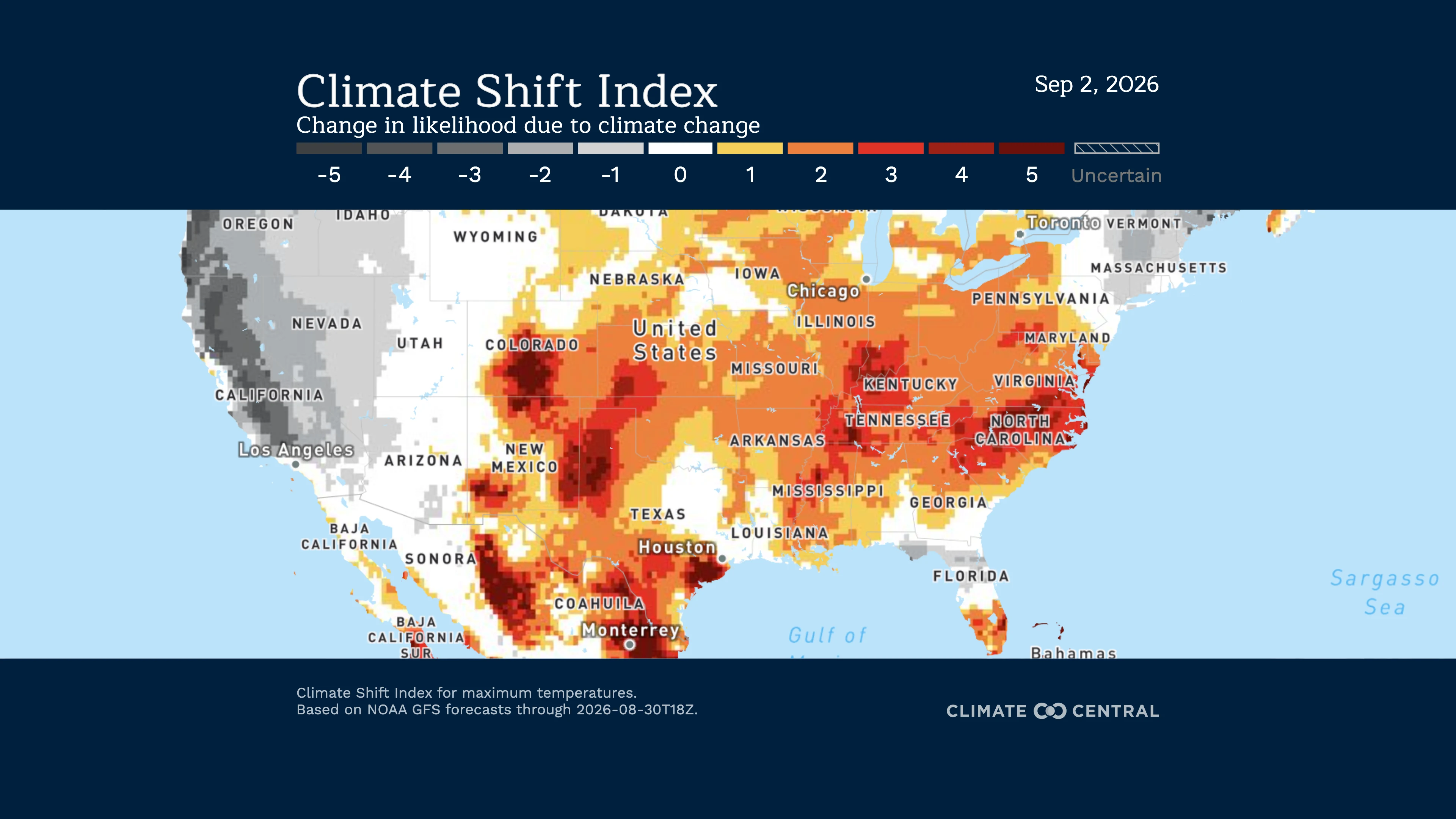
Climate-Driven Heat in the U.S. South, Southeast, Ohio Valley, Upper Midwest, and Northeast
High temperatures are forecast to reach the triple digits across the central and southern Plains, and temperatures are expected to be in the mid-to-upper 90s across the eastern United States through at least Friday, September 4. Near-to-all-time record high temperatures are expected in Arkansas, Delaware, Georgia, Kansas, Kentucky, Mississippi, North Carolina, South Carolina, Texas, Virginia, and West Virginia.
Daily maximum temperatures are forecast to reach a CSI level 3 in cities across multiple regions across the central and eastern United States, including San Antonio, Miami, and Washington, D.C. A CSI 3 indicates that human-caused climate change is making this event at least 3 times more likely, signaling a significant climate change event.
From August 31 through September 4, more than 192 million people across the central and eastern United States will experience at least one day with average temperatures reaching a CSI 3 or higher, indicating a significant influence from climate change.
Tropical Storm Edouard in Gulf to bring rain and floods to Texas
Tropical Depression Five formed over the northern Gulf of Mexico around 1 p.m. CDT Monday, August 31, and strengthened into Tropical Storm Edouard by evening. The National Weather Service is forecasting 3 to 5 inches of rain, with isolated amounts of 6 to 9 inches possible over parts of southeast and eastern Texas. Rainfall rates exceeding 3 to 4 inches per hour at times could lead to flash flooding in urban and other vulnerable areas.
While a tropical storm is not unusual at this time of year, the ocean temperatures it is encountering are. Sea surface temperatures are 2°F to 2.5°F above average for late August. According to the Climate Shift Index: Ocean, this unusual warmth is made at least 200 times more likely by human-caused climate change.
Flooding in Grand Canyon
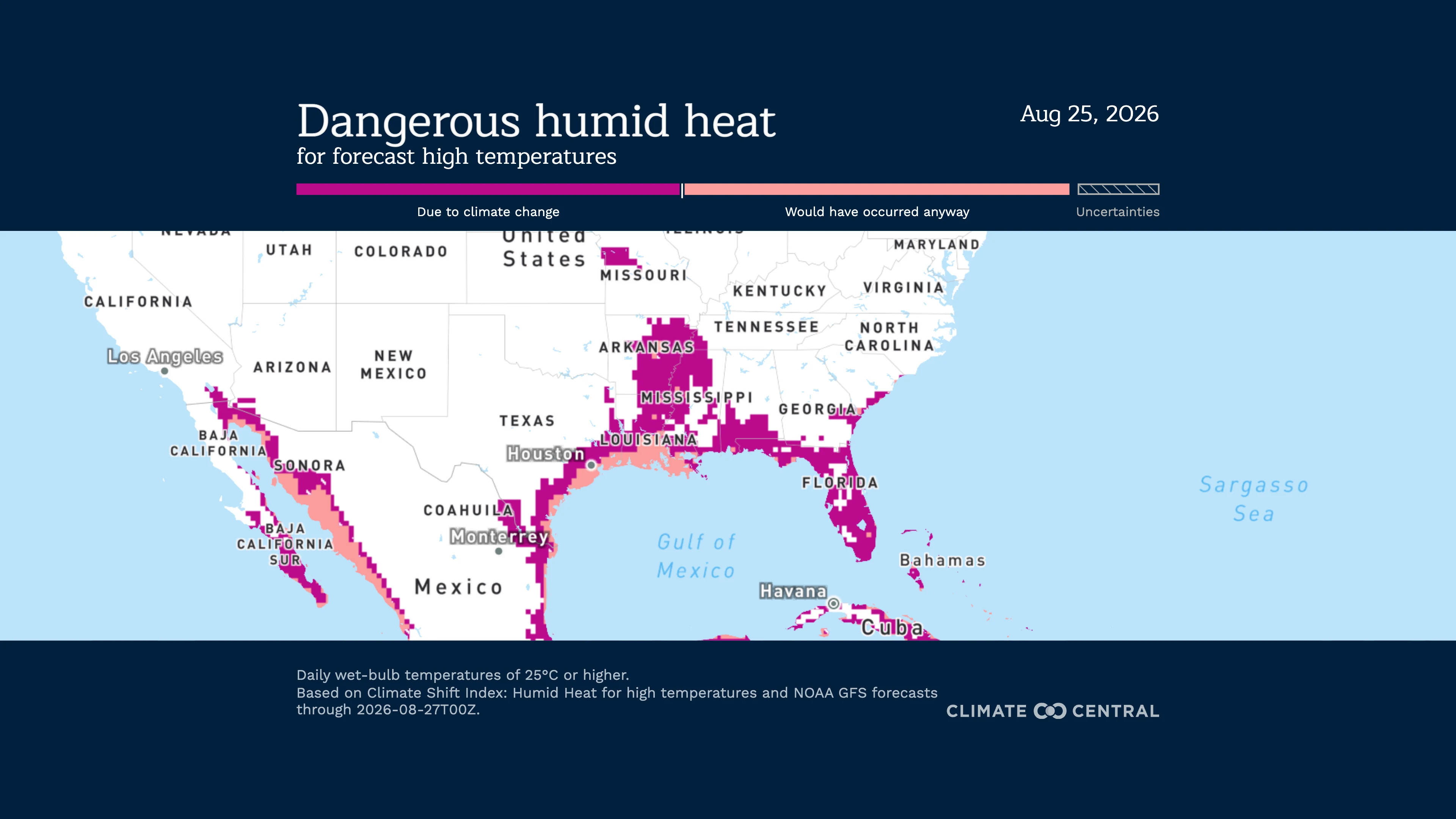
Climate change amplifies dangerous humid heat across the Gulf Coast
Climate change is fueling dangerous humid heat across the Gulf Coast through the end of August. About 37.5 million people are expected to experience humid heat made more likely by human-caused climate change, with nearly 15 million facing conditions made at least 10 times more likely.
Unusual temperatures:
Dangerous humid heat is forecast to affect the entire Gulf Coast from August 24 through the end of the month. A strong upper-level ridge over the southern U.S. is driving the heat by boosting temperatures, while persistent onshore flow from the very warm Gulf of Mexico is supplying abundant moisture and keeping humidity high.
Scientists consider wet-bulb temperatures exceeding 77°F (25°C) dangerous because they can put many people at risk of heat illness.
Wet-bulb temperatures are forecast to reach between 77°F and 79°F (25-26°C) along the Gulf Coast during this time, affecting much of Florida and the entire coastline of Texas. Southern portions of Alabama and Georgia are also expected to experience these dangerous conditions, while wet-bulb temperatures of this magnitude will extend farther north through Louisiana and Mississippi, extending through parts of Arkansas.
Climate influence:
A strong human-caused climate change signal is forecast to influence humid heat across much of the Gulf Coast from August 24 through August 31, extending from coastal Texas to Florida. In the most affected areas, climate change made these humid heat conditions more than 100 times more likely.
Approximately 37.5 million people — 46% of the population across the Gulf Coast states — are forecast to experience humid heat made more likely by human-caused climate change during this event. Nearly 15 million of those people are expected to experience humid heat made at least 10 times more likely due to human-caused climate change.
Climate change is forecast to increase the likelihood of humid heat across approximately 94,000 square miles (24,3459 square kilometers) - about 29% of the Gulf States area.
Warm ocean temperatures in the Gulf that help drive this humidity have been made between 30 and 800 times more likely by climate change.
Climate change amplifies exceptional heat across western and southern U.S.
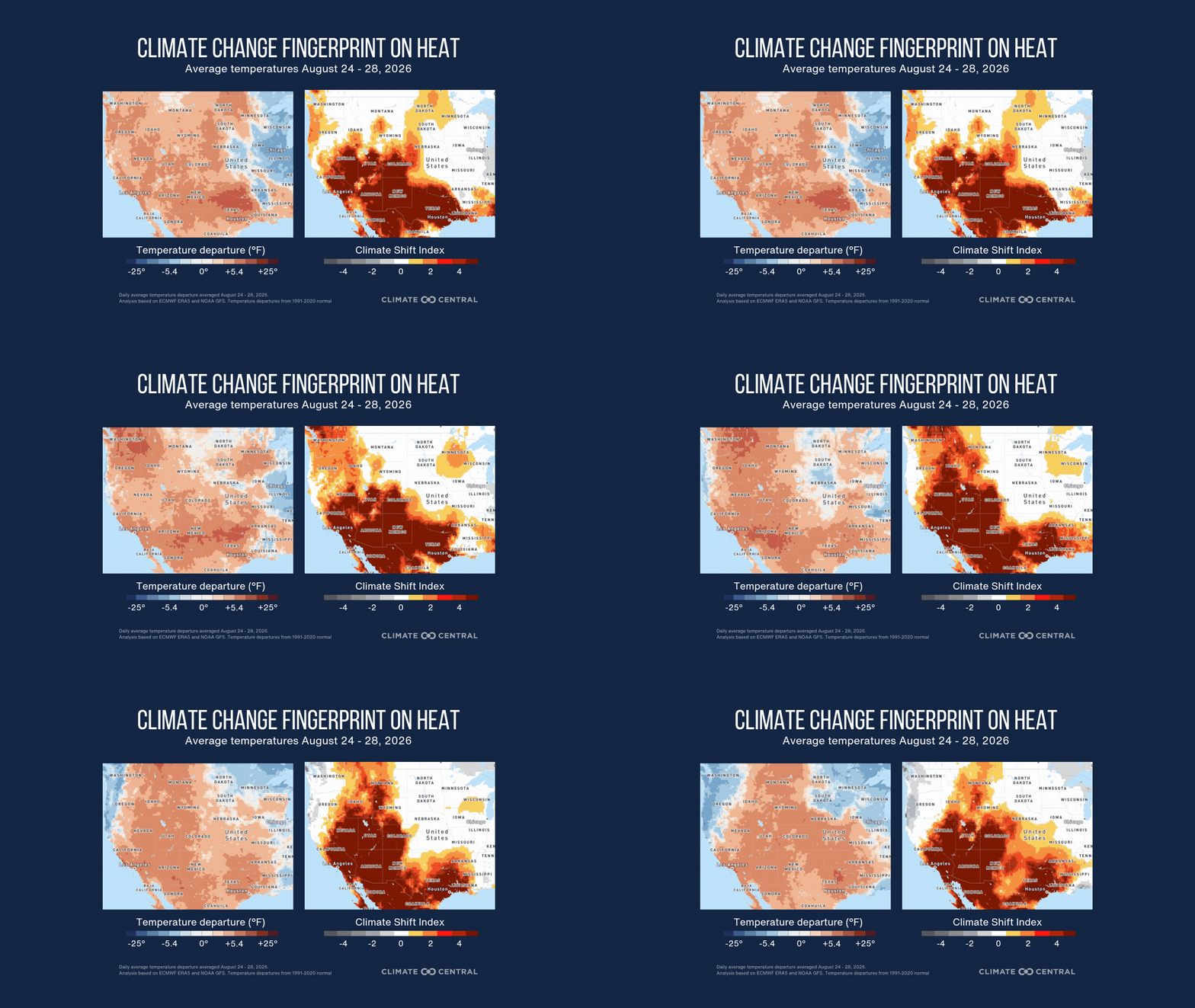
An intense heat dome is expected to bring dangerous temperatures across the western and southern United States through August 28, with some areas reaching 110°F to 115°F. Climate change has made the extreme heat at least five times more likely across large portions of the region, according to Climate Central’s Climate Shift Index.
Unusual temperatures:
Extreme Heat Warnings and advisories have been issued across Central and North Texas for cities including Abilene, Austin, Corsicana, Dallas, Denton, Fort Worth, Hearne, Waco, Waxahachie, and Wichita Falls.
According to the National Weather Service, “Dangerously hot conditions with temperature values up to 111°F” were in the forecast Monday, August 24, with highs reaching up to 107°F Tuesday, August 25.
Extreme heat between 110°F and 115°F is expected in the Southwest, with little overnight relief. Many areas may not cool below 80°F for several nights in a row.
This results in widespread Extreme HeatRisk, which is a level of heat dangerous to anyone without proper hydration or adequate cooling.
The center of this prolonged heat dome driving this hot weather pattern will shift from the Southern Plains to the Desert Southwest by mid-to-late week.
Climate influence:
Climate Shift Index (CSI) levels of 5 — the highest possible — are forecast across the western and southern halves of the United States from August 24 through August 28, meaning human-caused climate change made this extreme heat at least five times more likely. This signals an exceptional climate-influenced event.
From August 24 through August 28, more than 103 million people across the western and southern United States will experience at least one day with average temperatures reaching a CSI 5 or higher, indicating an exceptional influence from climate change.
Temperatures made at least five times more likely by human-caused climate change are projected to affect approximately 1 million square miles (2.6 million square kilometers) of the western and southern United States.
Climate change amplifies extreme heat across the U.S. as 156 million experience climate-influenced temperatures
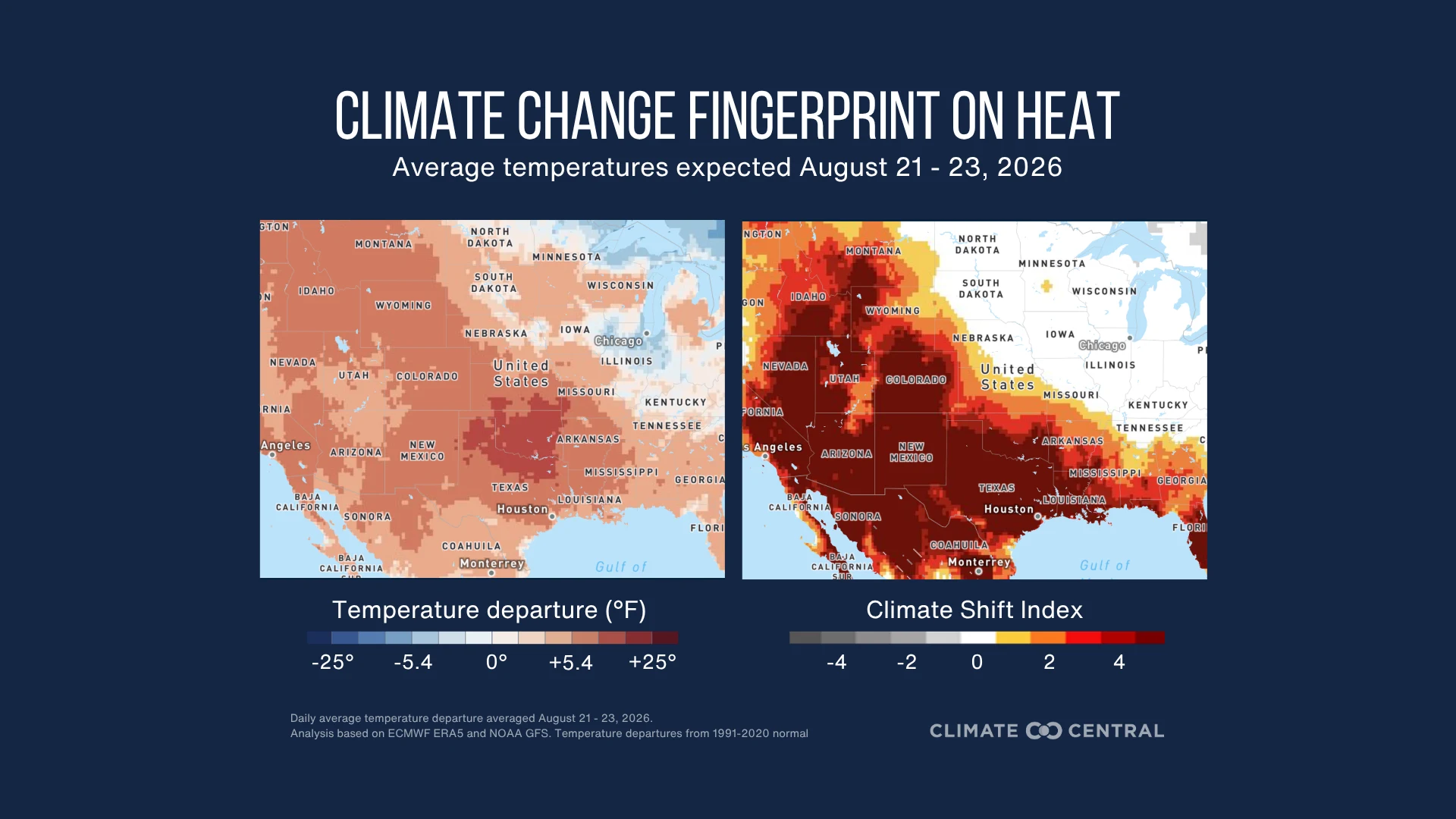
More than 156 million people across the western and southern U.S. are forecast to experience at least one day from Aug. 20-23 with temperatures reaching a Climate Shift Index level of 3 or higher, indicating a very strong influence from human-caused climate change. Excessive heat warnings are in effect across 17 states, with high temperatures expected to reach the 100s.
Climate influence
Climate Shift Index (CSI) levels of 5 — the highest possible — are forecast across the western and southern halves of the United States from Aug. 20 through Aug. 23, meaning human-caused climate change made this extreme heat at least five times more likely. This signals an exceptional climate-influenced event.
From Aug. 20 through Aug. 23, more than 156 million people across the western and southern United States will experience at least one day with average temperatures reaching a CSI 3 or higher, indicating a very strong influence from climate change.
Temperatures made at least three times more likely by human-caused climate change are projected to affect approximately 1.4 million square miles (3.6 million square kilometers) — an area larger than all of India.
Unusual temperatures
Heading into the weekend, heat advisories and excessive heat warnings are in effect for 17 states, primarily from Texas to central and eastern North Carolina.
According to the National Weather Service, daytime high temperatures will reach 100°F to 110°F with “high humidity resulting in widespread heat indices of 105°F to 115°F.”
Even for late August, this excessive heat is as much as 10°F to 15°F above-average, particularly in Arkansas, Colorado, Kansas, New Mexico, Oklahoma, and Texas.
Near-record to record high temperatures are forecast Saturday, Aug. 22 and Sunday, Aug. 23 across Arizona, Arkansas, Louisiana, Mississippi, New Mexico, Oklahoma, and Texas.
This heat risk is made worse by warmer-than-usual overnight temperatures — cities like Dallas, Miami, and New Orleans may not cool below 80°F for several nights in a row.
Multi-day heat streaks are dangerous, worsening air quality and raising the risk of heat-related illness.
On average, 198 major U.S. cities now experience two more extreme heat streaks each year compared to the early 1970s.
Climate change is fueling extreme rainfall and flooding hitting communities across the U.S.
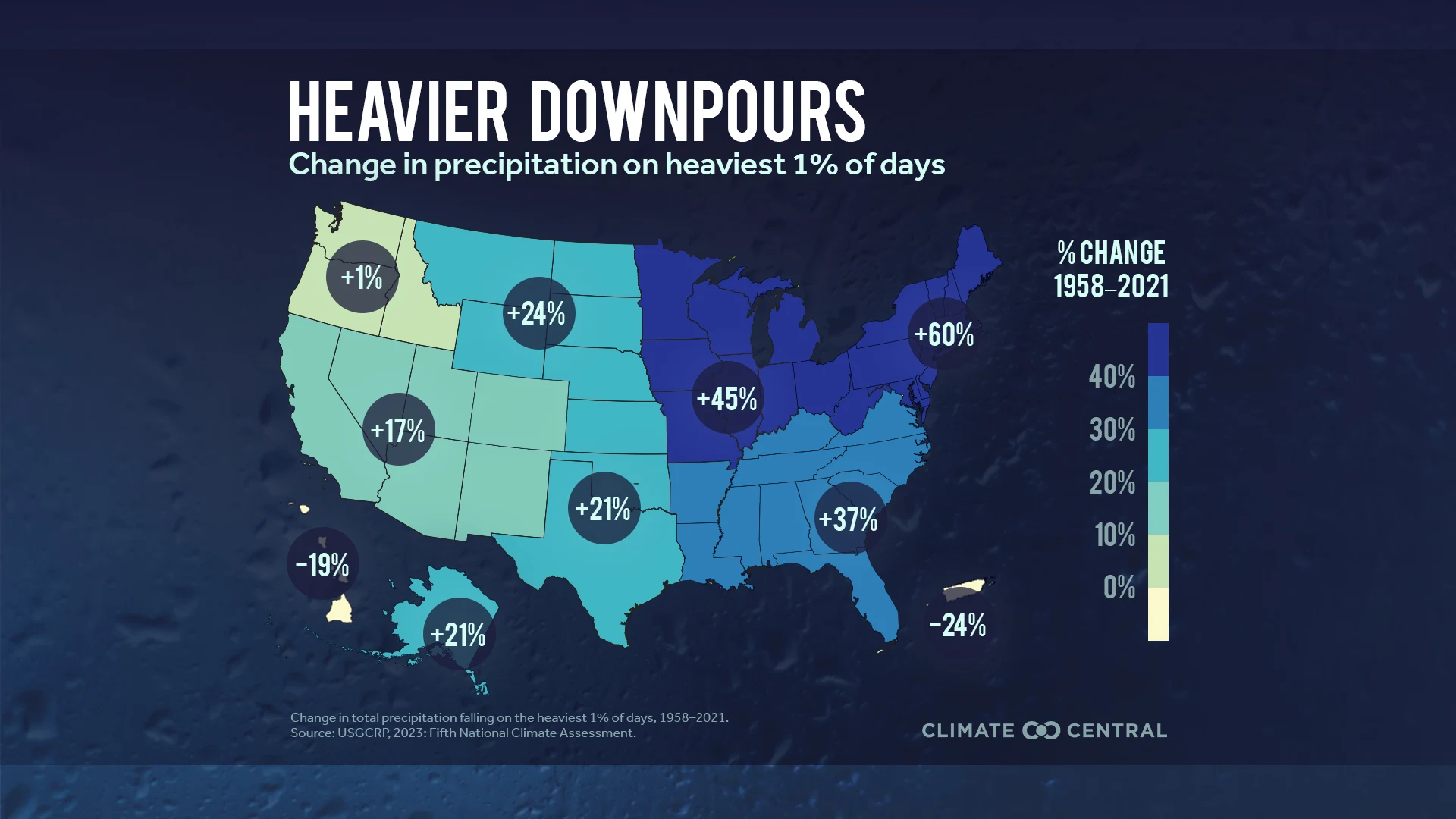
Climate change is supercharging the water cycle, bringing heavier rainfall extremes and higher flood risk across the United States. A warmer atmosphere holds more moisture, increasing the odds of heavier downpours and flash flooding. Over the past two weeks, multiple communities have been impacted by repeated thunderstorms tied to a stalled front, trapped beneath a heat dome. Meanwhile, Hawaii experienced flooding from a tropical system boosted by unusually warm ocean waters.
Kauai, Hawaii: Hurricane Lala
On Aug. 15, Lala strengthened to a Category 1 hurricane as it approached the southern coast of the Big Island. Five places in Hawaii received 35 inches or more of rain, with 48 inches reported in Kapalua, Maui County.
Lala tracked over moderate to strong marine heat wave conditions as a tropical storm, with sea surface temperatures running 2°F to 4°F (1°C to 2°C) above normal. Climate Shift Index: Ocean values show that this unusual Pacific warmth was more than 100 times more likely due to human-caused climate change, and in some areas, up to 400 times more likely.
Columbus, Ohio
A stalled weather front allowed for repeated rounds of multi-day thunderstorms, starting on Aug. 11. Five to six inches of rain fell over the following week, with eight to 10 inches reported east of Columbus.
A strong subtropical high over the Southeast maintained a persistent clockwise circulation that transported moisture from the Gulf of Mexico into the Ohio Valley, where sea surface temperature anomalies were running roughly 2°F to 5°F (1°C to 3°C) above normal. Climate Shift Index: Ocean values show this unusual warmth was more than 100 times more likely due to human-caused climate change, and, in some areas, over 800 times more likely.
Hourly rainfall rates in Columbus have increased 19% since the early 1970s.
Franklin County already faces annual average flood losses of $20 million or more.
Indianapolis, Indiana
A sustained, multi-round weather event resulted in widespread flooding across the state. A derecho — sometimes called an “inland hurricane” — kicked off the event on Aug. 11 as severe thunderstorms swept across Indiana. Then a squall line on Aug. 12 brought heavy rain, triggering major river flooding. Additional, repeated rounds of heavy rain on Aug. 15 and 16 caused severe flooding in Indianapolis as the White River reached historic highs. Seven to 11 inches of rain fell across parts of the state.
.....
Climate change is driving widespread marine heat waves across the globe
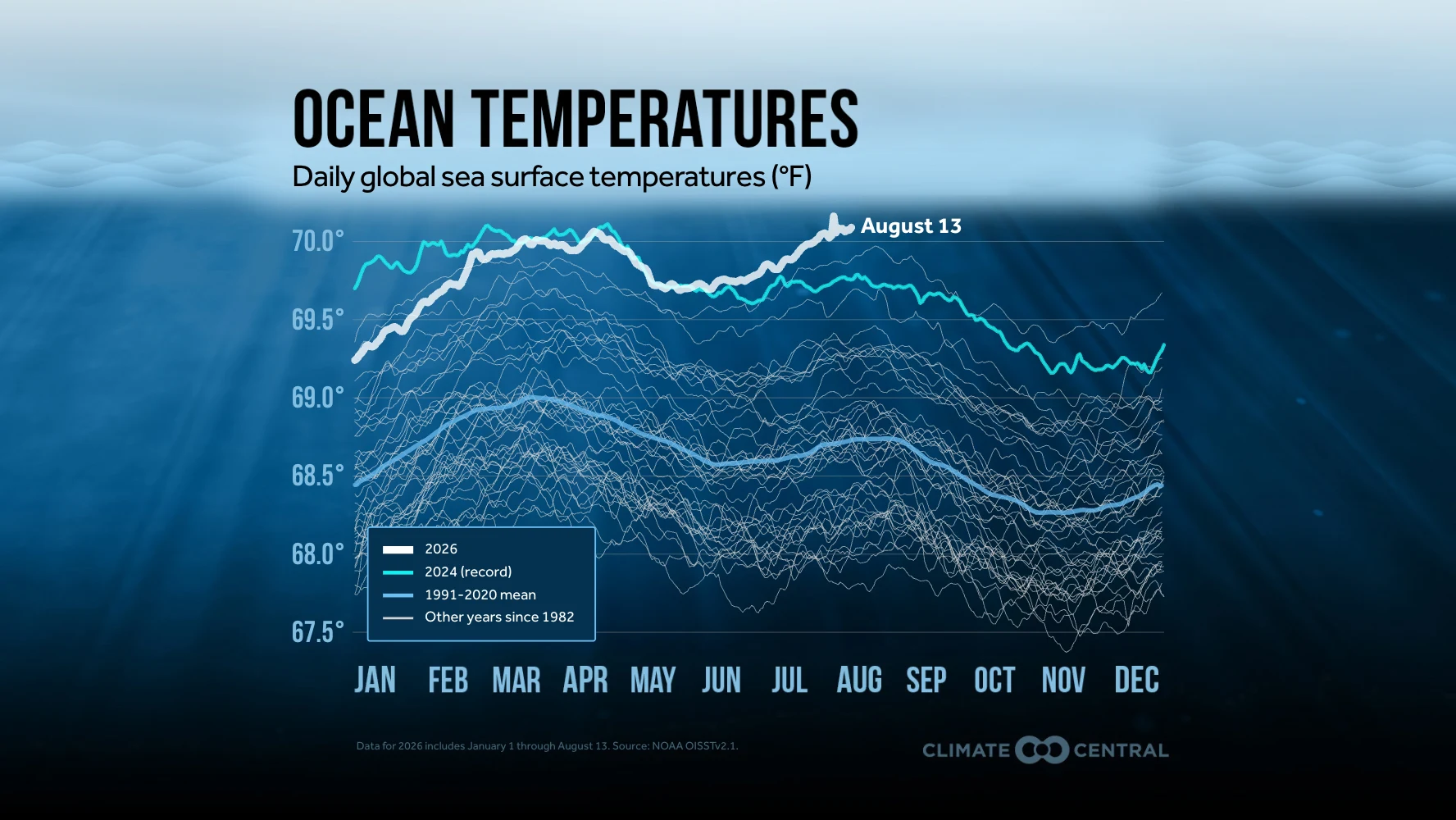
The Pacific is experiencing a historic marine heat wave — but it’s far from alone. Every major ocean basin across the globe is currently experiencing unusually warm sea surface temperatures driven by climate change.
Pacific Ocean
The Pacific continues to host the world’s largest marine heat wave, now covering 63 million square kilometers — about 17% of Earth's oceans — an area larger than North and South America combined. A strengthening El Niño is contributing to some of this warming in the eastern Pacific.
Climate change is driving the vast majority of this event: 86% of the marine heat wave area would not have occurred without human-caused warming.
Since January, approximately 94% of the Pacific has experienced marine heat wave conditions, with the most persistent hotspots in the North Pacific remaining in marine heat wave conditions for more than 180 consecutive days.
Mediterranean
The Mediterranean marine heat wave has intensified following repeated heat waves over Europe, with 82.9% of the basin now experiencing marine heat wave conditions. About 85% of the current marine heat wave area is due to human-caused warming.
Sea surface temperatures have climbed into the mid-80s to low 90s °F (29-32°C), while large areas of the western Mediterranean are running 9-10°F (5-6°C) above normal.
One hundred percent of the basin has experienced at least one day this year under marine heatwave conditions.
Atlantic Ocean
Marine heat waves are less widespread across the Atlantic than in the Pacific or Mediterranean, with 23.3% of the basin currently affected. However, tropical sea surface temperatures largely remain in the upper 70s to upper 80s°F (24-32°C). Broad areas of the Atlantic are 2-5°F (1-3°C ) above normal compared to the 1991-2020 climatology.
Climate change is driving nearly all of the existing marine heat wave area: 81% would not have occurred without human-caused warming.
Gulf of Mexico
Marine heat waves encompass the southern Gulf of Mexico and the northwestern region of the Caribbean, as in some of the other basins, with 39.7% of the region currently experiencing marine heat wave conditions. Of the area experiencing marine heat wave conditions, however, 98% is attributable to climate change.
Sea surface temperatures are broadly in the 80s°F (27°C), with the hottest waters approaching 90°F (32°C) around Florida.
Record-hot nights grip much of the U.S. as climate change intensifies extreme heat
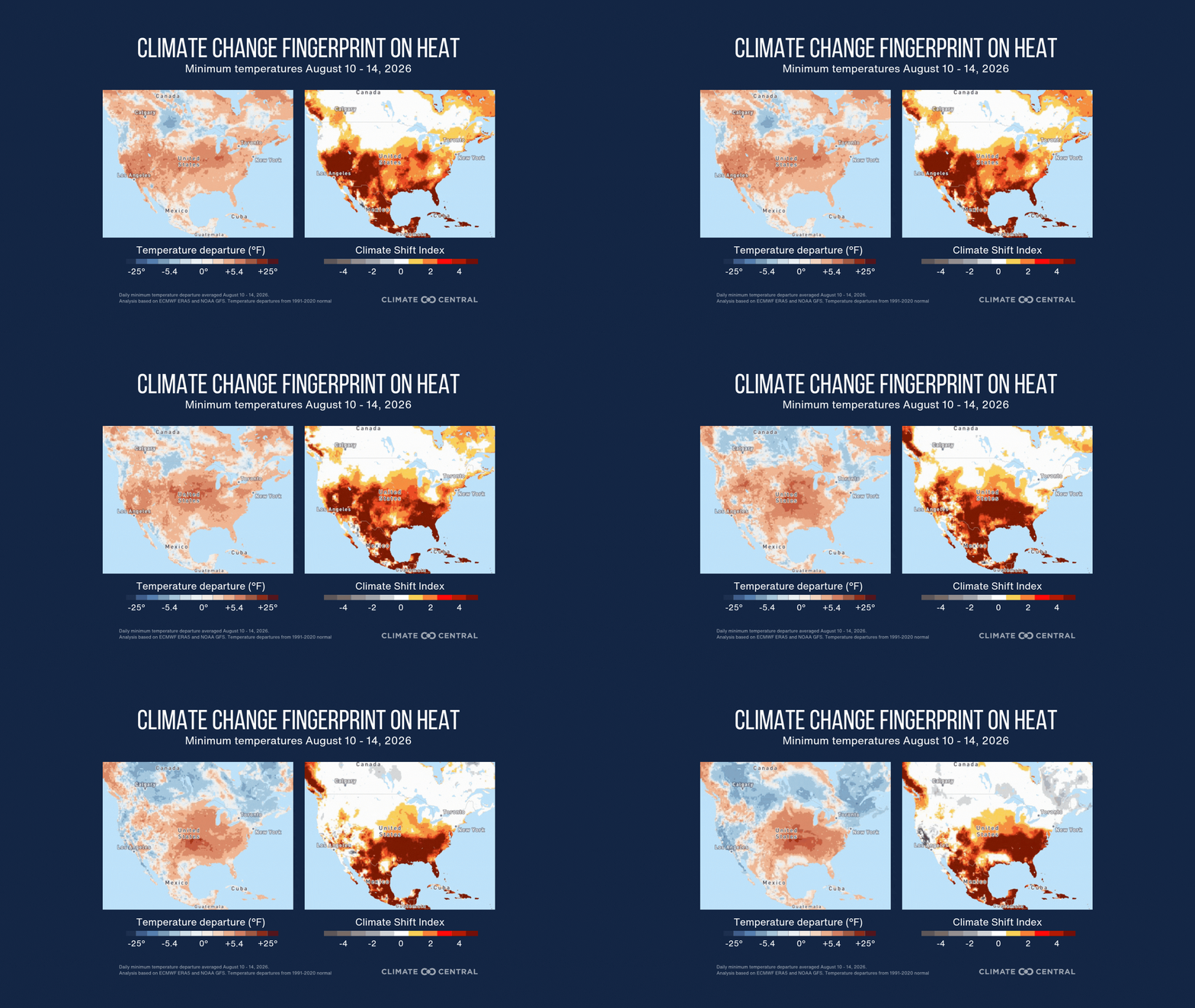
Record-warm nights are spreading across much of the U.S. this week, Aug. 12-14, offering little relief from extreme daytime heat and putting millions at greater risk of heat-related health impacts. Human-caused climate change made the extreme overnight temperatures at least three times more likely across more than 60% of the contiguous U.S., with the strongest influence across the West, South, and Southeast.
According to the National Weather Service, much of the Central and Southeastern U.S. is “forecast to see their hottest temperatures so far this year or even in the past few years. There will be little nighttime relief from the heat, and urban areas may not cool below 80°F.”
Record high minimum temperatures — the warmest daily low temperatures on record — were set across 20 states from California to Kentucky and West Virginia on Aug. 10 and 11. All-time and top-five records were also set in Florida, Georgia, South Carolina, and North Carolina.
From Wednesday, Aug. 12 through Friday, Aug. 14, low temperatures are forecast to only fall to the mid-to-upper 70s from Kansas to Texas and expanding into the Southeast U.S. Cities like Tulsa, OK; Dallas, TX; Little Rock, AR; New Orleans, LA; and Memphis, TN are not expected to fall below 80°F. Additional record high minimums are expected.
Hot summer nights limit the body’s ability to cool down and recover from extremely hot days, increasing the risk of heat stress, disrupted sleep, and related health impacts.
Since 1970, the number of unusually warm summer nights has increased in 95% of the 243 major U.S. cities analyzed by Climate Central.
Climate influence:
Climate Shift Index (CSI) levels of 5 — the highest possible — are forecast for minimum temperatures across much of the lower 48, or contiguous U.S., with the highest concentrations in the West, South, and Southeast from Aug. 10 through Aug. 14, meaning human-caused climate change made this extreme heat at least five times more likely. This signals an exceptional climate-influenced event.
On Aug. 11, the contiguous U.S. set a new record for warm overnight temperatures, with 82% of the lower 48 experiencing the largest spatial extent of overnight heat with a CSI 1 or higher.
From Aug. 10 through 12, more than 201 million people across the western, southern, and southeastern U.S will experience at least one night with a low temperature reaching a CSI 3 or higher.
An additional 138 million people will experience at least one night with a low temperature reaching a CSI 3 or higher on Aug. 13 and 14. A CSI 3 indicates a very strong influence of climate change.
Minimum temperatures made at least three times more likely by human-caused climate change are projected to affect approximately 1.9 million square miles (4.8 million square kilometers) — more than 60% of the contiguous U.S.
Climate change intensified dangerous heat across South Korea and Japan
An intense heat wave has brought prolonged extreme heat to the Korean Peninsula and Japan, with Climate Shift Index levels indicating human-caused climate change made the event at least five times more likely across much of the region. The heat has contributed to heat illnesses, deaths, and widespread impacts as dangerously hot days and nights continue.
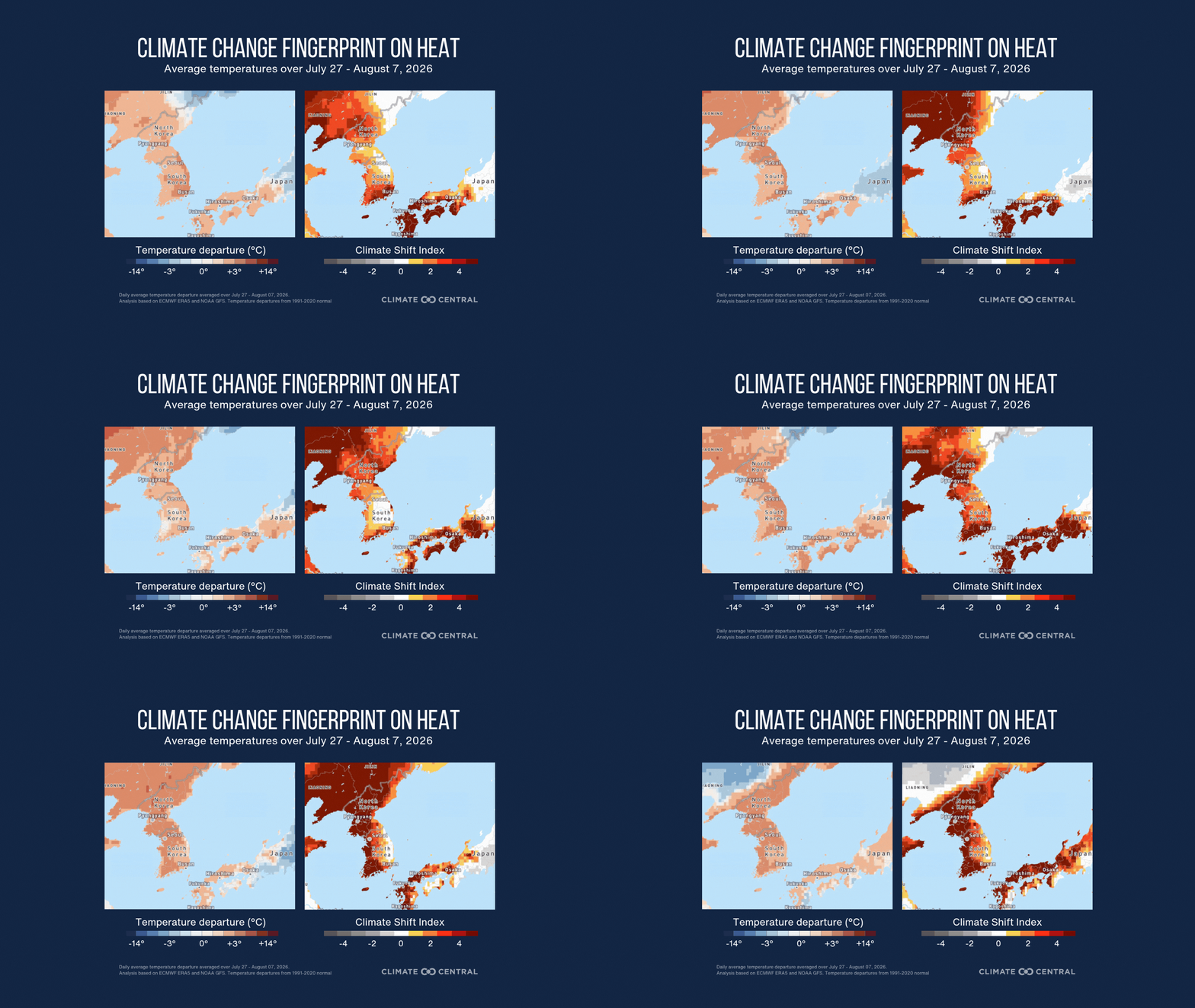
Excessive heat has been affecting much of South Korea and Japan since mid- to late July, and is forecast to continue through the first week of August.
The heat wave is being driven by overlapping high-pressure systems — the North Pacific High near the surface and the Tibetan High aloft — which are acting like a heat dome over the region. Sinking air is suppressing clouds and rainfall, allowing strong sunshine and heat to build over several days.
Hot, humid air moving north from the surrounding seas is also keeping overnight temperatures elevated, while downslope winds are further intensifying the heat in parts of southeastern Korea.
Since July 27, temperatures reaching between 30°C and 40°C have affected much of the Korean Peninsula, with the highest temperatures along South Korea’s southern and western coasts.
Yangsan in South Gyeongsang recorded South Korea’s highest temperature since observations began in 1904, with temperatures reaching 42.5°C over the weekend. South Korea issued its first-ever severe heat wave warning, urging people to avoid all outdoor activities.
Similar hot conditions have affected western and southwestern Japan over this period, with temperatures ranging from 30°C to 38°C. In some regions, temperatures topped 40°C.
Nighttime has offered little relief across the region. Pyongyang in North Korea and Donghae, Samcheok, and Goseong in South Korea recorded five straight tropical nights — nights with temperatures at or above 25°C — while Seoul recorded 12 consecutive tropical nights as of Monday, Aug. 3.
High nighttime temperatures can prevent the body from cooling and recovering after daytime heat, disrupting sleep and increasing heat strain over consecutive nights.
This heat is forecast to continue through the end of the week, affecting most of the Korean Peninsula and southwestern Japan.
Climate influence:
Climate Shift Index (CSI) levels of 5 — the highest possible — are forecast across much of Japan and South Korea, with the highest concentrations in South Gyeongsang, North Jeolla, and western Japan from July 27 through Aug. 7, meaning human-caused climate change made this extreme heat at least five times more likely. This signals an exceptional climate-influenced event.
From July 27 through Aug. 8, more than 149 million people (86% of the population) across South Korea and Japan will experience at least one day with average temperatures reaching a CSI 3 or higher, indicating a very strong influence from climate change.
Temperatures made at least three times more likely by human-caused climate change are projected to affect approximately 319,000 square kilometers (123,000 square miles).
See this event on the Climate Shift Index map
Impacts:
This heat has affected both people and animals across the Korean Peninsula and Japan, resulting in more than 1,800 cases of heat illness and 14 heat-linked deaths during the latter half of July in South Korea.
Three lions at a Tokyo zoo and more than 30,000 farmed flatfish on Jeju Island have also died as a result of this ongoing heat wave.
This heat is complicating earthquake-recovery efforts in Kumamoto Prefecture following the magnitude 7.1 earthquake that struck last week.