Climate Shift Index Alert•July 27, 2026
How climate change shaped the 2026 World Cup
From extreme heat to increasingly humid playing conditions, climate change influenced the environment in which teams competed throughout the tournament. While every match is decided by the players on the pitch, the conditions they faced were increasingly influenced by a warming world.
Almost every team encountered temperatures or humid heat conditions that were intensified by climate change. As global temperatures continue to rise, these conditions are becoming more common, raising important questions about athlete safety, performance, and the future of major sporting events.
We've taken a closer look at Team Spain, the tournament's champion, along with overall tournament trends, to understand how climate change influenced the conditions throughout the competition.
Big Picture
Matches Impacted by Climate Change: Nearly half of all matches were played on days where the host city experienced a climate change signal, either through our Climate Shift Index (CSI) signal for temperature and/or dangerous humid heat attributable to climate change.
Athletic Performance Threshold: 58 of 104 matches (55.8%) were played in cities where the daily high exceeded 82.4°F (28°C), a threshold at which heat can begin to affect athletic performance. Thirty-five of those matches were played in non-climate-controlled stadiums.
40 of 104 matches (38.7%) had kickoff temperatures above 82.4°F (28°C), based on observations from the nearest weather station. Twenty of those matches were played in non-climate-controlled stadiums.
Hottest Stadium: Miami
The non-climate-controlled stadium that hosted the hottest matches (high temperature for the day and at kickoff) was Miami Stadium.
Miami hosted seven matches.
The average daily high temperature for each match day was 93.4°F (34.1°C).
The average temperature at kickoff for each match was 86.9°F (30.5°C), based on observations from the nearest weather station.
Every match day registered a Climate Shift Index (CSI) signal of 2 or higher for either the daily high or average temperature.
Every match day experienced dangerous humid heat. All but one of those events was attributable to climate change.
Hottest Game: Paraguay vs. France
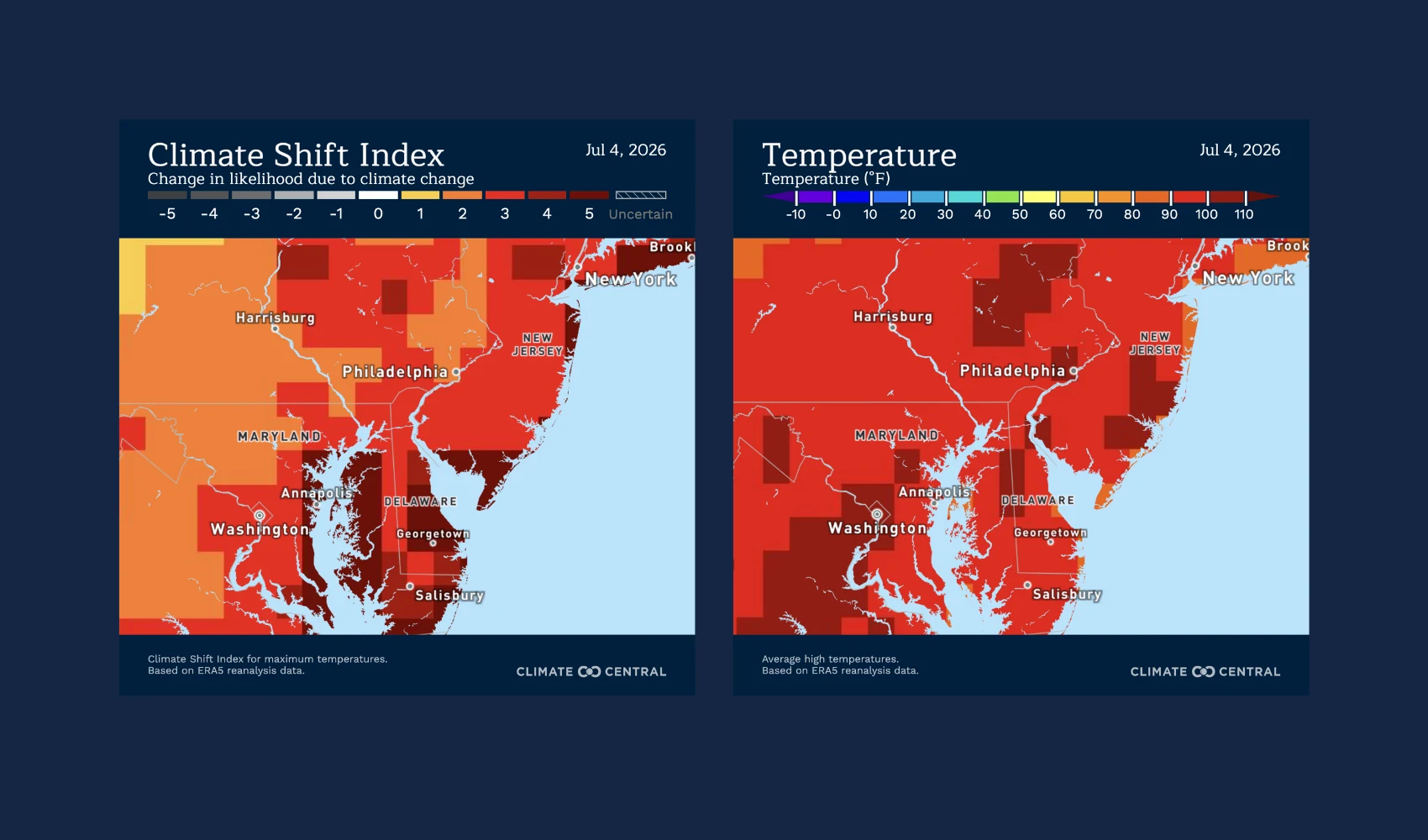
Philadelphia hosted the hottest match of the tournament: Paraguay vs. France on July 4, 2026.
The day's high temperature reached 101°F (38.3°C), made twice as likely by climate change (CSI 2), while the kickoff temperature was 100°F (37.7°F), based on observations from the nearest weather station. Dangerous humid heat was attributable to climate change.
Most Heat-Exposed Team: France
France played more matches in non-climate-controlled stadiums with daily highs above 82.4°F (28°C) than any other team.
Seven of France's eight matches were played in non-climate-controlled stadiums.
Of those seven outdoor matches, four were played on days with a climate change signal, either through our Climate Shift Index (CSI) signal for temperature and/or dangerous humid heat attributable to climate change.
France's average kickoff temperature for matches played outdoors was 86.1°F (30.1°C).
Two of France's outdoor matches were played under dangerous humid heat conditions attributable to climate change.
France played in the hottest match of the tournament: Paraguay vs. France on July 4, 2026, which had a high temperature of 101°F (38.3°C).
Other Notable Heat-Exposed Team: Uruguay
Uruguay also had a very hot run in the tournament. While the team only played three matches, all were in non-climate-controlled stadiums, and two were on days with daily highs above 82.4°F (28°C).
All three of Uruguay's matches were played in non-climate-controlled stadiums.
Of those three outdoor matches, all were played on days with a climate change signal, either through our Climate Shift Index (CSI) signal for temperature and/or dangerous humid heat attributable to climate change.
Uruguay's average kickoff temperature was 86.6°F (30.3°C), slightly higher than France’s average.
Two of Uruguay's matches were played under dangerous humid heat conditions attributable to climate change.
A Champion’s Journey: Spain
Spain’s World Cup journey was not nearly as hot as France’s, aided by many games in climate-controlled stadiums.
Four of Spain's eight matches were played in non-climate-controlled stadiums.
Out of the eight matches they played, one of them was on a day with temperatures made more likely by climate change, and they played it in an open-air stadium. The match was — Spain vs. Uruguay at Estadio Guadalajara on June 26, 2026.
Spain’s average kickoff temperature for matches played outdoors was 75.8°F (24.3°C).
Three out of eight matches were played in cities with daily highs above 82.4°F (28°C), the threshold at which heat can begin to affect athletic performance. All three of those matches were played in climate-controlled stadiums.
Two out of eight matches had kickoff temperatures above 82.4°F (28°C), based on observations from the nearest weather station. Both of those matches were played in climate-controlled stadiums.