
Climate Matters
Wildfire Risk to Homes, Roads, and Power Lines
Across the U.S., communities face risks from wildfires to homes, roads, and more. Those risks are likely to increase as the climate warms.
Climate Matters•May 6, 2026•Reuse this content
Climate Central examined historical trends in fire weather — a combination of hot, dry, windy conditions — across the U.S.
This analysis uses data from 476 weather stations to assess fire weather trends in 245 climate divisions spanning the contiguous U.S. from 1973 to 2025.
On average, climate divisions in the western U.S. experience 32 fire weather days annually. That’s four times more than in the eastern U.S.
Wildfire seasons are lengthening and intensifying, particularly in the western U.S. Parts of the eastern U.S. have seen smaller but impactful increases in fire weather days.
Much of the country has seen fire weather increase the most during spring. The Southwest is also seeing more fire weather during summer.
This Climate Matters analysis is based on open-access data from the National Oceanic and Atmospheric Administration (NOAA). See Methodology for details.
A record-warm winter and exceptional March heat wave have left the western U.S. in a historic snow drought. These hot, dry conditions are raising concerns about wildfire risks (due to drier and more flammable vegetation) in the months ahead.
As of mid-April 2026, the total area burned by wildfires in the U.S. is already about double the previous record for this time of year. Continued drought and above-normal wildfire potential are forecast for the Southwest, Northwest, and Northern California through mid-summer.
Amid these conditions, fire prevention is critical given that most fires are sparked by people.
Regardless of how fires start, more frequent hot, dry, windy conditions — known as fire weather — prime the landscape for wildfires to ignite and spread.
Climate change is causing more frequent fire weather across the U.S. Warming temperatures and increasingly dry air, vegetation, and soils make it easier for fires to spread, and harder to fight or prevent.
Climate Central analyzed data from 476 weather stations to assess fire weather trends in 245 climate divisions spanning the contiguous U.S. from 1973 to 2025. Regional climate differences result in distinct fire weather trends in the western and eastern U.S. (see Methodology for details).
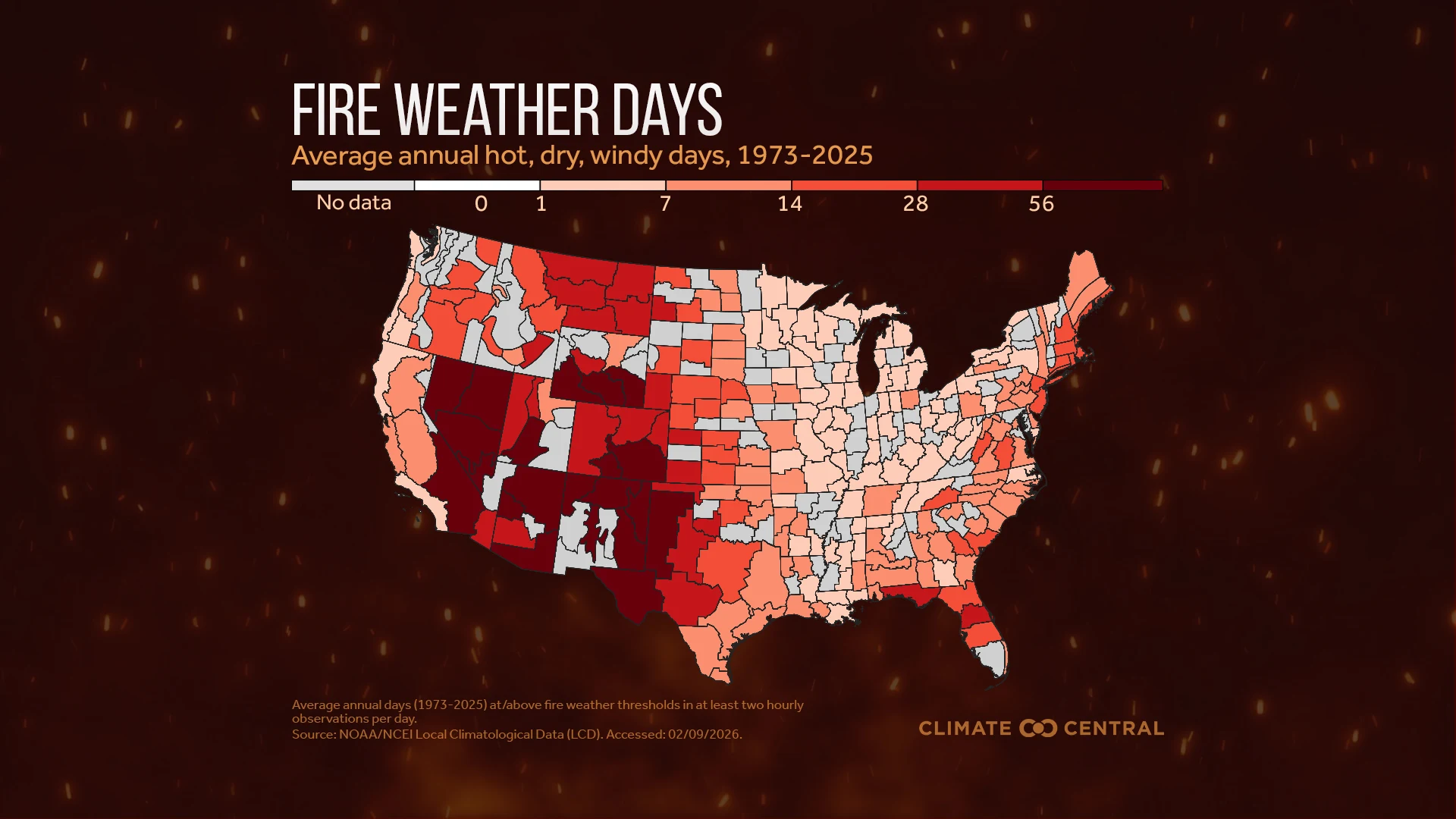
Average annual fire weather days, 1973-2025:
Climate divisions in the western U.S. experience an average of 32 fire weather days each year.
On average, Nevada and New Mexico experience the most annual fire weather days (78 and 76, respectively). Oregon and Washington experience the fewest (both 12 days).
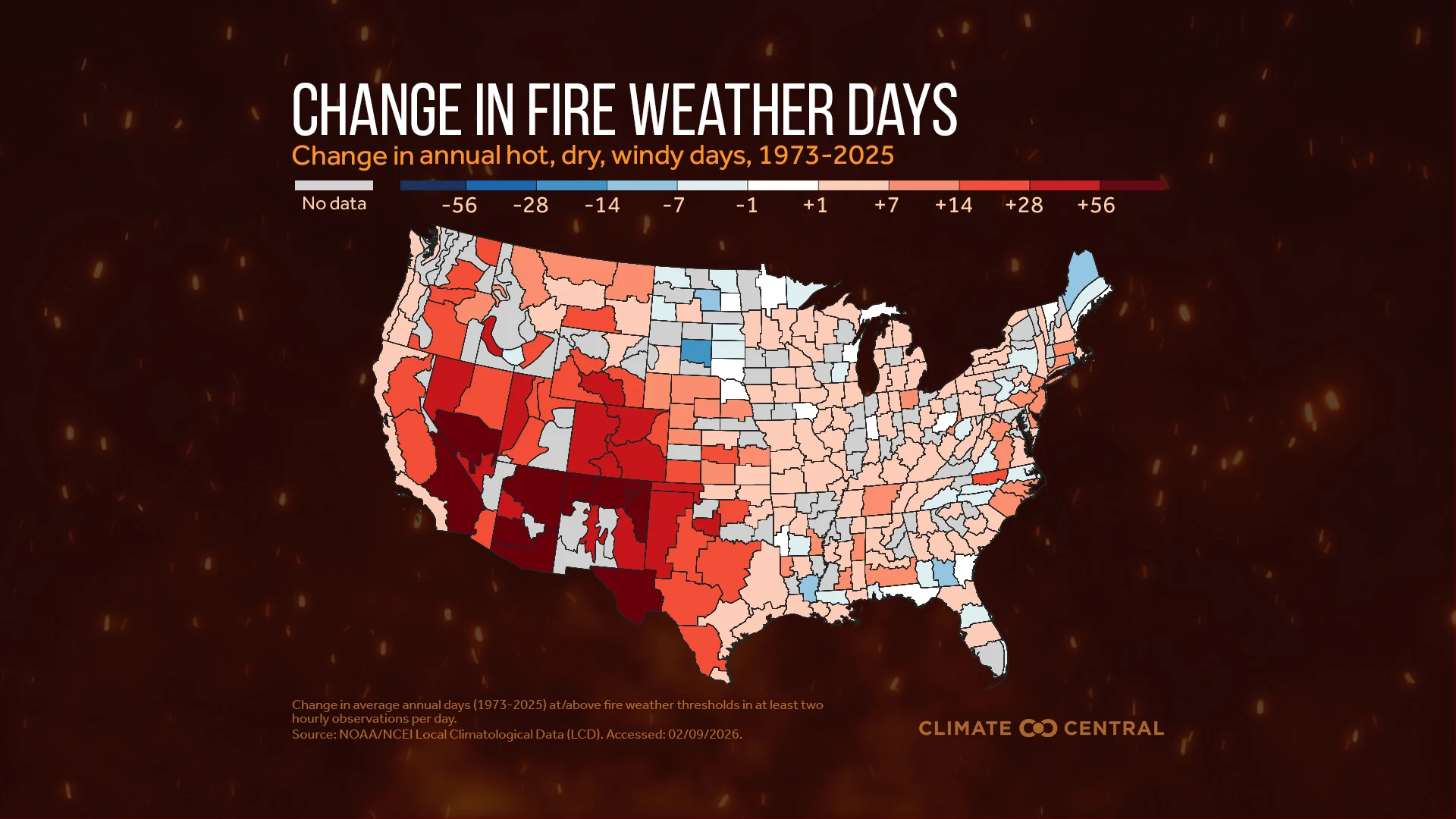
Change in fire weather days, 1973-2025:
The western U.S. has experienced a strong increase in the average annual number of fire weather days since 1973. These results are consistent with findings from previously published research.
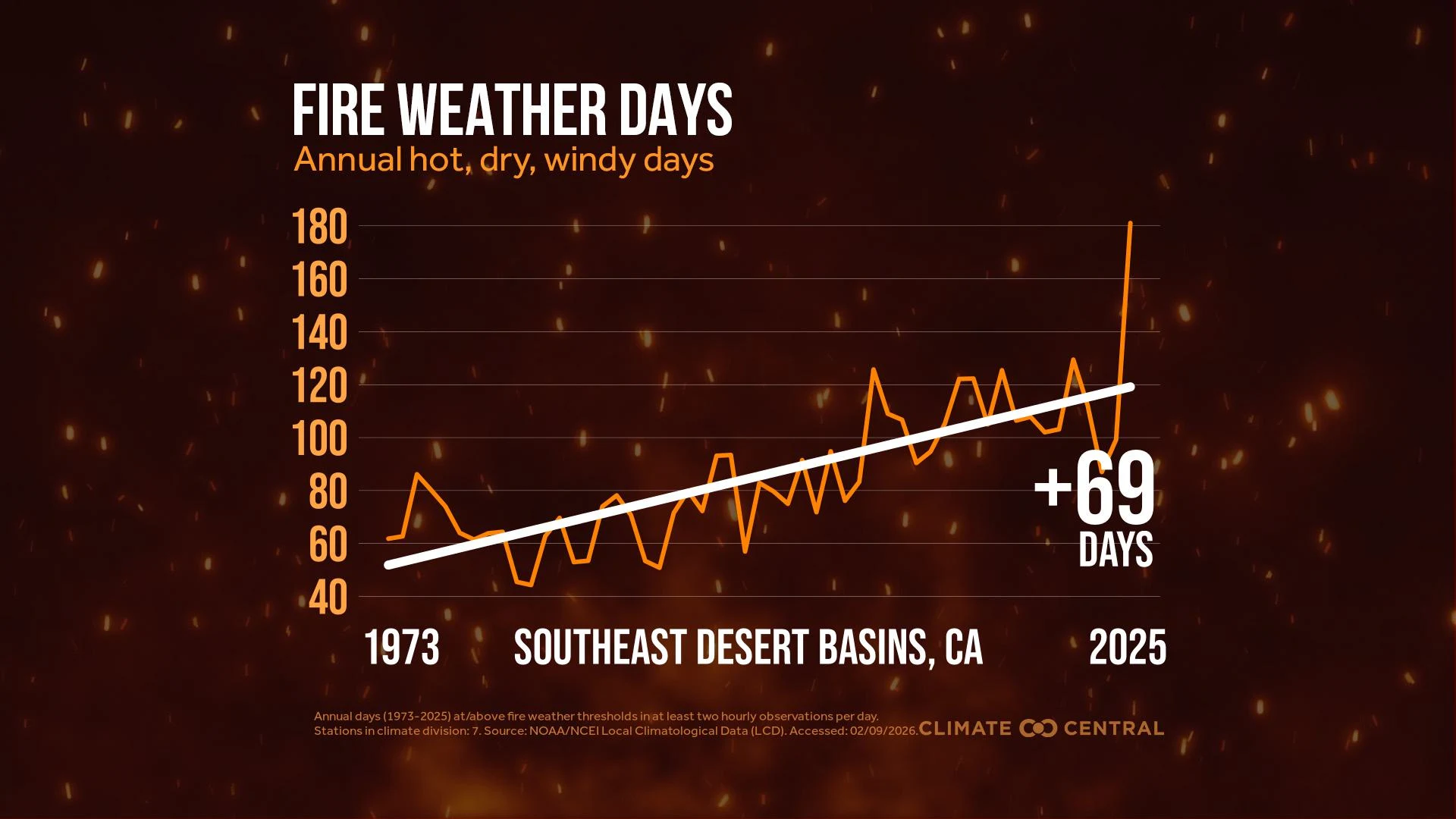
Areas in Southern California, New Mexico, Texas, and Arizona have experienced some of the largest increases in annual fire weather days, with some areas now seeing around two more months of fire weather per year compared to a half century ago.
Some places, including parts of California, Nevada, New Mexico, and Texas now experience fire weather around twice as often as in the early 1970s.
By contrast, parts of North Dakota and South Dakota have experienced a decline in the frequency of fire weather days. The Dakotas are part of a region where spring has been cooling slightly.
Seasonal fire weather trends, 1973-2025:
Overall, the western U.S. has seen the greatest jump in fire weather days in the spring and summer, particularly in southwestern areas.
Parts of New Mexico, Arizona, and Colorado are seeing around a month more of fire weather days during spring.
Areas in Southern California, Utah, and Arizona are experiencing around three weeks more fire weather days during summer.
Average annual fire weather days, 1973–2025 | Average change in annual fire weather days, 1973–2025 | Fastest-growing season, 1973-2025 | |
|---|---|---|---|
Southwest | 57 days | +44 days | Spring (+13 days) |
West | 44 days | +26 days | Summer (+8 days) |
Northern Rockies and Plains | 27 days | +7 days | Winter (+3 days) |
western South (TX, OK, KS) | 25 days | +16 days | Winter (+5 days) |
Northwest | 14 days | +11 days | Summer (+6 days) |
Average annual fire weather days, 1973-2025:
Climate divisions in the eastern U.S. experience an average of eight fire weather days each year.
On average, Rhode Island experiences the most annual fire weather days (24 days), followed by Florida, New Jersey, and Connecticut (all 21 days). Wisconsin and Indiana experience the fewest (both 2 days).
A band stretching from coastal Maine through the Northeast, Piedmont Valley, and into northern Florida experiences the highest average number of annual fire weather days in the eastern U.S. Parts of the Southeast and Northeast experience several weeks of fire weather on average each year. Northern Florida experiences around a month.
Change in fire weather days, 1973-2025:
Most eastern areas included in this analysis saw, at most, a few more days of annual fire weather since 1973. Variable regional increases in fire weather days align with recent research that shows more large wildfires are occurring in the eastern U.S., particularly in southeastern areas.
Parts of the Southeast and Northeast have experienced some of the greatest increases in annual fire weather days across the eastern U.S. The northern Piedmont area in North Carolina is seeing nearly two more weeks of fire weather, while northern New Jersey and coastal New York are experiencing at least 10 additional days of fire weather annually.
Around 23% of eastern climate divisions saw either no change or a decrease in the frequency of fire weather days.
Seasonal fire weather trends, 1973-2025:
Across much of the eastern U.S., the greatest increase in fire weather days is happening during spring, which aligns with spring warming trends experienced in many eastern states.
Average annual fire weather days, 1973–2025 | Average change in annual fire weather days, 1973–2025 | Fastest-growing season, 1973-2025 | |
|---|---|---|---|
Northeast | 12 days | +3 days | Winter (+2 days) |
Southeast | 12 days | +3 days | Winter (+1 day) |
eastern South (AR, LA, MS) | 7 days | +3 days | Winter (+1 day) |
Ohio Valley | 4 days | +3 days | Fall (+1 day) |
Upper Midwest | 4 days | +1 day | Not applicable |
Fire weather refers to meteorological conditions that promote the spread of wildfires. As fire weather becomes more prevalent, there are more days when extreme conditions can turn small blazes into big ones or fuel the growth of large wildfires.
Climate Central’s analysis focuses on three conditions fundamental to fire weather: temperature, relative humidity, and wind (see Methodology for details).
Hotter temperatures have a direct influence on fire behavior, heating the fuels and making them more likely to ignite. Warmer nighttime temperatures decrease the overnight relative humidity that has historically helped firefighters gain control over wildfires.
When relative humidity levels are very low, the air pulls moisture from the land and vegetation, leaving plants and trees dry and prone to burning. Climate Central’s analysis shows that decreasing relative humidity has been a major factor in boosting annual fire weather days for many locations across the U.S.
Wind supplies oxygen to a fire, causing it to burn more rapidly. Wind increases evaporation, drying out the land. Wind also carries embers, which helps fires spread.
Explore seasonal trends in fire weather drivers.
Climate Central’s 2023 report, Wildfire Weather: Analyzing the 50-year shift across America, explains additional factors that influence wildfire, including fuels (such as dried vegetation or downed trees), other weather conditions, and human activity.
Temperature, relative humidity, and wind speed are key variables that drive fire weather, and each can vary seasonally. Explore trends in the seasonal fire weather drivers (via Observable). Find local spring, summer, fall, and winter temperature trends for your area. Climate Central will publish updated local summer temperature trends on May 21.
NOAA’s Storm Prediction Center produces daily reports of elevated fire weather conditions. The Incident Information System identifies where wildfires have been reported and provides detailed information on conditions. Each month, the National Interagency Fire Center issues a 3-month fire outlook for North America. The latest outlook covers April-June 2025.
The University of Wisconsin-Madison’s SILVIS Lab provides maps and data on the wildland urban interface (WUI) from 1990 to 2020.
The U.S. Fire Administration outlines steps communities can take toward being wildfire adapted. A number of fire adaptation strategies include increased use of land management techniques that eliminate excessive fuels, such as prescribed burns, or creating defensible space around homes and other structures. There are toolkits to prepare homes and create evacuation plans.
To request an interview with a Climate Central expert about this analysis, please contact Abbie Veitch, aveitch@climatecentral.org.
Submit a request to SciLine from the American Association for the Advancement of Science or to the Climate Data Concierge from Columbia University. These free services rapidly connect journalists to relevant scientific experts.
Browse maps of climate experts and services at regional NOAA, USDA, and Department of the Interior offices.
Explore databases such as 500 Women Scientists, BIPOC Climate and Energy Justice PhDs, and Diverse Sources to find and amplify diverse expert voices.
Reach out to your State Climate Office or the nearest Land-Grant University to connect with scientists, educators, and extension staff in your local area.
Graphics showing trends in annual fire weather days from 1973 to 2025 for 245 U.S. climate divisions are organized by respective media markets.
The findings are divided into broad geographic regions (West and East), each comprising multiple climate regions as defined by NOAA’s National Centers for Environmental Information. Note: The NCEI South region was split into the western South (Texas, Oklahoma, and Kansas) and eastern South (Arkansas, Louisiana, and Mississippi) and grouped as indicated in the tables above.
This analysis defines a “fire weather day” as one where the following three conditions co-occur in at least two hourly measurements:
Temperature of at least 45-55°F, depending on the season (winter: 45°F; summer: 55°F; spring and fall: 50°F)
Relative humidity within 5% of regional thresholds defined by NOAA’s Storm Prediction Center (based on predominant fuel type and local climate)
Sustained wind speeds of 15 mph or greater (10 mph or greater for Florida locations)
Hourly observations for 476 stations across the contiguous United States were obtained from 1973 to 2025 using NOAA/NCEI’s Local Climatological Data. Stations needed to pass several data completeness checks in order to be included in this analysis. Using the thresholds detailed above, Climate Central calculated the number of annual and seasonal fire weather days at each station from 1973 to 2025. Thresholds were not available for Alaska, Hawaii, or Puerto Rico, and therefore these locations were not included in this analysis. Results were mapped to each station’s climate division. For climate divisions with multiple stations, data were averaged across all stations. Additionally, we calculated the average annual and seasonal fire weather days (using meteorological seasons) and used linear regression to calculate the total change. Data were rounded to the nearest whole day. Some climate divisions only had one weather station with sufficient data inside its boundary. While confidence in our results increase with additional stations, our results are consistent with recent findings (Bowman et al., 2020 and Jolly et al., 2015).
This analysis is not a comprehensive assessment of fire weather and should not be used in isolation to make conclusions about overall fire risk. A detailed methodology is available in the 2023 report, Wildfire Weather: Analyzing the 50-year shift across America.
Climate Matters © 2026 by Climate Central is licensed under CC BY 4.0
This license grants permission to use, distribute, and reproduce all text, graphics, and multimedia content published on this page in any medium, provided that Climate Central is credited per the CC BY 4.0 license.
Permission to use data and other materials published on this page is granted for non-commercial uses, commercial news purposes, and educational purposes as governed by Climate Central's Terms of Use.