Climate Matters
Record Snow Drought Limits Western Water Supplies
A historic western U.S. snow drought, worsened by record winter and early-spring heat, is raising concerns about water supplies and wildfire risks in the months ahead.
Dr. Zachary Labe, climate scientist at Climate Central, said:
“March 2026 was a truly extraordinary month for climate extremes, with summerlike heat affecting millions across the U.S., more than 10,000 daily temperature records set, and missing snow even on the highest peaks of the Rockies. Human-caused climate change is amplifying these extremes and increasing risks to people, communities, and ecosystems.”
March 2026 Highlights: Temperature
March 2026 was statistically tied with 2024 for the second-warmest on record globally (for land and ocean temperatures combined). The record warmest is March 2025. The last time March’s global mean temperature was cooler than normal (compared to the 20th century average) was in 1976. Records have been kept since at least 1850.
Global average temperatures over land areas were the third-warmest on record in March.
Global average temperatures over ocean areas were the second-warmest on record in March.
Both hemispheres experienced one of their warmest Marches on record, ranking third-warmest in the Northern Hemisphere and second-warmest in the Southern Hemisphere.
March 2026 Highlights: Other Climate Indicators
March snow cover across the Northern Hemisphere was the sixth-lowest on record. Records have been kept for 60 years.
Arctic sea-ice extent ranked as the second-lowest on record for March.
Antarctic sea-ice extent ranked as the 13th-lowest on record for March (a statistical tie).

March 2026 Highlights: Temperature
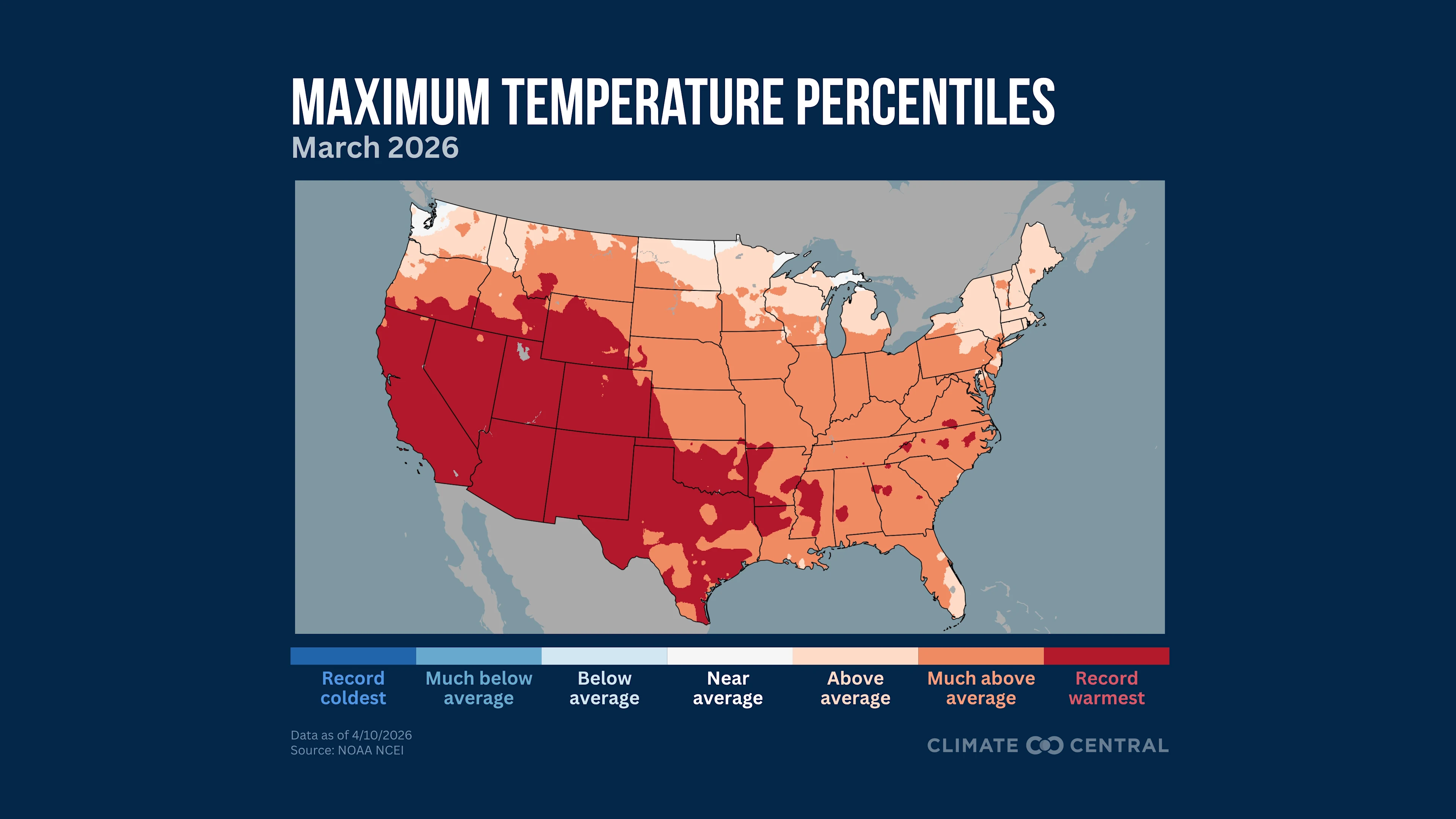
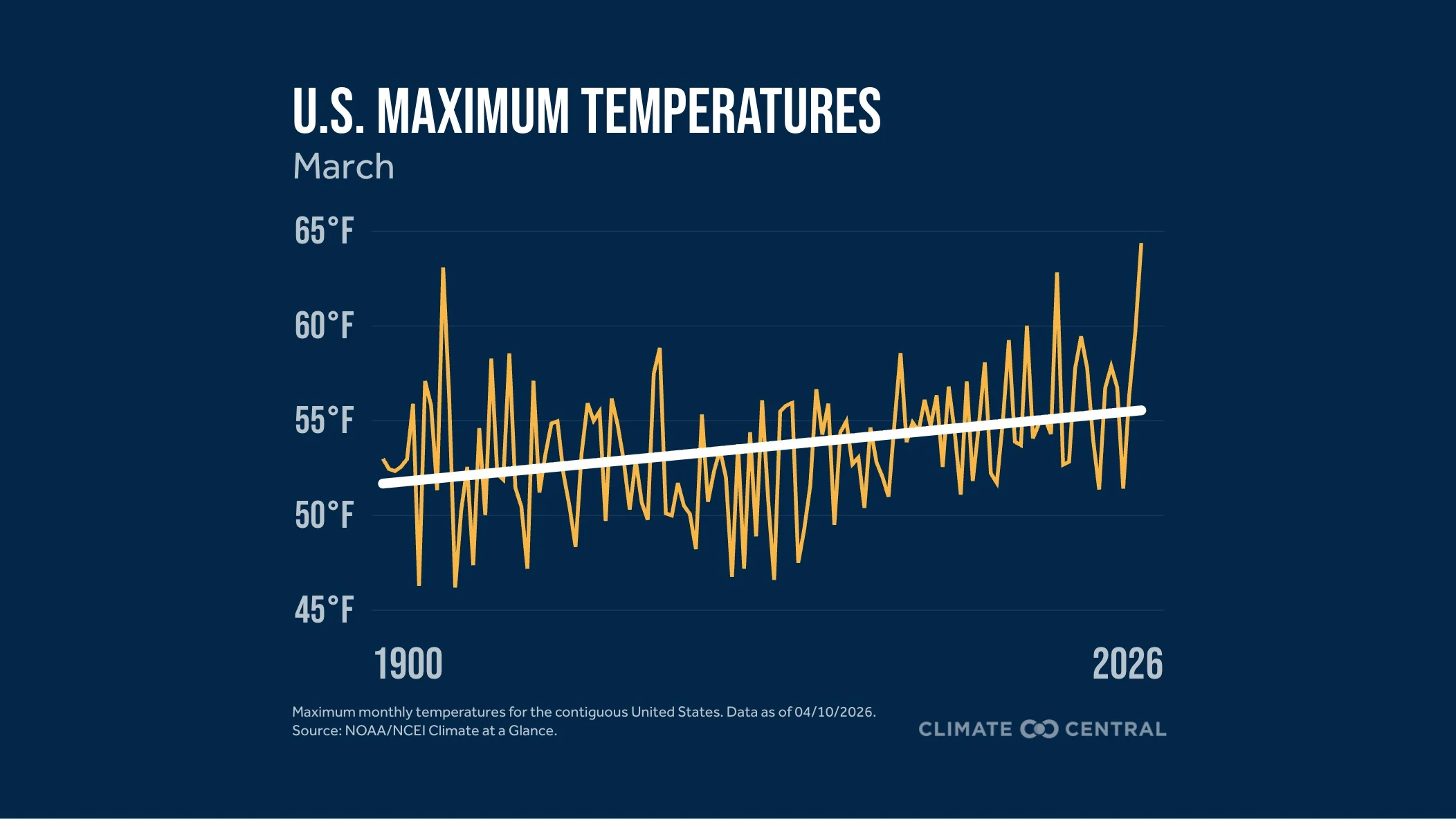
March 2026 ranked as the warmest March on record for the contiguous U.S.
The average contiguous U.S. temperature in March was 9.4°F above the 20th-century average, the first monthly anomaly on record to exceed +9°F.
March was the warmest for average maximum temperatures and second-warmest for average minimum temperatures.
Ten states recorded their warmest March on record: Arizona, California, Colorado, Idaho, Nevada, New Mexico, Oklahoma, Texas, Utah, and Wyoming.
Alaska saw its fourth-coldest March on record for average temperatures and its third-coldest for minimum temperatures. Records have been kept there since at least 1925.
Recent Temperatures from a Climate Perspective:
The average temperature so far in 2026 is the warmest on record for the contiguous U.S. (January 2026 to March 2026).
The average temperature over the last six months was the warmest on record for the contiguous U.S. (October 2025 to March 2026).
The average temperature over the last year was the warmest on record for the contiguous U.S. (April 2025 to March 2026).
The average temperature over the past 18, 24, 36, 48, and 60 months each ranked as the warmest on record for the contiguous U.S.
March 2026 Highlights: Precipitation
March 2026 ranked as the eighth-driest March on record for the contiguous U.S.
California had its driest March on record, and Colorado and New Mexico saw their second-driest.
Alaska recorded its fifth-driest March on record, while Hawaii had its wettest March on record.
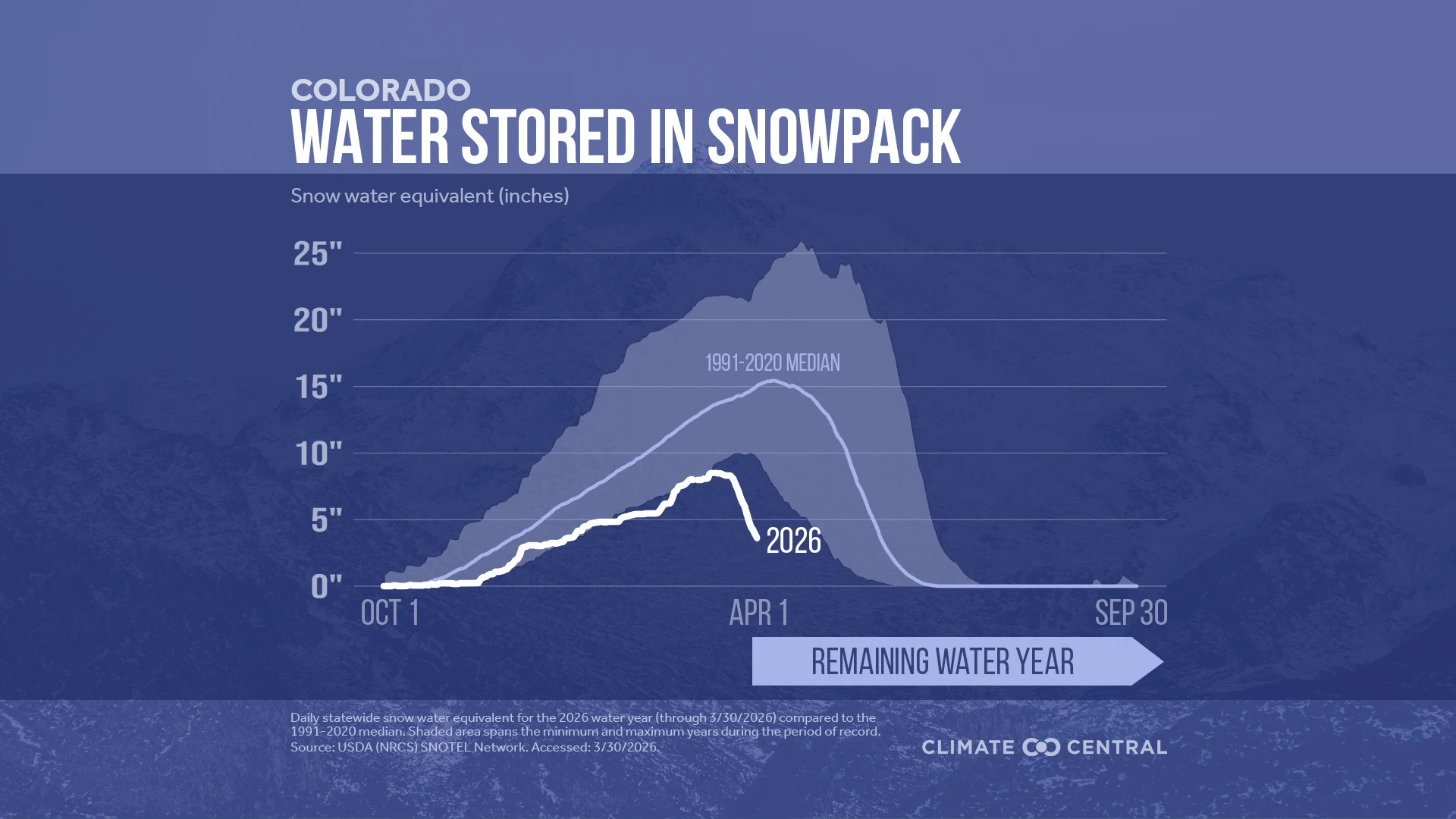
Snow water equivalent remains below 50% of the 1991-2020 normal in most watershed basins from Oregon to New Mexico.
The amount of water stored in Western U.S. snowpack was the lowest on record for April 1, which is typically near the annual peak (halfway through the water year).
As of April 7, 2026, at least 77% of the contiguous U.S. is experiencing abnormally dry or drought conditions.
Across the contiguous U.S., the last three months (January-March 2026) were the driest on record. Only Michigan and Wisconsin fell within the wetter-than-normal percentile range during this period.
Parts of Arizona, California, Colorado, Kansas, Nebraska, New Mexico, and Texas have observed less than 10% of their average January to March precipitation in 2026.
The first three months of 2026 are the wettest on record for the state of Hawaii. Records have been kept there since at least 1991.
By Dr. Zachary Labe, climate scientist at Climate Central
Polar sea ice in both the Arctic and Antarctic follows a strong seasonal cycle. In late February to early March, Antarctic sea-ice extent reaches its annual minimum during the austral summer. By contrast, March marks the seasonal maximum for Arctic sea ice, as it peaks at the end of boreal winter. While this seasonal rhythm is normal, Arctic sea ice has experienced a persistent long-term decline across all months of the year, which is driven primarily by human-caused climate change.
On March 15, Arctic sea-ice extent reached its maximum for 2026 at 5.52 million square miles (14.29 million square kilometers). This year’s Arctic sea-ice maximum was statistically tied for the lowest on record, which is based on the passive microwave satellite record that started in 1978/1979. This year closely matches the previous record set in 2025, meaning the past two winters have both reached historically low sea-ice extent around the climatological peak. This year’s maximum sea-ice extent is approximately 525,000 square miles below the 1981-2010 average, which is roughly equivalent to about twice the size of the state of Texas.
Some of the largest sea-ice departures this past winter were found in several marginal seas around the Arctic, including in Baffin Bay, Barents Sea, Kara Sea, Labrador Sea, and Sea of Okhotsk. However, sea ice was notably more extensive this winter along the eastern Bering Sea coast of Alaska compared to recent years. This expansion was driven by unusually strong cold conditions and persistent northerly winds, which pushed the ice farther south. The Arctic often experiences large year-to-year variability and strong regional contrasts in both weather conditions and long-term climate trends. However, March sea ice is declining overall at approximately 2.49% per decade.
In the Antarctic, long-term sea-ice trends have been more variable, with only recent years showing clearly negative departures. The reasons are complex and remain an active area of scientific research. It involves a strong role for natural variability, ice-ocean-atmosphere interactions, and local climate feedbacks between the Antarctic Ice Sheet and the Southern Ocean. This summer was less extreme than recent years, with Antarctic sea ice reaching its minimum extent on February 26 at 996,000 square miles (2.58 million square kilometers). This was the 16th lowest on record in the satellite-era and about 100,000 square miles below the 1981-2010 baseline average. The current record low for the Antarctic annual sea-ice extent minimum was set in February 2023.
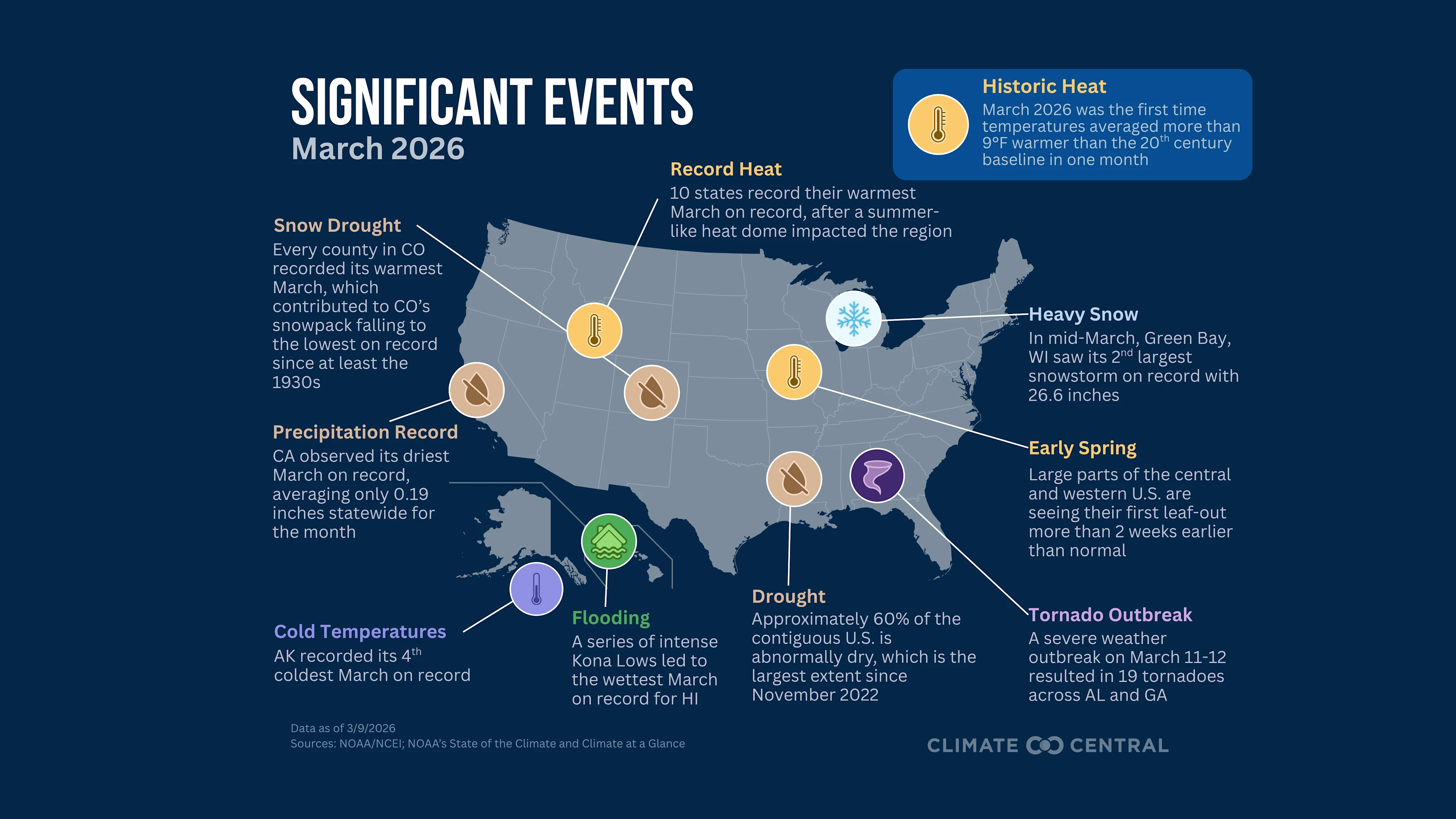
Notable temperature event: Multiple locations and days set new U.S. national temperature records for March 2026. Prior to this heat dome, the highest temperature ever observed in March across the U.S. was 108°F in Rio Grande City, Texas (March 30, 1954, and March 14, 1902). In fact, on March 20, 2026, at least four reporting sites in Arizona and California recorded their air temperatures reaching 112°F. For perspective, the highest U.S. temperature recorded in the month of April is 113°F (Death Valley, California). The previous national March temperature record was actually first tied on March 18, 2026, and then broken again on March 19, underscoring the persistence and magnitude of this event.
Notable precipitation event: A series of low-pressure systems (also known as Kona lows) brought heavy rain, flash flooding, and damaging winds to the Hawaiian islands in March 2026, with statewide precipitation averaging 22.27 inches for the month. This surpassed the prior record from 2006 with 18.77 inches. On the north shore on the island of Maui, Kahului recorded its highest March rainfall total on record with 21.12 inches, with consistent data records kept there since 1955. Their 1991-2020 average precipitation for March is 2.64 inches. Some of the highest rainfall totals were recorded in the highest elevations of Maui and Oahu, with preliminary totals exceeding 50 inches between March 10th and 24th. Unusually warm sea surface temperatures around Hawaii were made at least 40 times more likely due to climate change, which may have also contributed to amplifying the moisture and related precipitation.
March 2026:
A new Climate Central analysis using the Climate Shift Index (CSI) shows that human-caused climate change has been the main driver of spring (March, April, May) warming trends in 98% of 241 major U.S. cities from 1970 to 2025.
The fastest-warming city in spring is Reno, Nevada, with an increase of 6.9°F since 1970 — at least 65% of which is driven by human-caused climate change.
March has warmed since 1970 in nearly all major U.S. cities analyzed and ranks among the fastest-warming months of the year, particularly across the west-central U.S.
In March 2026, 111 out of 192 cities analyzed across the contiguous U.S. experienced at least one week’s worth of days with temperatures made at least twice as likely by human-caused climate change (CSI level 2).
Cities in the Southwest saw the most March days with temperatures made at least twice as likely by human-caused climate change (CSI 2), led by Flagstaff, Arizona, with 28 days.
Arizona and New Mexico both saw more than 25 average days statewide with a CSI level 2 or higher in March 2026.
Arizona, California, Colorado, Nevada, New Mexico, and Puerto Rico each had cities log at least two weeks’ worth of CSI level 2 or higher days in March.
During the middle of March, more than 26 million people likely observed at least one day’s average temperature made at least five times more likely due to human-caused climate change.
On March 20, CSI 3, 4, and 5 all reached their largest U.S. extent on record (since 1970). CSI 5 alone covered approximately 3 million square kilometers, or about 29% of the continental U.S.
Learn more about how climate change altered March’s temperatures in our latest monthly attribution overview. Climate Central also has an explainer on attribution science and how it works.
Global Temperature: Similar to our briefing discussion from last month, the latest forecasts from the North American Multi-Model Ensemble (NMME) show global temperatures will remain relatively steady over the next few months before increasing again by late boreal summer. The multi-model mean projects global temperatures rising to nearly 1.8°C above the 1850-1900 preindustrial baseline by the end of 2026, though uncertainty increases at these longer timescales. This excessive warmth globally is associated with the development of a potentially large and strong El Niño in the tropical Pacific. The latest NMME outlook also shows temperatures at least 1°C warmer than normal across the entire U.S. for the upcoming summer season (June, July, August), but lower predictive skill is found across the Ohio Valley region. One of the strongest forecast signals is in the Pacific Northwest, where NMME models show at least a 90% chance of above-normal temperatures by August.
El Niño-Southern Oscillation (ENSO): Most recently, the NOAA Climate Prediction Center has issued the Final La Niña Advisory, as well as an El Niño Watch, given that neutral ENSO conditions are now prevalent across the equatorial tropical Pacific Ocean. El Niño is now expected to develop during May to July 2026, with a 61% likelihood, and is forecast to persist through at least the end of the year. The likelihood of a very strong El Niño developing is currently about 25%, but it depends heavily on sustained westerly wind anomalies across the equatorial Pacific during the coming months, which remains uncertain at this time. Using the Relative Oceanic Niño Index (RONI), which is described here, ENSO forecasts from the NMME still show a large spread in the strength of the potential El Niño developing later on in 2026. This is also the time of year when ENSO forecasts have lower skill due to the “spring predictability barrier,” which is a nickname for when models often struggle to reliably predict the following winter’s ENSO state. Given the strong links between El Niño, global temperature variability, and regional climate extremes, we will continue closely monitoring forecasts in the coming months. Caution is still warranted in interpreting the projected strength of this event until confidence improves later on in the year.
U.S. Drought: As of early April, more than 59% of the contiguous U.S. is in at least moderate drought conditions, and about 8% of that region is seeing extreme or exceptional drought. Stream gauges are reporting widespread unusually low flows (below the 10th percentile) across the Southeast up through southern New England. A number of streamflow sites are experiencing record low flows for this time of year as well, particularly across Alabama, the panhandle of Florida, Georgia, Mississippi, North Carolina, and Tennessee. Some of the only areas with higher-than-normal streamflows in the contiguous U.S. are currently in the northern Great Lakes and parts of Idaho and Montana. The monthly drought outlook indicates likely improvement across parts of the central U.S., including Arkansas, Oklahoma, and Texas, while conditions are expected to further worsen in Arizona, Colorado, Kansas, Nevada, and New Mexico
U.S. Temperature: Warmer-than-normal temperatures are favored across Hawaii and the southern contiguous U.S., with the strongest signal in the Southeast. The NOAA Climate Prediction Center also highlights a slight risk of extreme heat during the third week of April in the Southeast U.S., which could accelerate drought development in parts of Alabama and Mississippi. In contrast, continued colder-than-normal temperatures are more likely in Alaska. By late April into early May, above-normal warmth is expected to expand across the southern and western U.S., as well as in Hawaii and Alaska.
U.S. Precipitation: There is lower confidence in precipitation anomaly forecasts over the next two weeks, though chances for wetter-than-normal conditions are found across the Great Lakes region as well as over most of Alaska and Hawaii. Drier-than-normal conditions are likely to continue across the Southeast U.S.
U.S. Energy: In response to the summerlike temperatures, the Northwest, Southwest, and West U.S. climate regions saw their highest number of cooling degree days in March 2026, with records going back to 1895. For example, Arizona tallied 228 degree-days Fahrenheit (°Df) in March 2026, and their previous record was only 116°Df from 2004. Cooling degree days are a rough measure of how much energy is needed for air conditioning, with higher values indicating hotter conditions and greater cooling demand. Earlier spring warming and unusually early heat waves are driving higher cooling demand and extending the length of the cooling season. Along the same lines, the demand for heating was less than normal in March for all states across the contiguous U.S.
Our team of scientists can help interpret these findings and answer your questions. Contact us here.
To request a media interview with a Climate Central scientist about this briefing, please contact Abbie Veitch, aveitch@climatecentral.org.
Global and U.S. climate statistics are provided by NOAA’s National Centers for Environmental Information (NCEI), including through the Climate at a Glance tool. All climate regions and divisions follow the standard definitions established by NOAA NCEI. Data is also provided by the Applied Climate Information System (ACIS) using ThreadEx, which is developed, maintained, and operated by NOAA’s Regional Climate Centers. We recognize that climate ranking statistics can vary slightly between datasets, and there are higher uncertainties in temperature data prior to 1900.
Drought information is available through the U.S. Drought Monitor, western U.S. snowpack data is provided by the USDA National Water and Climate Center, and streamflow information is from the National Water Dashboard by the U.S. Geological Survey. Weekly and seasonal temperature and precipitation outlooks are from the NOAA Climate Prediction Center. Sea ice data statistics are from the National Snow and Ice Data Center’s Sea Ice Index v4. Carbon dioxide concentration data is from the NOAA Global Monitoring Laboratory.
Global Climate Report | March 2026 | National Centers for Environmental Information (NCEI)
Learn more about Climate Services at Climate Central.
Learn more about the Monthly Climate Brief.