Climate Matters•March 4, 2026•Reuse this content
Warmer Growing Season, Longer Allergy Season
KEY FACTS
Climate change contributes to earlier, longer, worse allergy seasons for millions in the U.S. that suffer from seasonal allergies to pollen — including about one in every five children.
Warming trends lead to more freeze-free days each year, giving plants more time to grow and release allergy-inducing pollen.
The freeze-free growing season lengthened in 87% (173) of the 198 U.S. cities analyzed — by 21 days on average from 1970 to 2025.
All U.S. climate regions have seen their freeze-free growing seasons lengthen — led by the Northwest, with an average of 31 more days compared to the early 1970s.
New animations show how pollen from trees, grasses, and ragweed spread and peak across the U.S. from the spring through fall.
“A longer allergy season is nothing to sneeze at — it’s a clear signal of a warming world, driven by carbon pollution. As temperatures rise, freeze-free seasons are stretching in every region of the country, giving plants weeks of extra time to grow and release pollen. In fact, most U.S. cities have gained about three additional weeks of growing season since 1970. For millions of Americans, that means earlier, longer, and often more intense allergy seasons that can take a real toll on health and daily life.”
— Kristy Dahl, Ph.D., vice president for science at Climate Central
This Climate Matters analysis is based on open-access data from the National Oceanic and Atmospheric Administration (NOAA). See Methodology for details.
Download local data
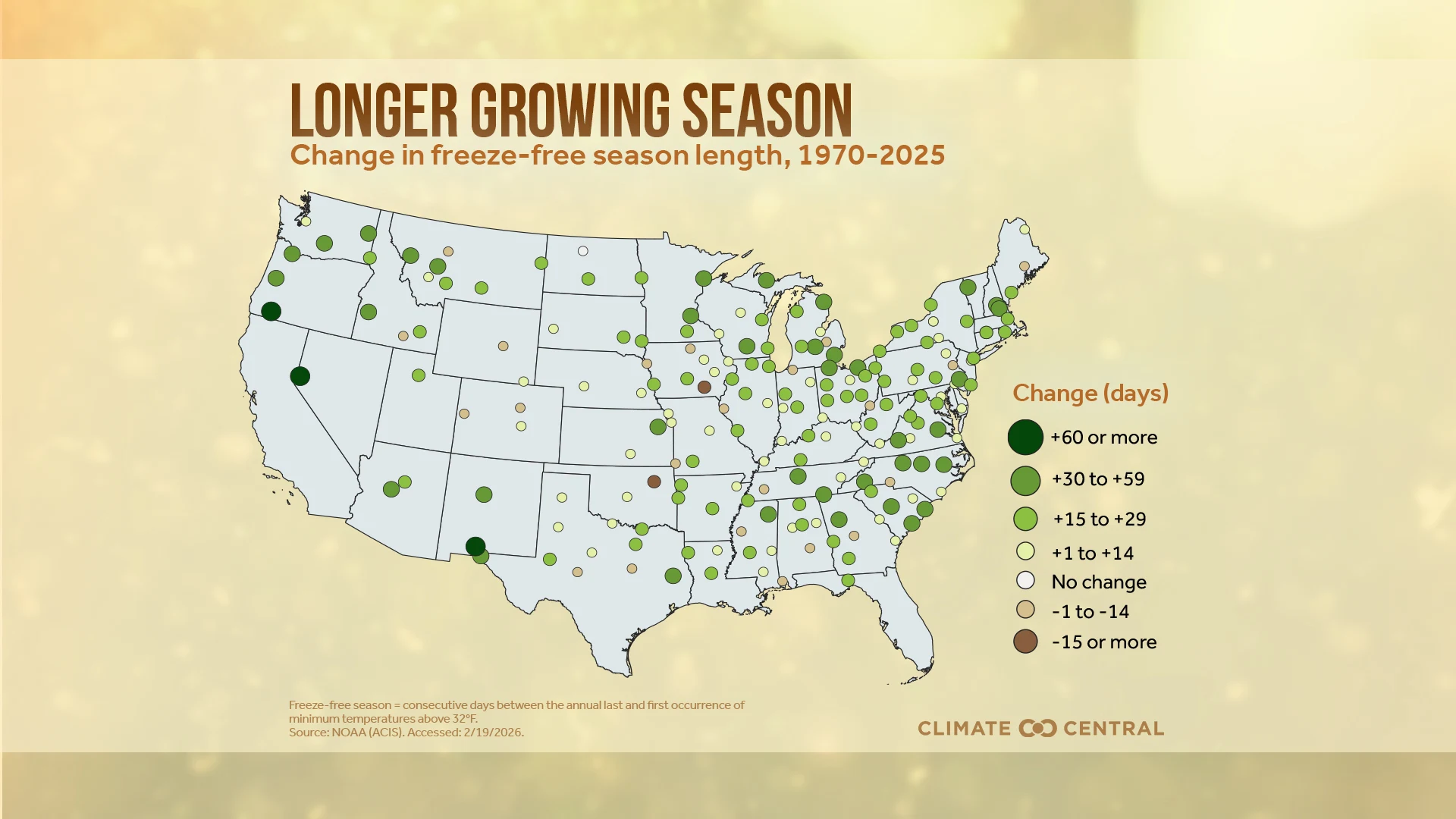
Warming climate, longer pollen season, worse allergies
The first spring leaves and flowers of 2026 are unfolding early along the Gulf Coast and across Oklahoma.
That’s bad news for people with seasonal allergies — about one-in-four adults and one-in-five children in the U.S.
A warmer, earlier spring means a longer growing season, giving plants more time to grow and release allergy-inducing pollen earlier in spring and later into fall.
Earlier springs, longer pollen seasons, and worse seasonal allergies are all linked to our warming climate.
Heat-trapping pollution (primarily from burning coal, oil, and methane gas) contributes to spring warming trends across the U.S.
A 2021 study found that human-caused warming was a primary driver of North American pollen seasons lengthening (by 20 days on average) from 1990 to 2018.
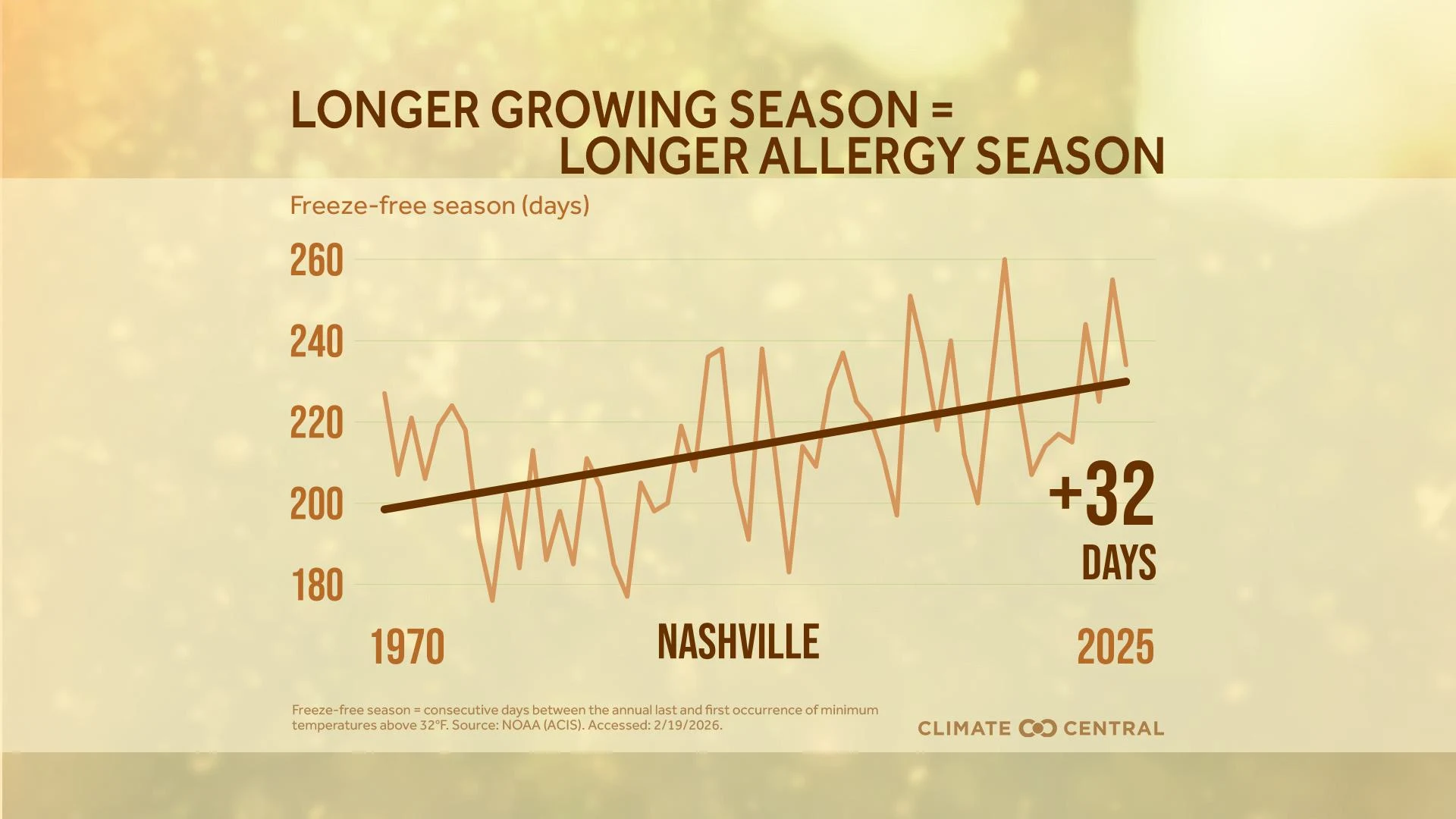
Longer freeze-free growing season in 173 U.S. cities
Climate Central assessed temperature trends in 198 U.S. cities to see how the length of the freeze-free growing season (the time between the annual last and first freeze) has changed from 1970 through 2025. See Methodology for details.
The freeze-free season lengthened in 87% (173) of the 198 cities analyzed — by 21 days on average since 1970.
The freeze-free growing season lengthened the most in: Reno, NV (100 more days); Medford, OR (68 more days); Las Cruces, NM (65 more days); Boise, ID (55 more days); and Tupelo, MS and Myrtle Beach, SC (both 51 more days).
Averaging city-level results across U.S. climate regions, all regions have seen their freeze-free growing season lengthen by at least 14 days on average since 1970 — led by the Northwest (+31 days) and Southwest (+22 days).
Region | Average change in freeze-free | Average freeze-free |
|---|---|---|
Northwest | +31 days | 187 days |
Southwest | +22 days | 190 days |
Southeast | +19 days | 136 days |
Northeast | +17 days | 185 days |
Upper Midwest | +17 days | 207 days |
Northern Rockies and Plains | +15 days | 229 days |
South | +14 days | 134 days |
Ohio Valley | +14 days | 177 days |
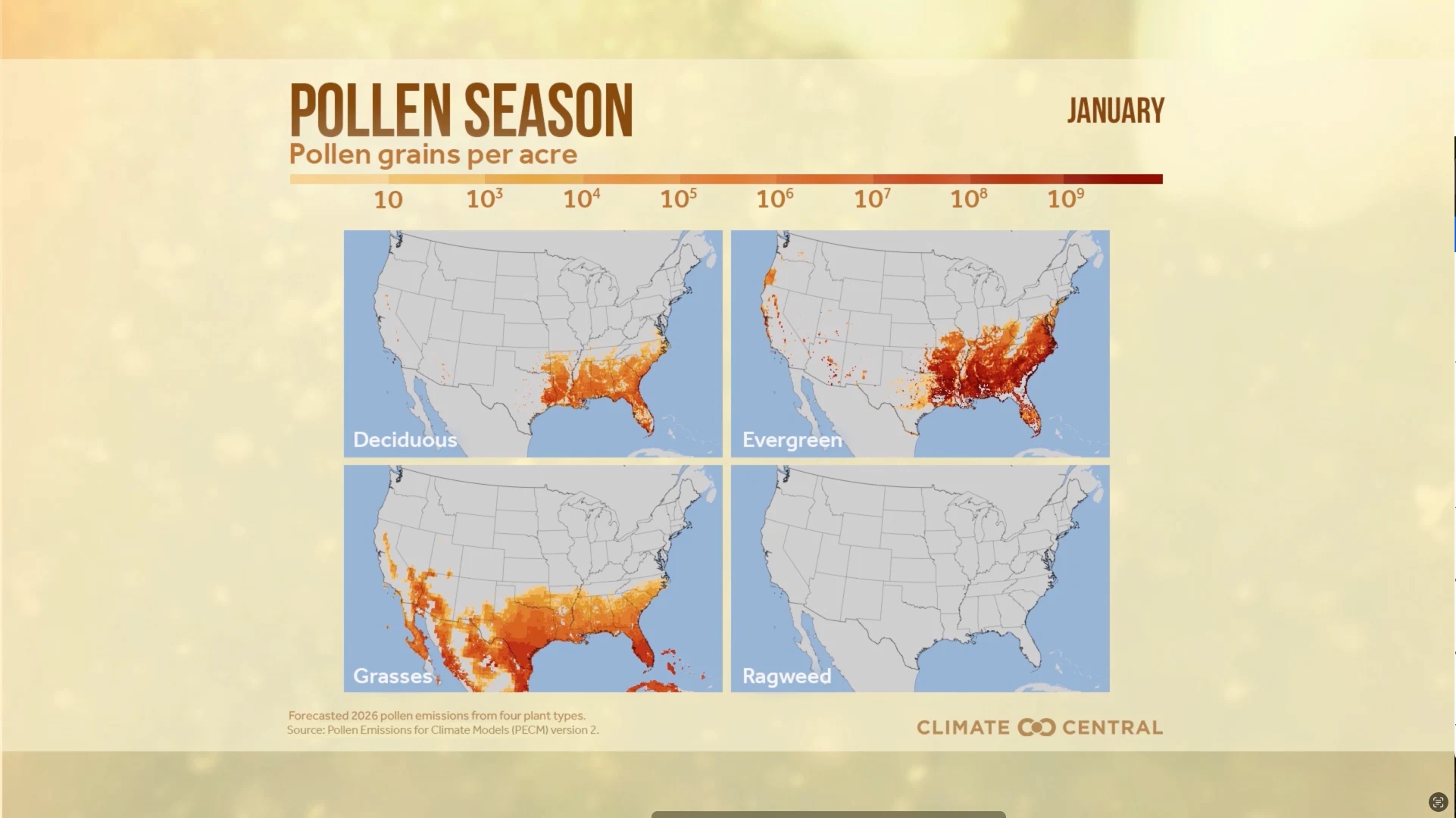
Pollen season forecast
People with seasonal allergies may be sensitive to pollen produced by different types of plants. Tree pollen generally dominates in the spring, grasses during summer, and ragweed in the fall.
Animations show when and where each of these pollen seasons are expected to peak across the U.S.
Pollen from deciduous plants typically peaks in the eastern U.S. in late April. Deciduous trees, shrubs, and vines lose their leaves each year. Oak trees are a common deciduous source of allergenic pollen.
Pollen from evergreen plants typically peaks in the eastern and western U.S. in May and persists through the summer in parts of the Northwest. Parts of the South and Southeast also typically experience an evergreen pollen peak during winter (for example, cedar fever in Texas and surrounding states). Evergreen trees and shrubs keep their needles each year. Junipers, cedars, and pines are common evergreen sources of allergy-inducing pollen.
Pollen from grasses is widespread and persists across the U.S. through much of the spring and summer.
Ragweed pollen typically peaks in September and October across much of the U.S. Ragweed, which is the main cause of fall allergies, is found in most U.S. states and thrives in both rural and urban areas. But warmer fall temperatures and a later first freeze can extend the growing season for ragweed.
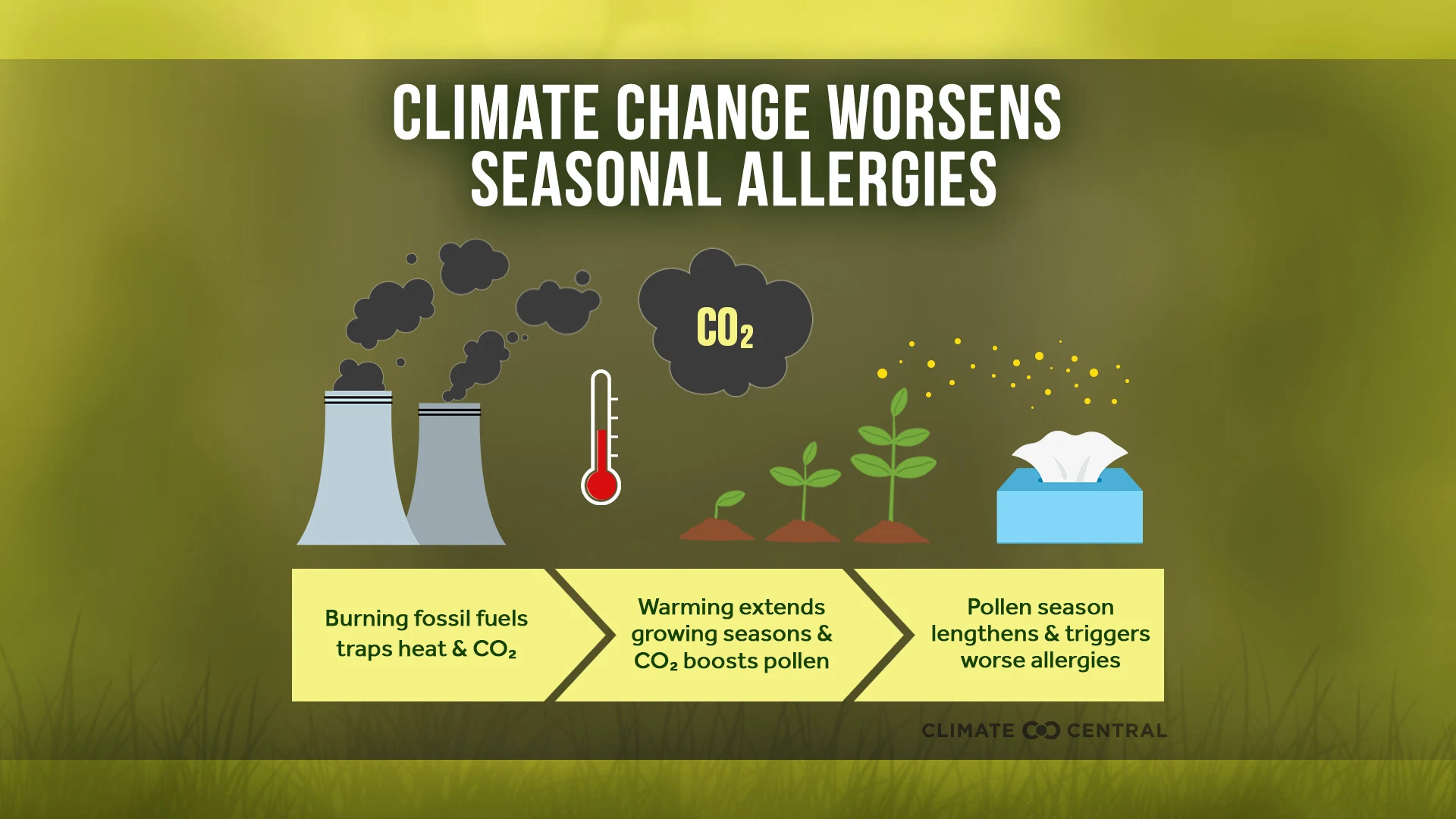
Heat-trapping pollution also boosts pollen production
Climate change makes pollen seasons not only longer, but also more intense due to heat-trapping pollution.
Higher levels of planet-warming CO2 in the air can boost pollen production in plants, particularly in grasses and ragweed.
With continued high rates of CO2 pollution, the U.S. could face up to a 200% increase in pollen production by the end of this century, according to a 2022 study.
Effects of a longer, worse pollen season on children
Longer and more intense pollen seasons can have serious consequences for people with respiratory illnesses like asthma — particularly for children.
Climate Central’s fact sheet, Climate Change & Children’s Health: Seasonal Allergies, details how the climate trends that are worsening allergy season affect children’s health and well-being.
Around 19% of children in the U.S. suffer from seasonal allergies, with symptoms that include sneezing, coughing, itchy or watery eyes, and runny noses.
Pollen is also a trigger for asthma, which affects 6.5% of children in the U.S. According to the Asthma and Allergy Foundation of America, allergic asthma is the most common type of asthma, and is most prevalent in early childhood.
These burdens are unequally shared. Black and Puerto Rican children are between two and three times more likely to have asthma than white children, and are therefore more at risk for allergic asthma.
Protecting children’s health
Parents and caregivers can protect children’s health, now and in the future, by minimizing the harmful effects of seasonal allergies in a changing climate. A few key ways:
Respond to symptoms, not the season. Children with allergies may experience symptoms earlier or later than usual as growing seasons expand and shift.
Minimize exposure. Check local air quality reports and allergen forecasts before heading outside. When pollen concentrations are high, consider limiting time outdoors for children with allergies or asthma.
Make the indoors safer and more comfortable. Close windows and doors to minimize aeroallergens inside. Use high-efficiency particulate air (HEPA) filters in living spaces and bedrooms to clean the air.
Commit to rapid, sustained cuts to carbon pollution from burning fossil fuels. Because higher levels of CO2 increase pollen production, reducing carbon pollution will bring more and sooner benefits to allergy sufferers of all ages.
LOCAL STORY ANGLES
Find local pollen and mold counts.
There are pollen and mold spore monitoring stations across the U.S. Local allergen counts and forecasts can be found through resources such as the National Allergy Bureau. State or tribal agencies for environmental protection or public health may also have relevant air quality reports. NOAA provides experimental tree, grass, and weed pollen forecast data for the U.S. as part of their RAP-Chem and MPAS-Aerosols Model.
Check your city’s status of spring.
See when spring will arrive at your location with First Leaf and First Bloom Indices from the USA National Phenology Network, which predict the first activity of plants in areas across the United States.
See where your city ranks.
The severity of the allergy season varies across the country. The Asthma and Allergy Foundation of America (AAFA) releases an annual report on the Allergy Capitals in the U.S., ranking cities based on pollen scores, over-the-counter medicine use, and the availability of board-certified allergists. Check out how your city ranked on AAFA’s 2025 Allergy Capitals Report; the 2026 list will be released in March 2026. The AAFA’s annual Asthma Capitals report also ranks U.S. cities where it’s most challenging to live with asthma.
CONTACT EXPERTS
To request an interview with a Climate Central expert about this analysis, please contact Tom Di Liberto, tdiliberto@climatecentral.org.
Jordan Schnell, Ph.D.
Research Scientist
Cooperative Institute for Research in Environmental Sciences, CU Boulder
NOAA Global Systems Laboratory
Relevant expertise: Air quality forecasting
Contact: jordan.schnell@noaa.gov
Allison L. Steiner, Ph.D.
Professor
Department of Climate and Space Sciences and Engineering
University of Michigan
Related expertise: Pollen counts, warming trends, growing season length
Contact: alsteine@umich.edu
FIND EXPERTS
Submit a request to SciLine from the American Association for the Advancement of Science or to the Climate Data Concierge from Columbia University. These free services rapidly connect journalists to relevant scientific experts.
Browse maps of climate experts and services at regional NOAA, USDA, and Department of the Interior offices.
Explore databases such as 500 Women Scientists, BIPOC Climate and Energy Justice PhDs, and Diverse Sources to find and amplify diverse expert voices.
Reach out to your State Climate Office or the nearest Land-Grant University to connect with scientists, educators, and extension staff in your local area.
METHODOLOGY
Daily minimum temperature data from 1970-2025 were obtained from the Applied Climate Information System, which is developed, maintained, and operated by NOAA’s Regional Climate Centers.
The length of the annual freeze-free season was determined based on the annual count of consecutive days with minimum temperatures above 32°F, i.e., the time between the last day with minimum temperatures of 32°F or lower (January 1 through June 30) and the first day with minimum temperatures of 32°F or lower (July 1 through December 31). Reported long-term (1970-2025) trends in freeze-free season length are based on linear regression.
Years with freeze-free seasons of less than two weeks (e.g., beginning June 30, ending July 3) were dropped from analysis. This condition affected several years in Bend, OR and Butte, MT.
Of 247 total stations assessed, 44 had an average growing season length of less than three months or a year-round lack of sustained freeze and were therefore excluded from this analysis. Summary statistics were reported for 198 of the 203 remaining stations due to data completeness issues for five stations: Bend, Ore; Hazard, Ky.; Jefferson City, Mo.; Twin Falls, Idaho; and Wheeling, W.Va.
Regional summaries for major U.S. Climate Regions exclude the West because this analysis includes only one station (Reno, NV) in that climate region. The eight other regions included between eight (Southwest) and 46 (Ohio Valley) stations.
Animations of 2026 pollen emission potentials (courtesy Jordan Schnell and Allison L. Steiner) were produced using the Pollen Emissions for Climate Models (PECM) version 2 (Wozinak et al., 2017; Zhang and Steiner, 2022), with inputs from the Global Historical Climatology Network (GHCN) version 2 and the Climate Anomaly Monitoring System (CAMS) (Fan and van den Dool, 2008), the Biogenic Emissions Landuse Database, Version 6 (BELD6; US EPA 2022), and the Community Land Model (Lawerence et al., 2011). The scientific results and conclusions, as well as any views or opinions expressed herein, are those of the author(s) and do not necessarily reflect those of OAR or the Department of Commerce.
Climate Matters © 2026 by Climate Central is licensed under CC BY 4.0
This license grants permission to use, distribute, and reproduce all text, graphics, and multimedia content published on this page in any medium, provided that Climate Central is credited per the CC BY 4.0 license.
Permission to use data and other materials published on this page is granted for non-commercial uses, commercial news purposes, and educational purposes as governed by Climate Central's Terms of Use.