Climate Shift Index Alert•August 14, 2026
Climate change is driving widespread marine heat waves across the globe
Aug. 14, 2026
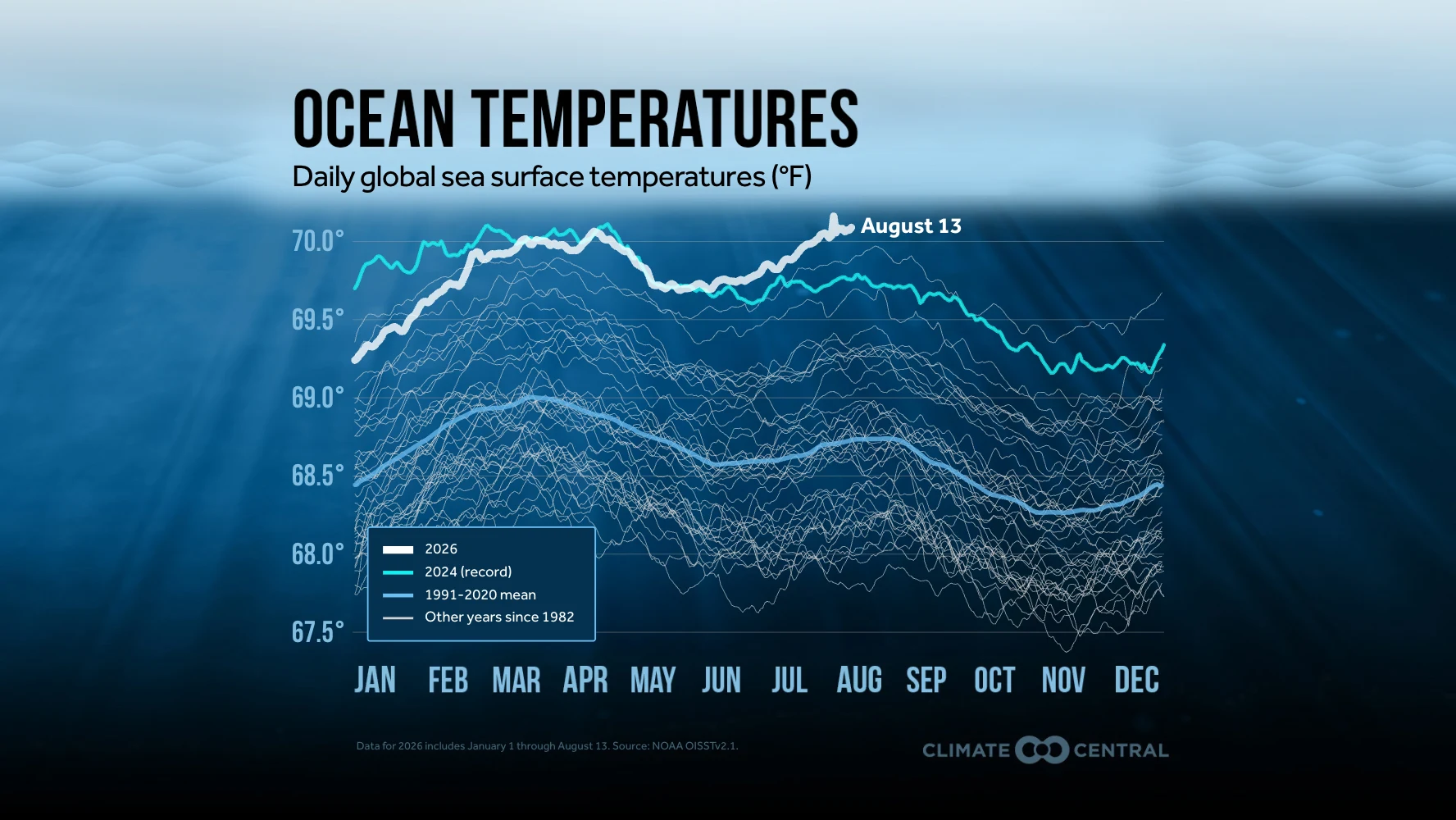
The Pacific is experiencing a historic marine heat wave — but it’s far from alone. Every major ocean basin across the globe is currently experiencing unusually warm sea surface temperatures driven by climate change.
Pacific Ocean
The Pacific continues to host the world’s largest marine heat wave, now covering 63 million square kilometers — about 17% of Earth's oceans — an area larger than North and South America combined. A strengthening El Niño is contributing to some of this warming in the eastern Pacific.
Climate change is driving the vast majority of this event: 86% of the marine heat wave area would not have occurred without human-caused warming.
Since January, approximately 94% of the Pacific has experienced marine heat wave conditions, with the most persistent hotspots in the North Pacific remaining in marine heat wave conditions for more than 180 consecutive days.
Mediterranean
The Mediterranean marine heat wave has intensified following repeated heat waves over Europe, with 82.9% of the basin now experiencing marine heat wave conditions. About 85% of the current marine heat wave area is due to human-caused warming.
Sea surface temperatures have climbed into the mid-80s to low 90s °F (29-32°C), while large areas of the western Mediterranean are running 9-10°F (5-6°C) above normal.
One hundred percent of the basin has experienced at least one day this year under marine heatwave conditions.
Atlantic Ocean
Marine heat waves are less widespread across the Atlantic than in the Pacific or Mediterranean, with 23.3% of the basin currently affected. However, tropical sea surface temperatures largely remain in the upper 70s to upper 80s°F (24-32°C). Broad areas of the Atlantic are 2-5°F (1-3°C ) above normal compared to the 1991-2020 climatology.
Climate change is driving nearly all of the existing marine heat wave area: 81% would not have occurred without human-caused warming.
Gulf of Mexico
Marine heat waves encompass the southern Gulf of Mexico and the northwestern region of the Caribbean, as in some of the other basins, with 39.7% of the region currently experiencing marine heat wave conditions. Of the area experiencing marine heat wave conditions, however, 98% is attributable to climate change.
Sea surface temperatures are broadly in the 80s°F (27°C), with the hottest waters approaching 90°F (32°C) around Florida.
Indian Ocean
Marine heat wave areas are more scattered in the Indian Ocean, affecting 33% of the basin. The most intense marine heat waves are concentrated in the southern Indian Ocean, and 95% of the current marine heat wave area would not have occurred without human-caused climate change.
For more information on the Climate Shift Index: Ocean, refer to the FAQs.