Report•March 3, 2025
Monthly Attribution Overview February 2025
An analysis of how climate change boosted United States temperatures in February 2025
Using Climate Central’s Climate Shift Index (CSI) tool to measure the impact of climate change on daily temperatures across the United States, as well as NOAA’s Applied Climate Information System (ACIS) to find daily temperature information, we have compiled a high-level overview of how climate change has affected temperature trends in February in cities across the United States.
1. High Level Findings
February temperature anomalies in the U.S. were split: 92 out of 191 analyzed cities were warmer than normal, while the remaining 99 were cooler than normal. The highest anomalies stretched across the Southeast and Southwest (Figure 1).
The average temperature anomaly across all cities was -0.3°F. Despite this, not one city in this analysis set a low temperature record for February. Phoenix, meanwhile, set the record for its hottest February on record.
Cities in the Northern Rockies and Plains stood out as some of the most anomalous, being on average 7.3°F cooler than normal.
Despite this cold, negative Climate Shift Index (CSI) values indicating that temperatures were less likely due to climate change did not stand out. More cities experienced days with positive than negative CSI.
This is likely because the CSI compares today’s temperatures to a 1900 temperature baseline, while temperature anomalies compare today’s temperature anomalies to 1991-2020. In other words, although this February was on average colder than normal when compared to the last 30 years, it was still warmer than it would have been without climate change for many cities.
The long-term warming trends during February (see our 2024 Winter Package) show the long-term temperature trends for each city in this analysis, where almost all cities have gotten warmer since 1970.
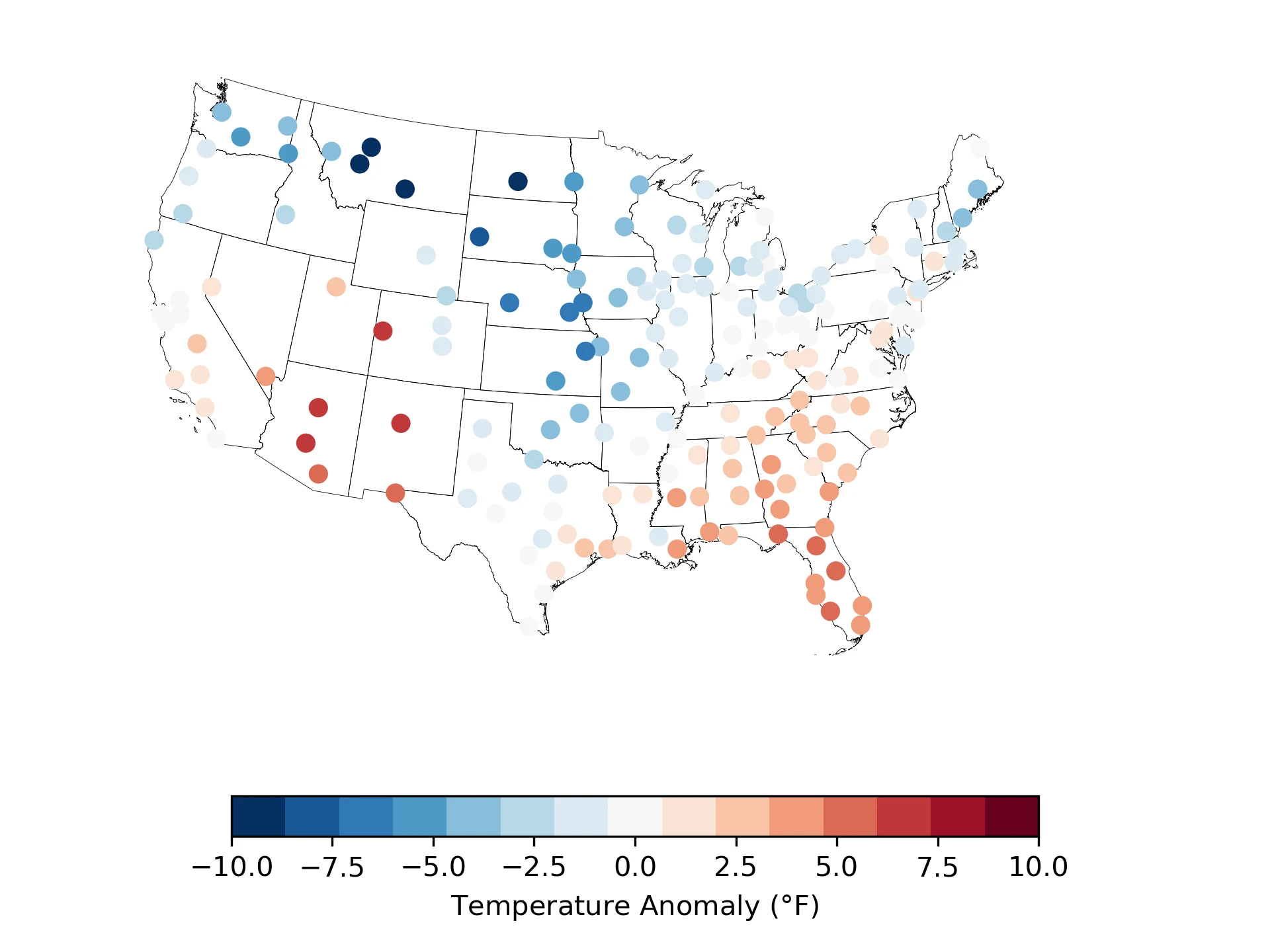
Figure 1. Threaded ACIS temperature anomalies for February 2025 relative to the 1991-2020 standard normal period. Analysis based on ACIS data.
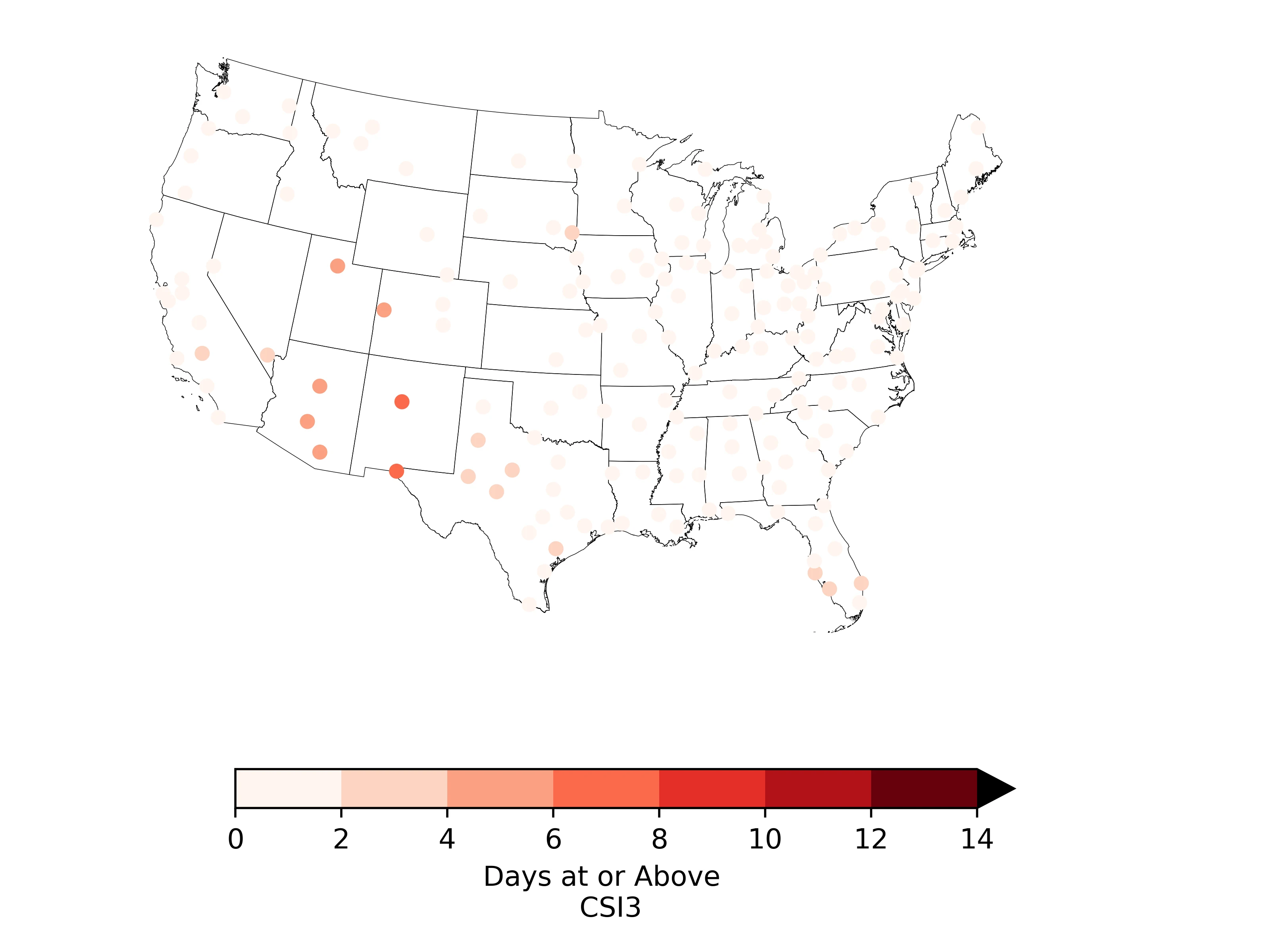
Figure 2. Days with a CSI of 3 or higher for February 2025 for ACIS threaded stations. Analysis based on ERA5 data (February 1-26) and GFS data (February 27-28).
2. Local Temperature Anomaly Analysis
The most unusually hot city in February was Grand Junction, Colorado, where it was 7.1°F hotter than normal.
15 cities had February temperature anomalies less than -5°F. These included cities in Montana, North Dakota, South Dakota, Nebraska, Kansas, Idaho, and Washington.
Nonetheless, no city set a record for the coldest January on record. This is likely because the "normal" temperature we use to calculate anomalies reflects the average temperature from 1991-2020, whereas temperature records have been kept for much longer. (For cities in this report, the mean year in which records start is 1892). So February temperatures were cold compared to 1991-2020, but less so compared to older records.
Nine cities had February temperature anomalies greater than 5°F. These included three in Arizona and three in Florida. It was the hottest February on record for Phoenix, Arizona
The average temperature anomaly across all cities was -0.3°F.
189 out of 191 ACIS stations analyzed had positive temperature trends for February, indicating that these cities have been warming on average since 1970.
Juneau, Alaska had an unusually cold February (with an average daily temperature anomaly of -2.9°F) but is the fastest-warming ACIS station for February, warming 9.6°F on average since 1970.
City | State | Temperature Anomaly (°F) | Average Temperature (°F) | Warming Since 1970 (°F) |
|---|---|---|---|---|
Grand Junction | CO | 7.12 | 42.38 | 4.2 |
Albuquerque | NM | 6.46 | 48.41 | 4.1 |
Flagstaff | AZ | 6.17 | 38.84 | 1.7 |
Phoenix | AZ | 6.06 | 65.96 | 3.6 |
Tucson | AZ | 5.54 | 61.73 | 3.2 |
Tallahassee | FL | 5.42 | 61.07 | 2.2 |
El Paso | TX | 5.37 | 56.86 | 3.4 |
Gainesville | FL | 5.04 | 63.43 | -1.7 |
Orlando | FL | 5.01 | 68.66 | 0.9 |
Fort Myers | FL | 4.80 | 72.11 | 1.2 |
Table 1. Top 10 ACIS stations with the highest February 2025 temperature anomaly.
City | State | Warming Since 1970 (°F) | Temperature Anomaly (°F) | Average Temperature (°F) |
|---|---|---|---|---|
Juneau | AK | 9.6 | -2.90 | 27.19 |
Bismarck | ND | 9.3 | -10.27 | 7.23 |
Minneapolis | MN | 9.1 | -3.50 | 17.11 |
Green Bay | WI | 8.9 | -1.82 | 19.29 |
Milwaukee | WI | 8.9 | -3.29 | 23.80 |
Billings | MT | 8.8 | -14.09 | 15.36 |
Duluth | MN | 8.8 | -3.76 | 11.64 |
Great Falls | MT | 8.8 | -14.95 | 11.30 |
Fargo | ND | 8.6 | -5.12 | 8.29 |
Waterloo | IA | 8.6 | -2.78 | 21.12 |
Table 2. Top 10 ACIS stations with the fastest warming February since 1970.
3. Local Climate Shift Index Analysis
San Juan, Puerto Rico had 11 days at CSI 5, indicating that temperatures on those days were made at least 5 times more likely because of climate change.
Although temperatures were colder than normal across much of the country, the average number of days experienced by cities with a CSI at or above 3 was higher than the average number of days experienced by cities with a CSI at or below -3.
(A CSI level of 3 indicates that temperatures were made at least 3x more likely to occur, while a CSI of -3 indicates that temps were made at least 3x less likely to occur). This is likely because although temperatures across the country were colder compared to today’s climate, they were not necessarily colder in comparison to a pre-global warming climate.
City | State | Days at CSI = 3 or higher | Days at CSI = 5 | Average Temperature (°F) | Temperature Anomaly (°F) |
|---|---|---|---|---|---|
San Juan | PR | 11 | 11 | 79.82 | 2.02 |
El Paso | TX | 7 | 0 | 56.86 | 5.37 |
Albuquerque | NM | 6 | 1 | 48.41 | 6.46 |
Grand Junction | CO | 5 | 1 | 42.38 | 7.12 |
Salt Lake City | UT | 5 | 2 | 39.70 | 3.06 |
Flagstaff | AZ | 5 | 2 | 38.84 | 6.17 |
Honolulu | HI | 4 | 3 | 75.07 | 1.27 |
Phoenix | AZ | 4 | 2 | 65.96 | 6.06 |
Tucson | AZ | 4 | 1 | 61.73 | 5.54 |
West Palm Beach | FL | 3 | 1 | 72.77 | 4.37 |
Fort Myers | FL | 2 | 1 | 72.11 | 4.80 |
Table 3. Top 10 ACIS stations with the highest number of days at or above a CSI of 3 during February 2025.
METHODS
Calculating the Climate Shift Index
All Climate Shift Index (CSI) levels reported in this brief are based on daily average temperatures and ERA5 data from February 1 to February 28, 2025, and GFS data from February 29 to February 30, 2025. See the frequently asked questions for details on computing the Climate Shift Index, including a summary of the multi-model approach described in Gilford et al. (2022).
City Analysis
We analyzed 191 Applied Climate Information System (ACIS) stations associated with U.S. cities. For each city, we found the CSI time series from the nearest 0.25° grid cell. We calculated the number of days at CSI levels 2, 3, 4, and 5. We used ACIS data to find the average monthly temperatures, temperature anomalies, and precipitation information, and to derive average monthly warming trends for each city.