Climate Central’s Monthly Briefing Highlights from February 2026
What do experts say?
Jen Brady, senior data analyst and research manager at Climate Central, said:
“Near record-low winter snowfall across the western United States has serious consequences for the region. Winter snow supplies water for the remainder of the year. The impact of this winter's snow drought will continue to be felt for months to come.”
Dr. Zachary Labe, climate scientist at Climate Central, said:
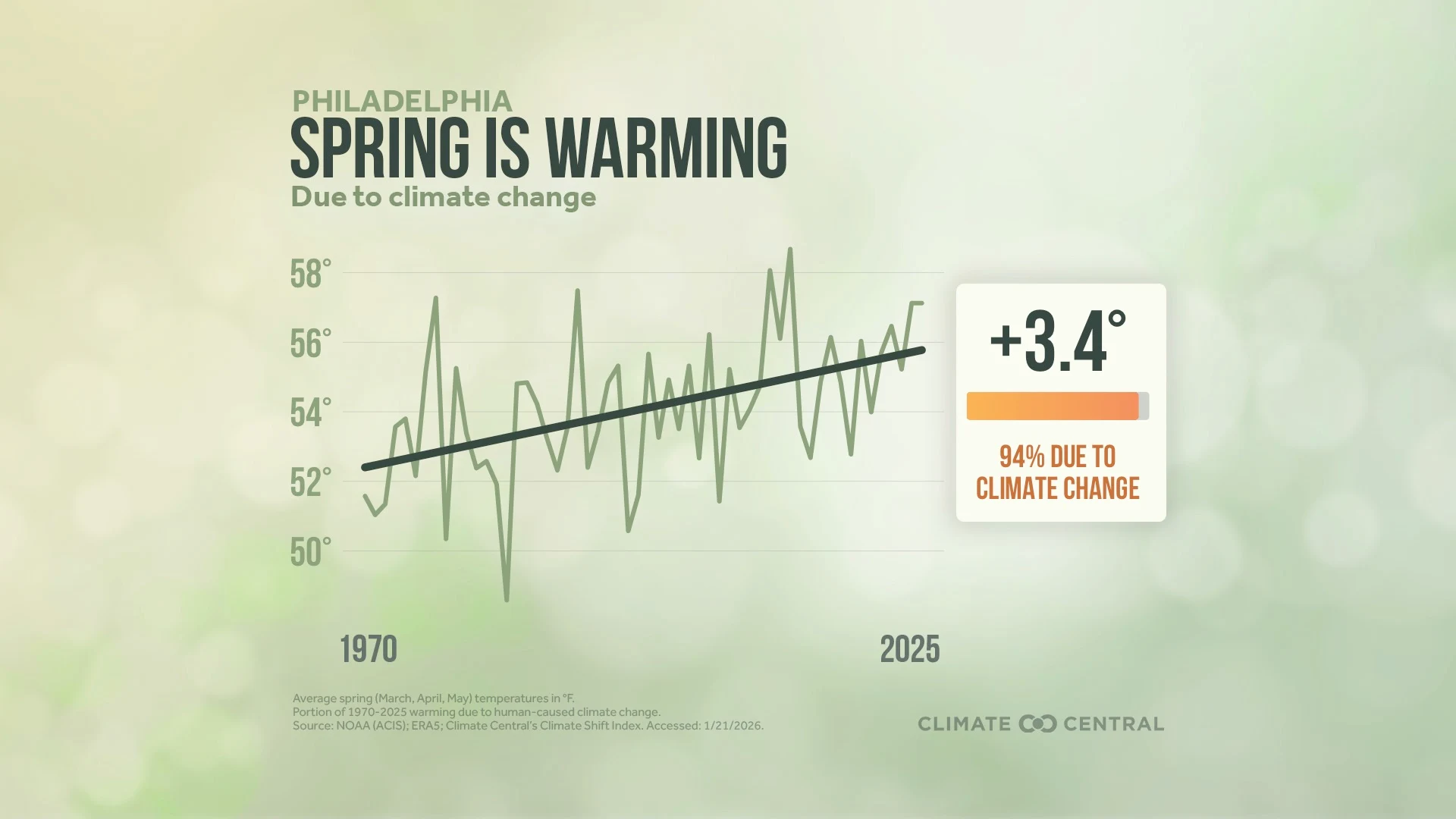
“Across the United States, the fingerprints of climate change are unmistakable in warming spring temperatures. These shifts are quickly reshaping everyday life, from longer allergy seasons to changing growing zones and earlier mountain snowmelt.”
Global Climate
February 2026 Highlights: Temperature
February 2026 was the fifth-warmest on record globally (for land and ocean temperatures combined). Records have been kept since at least 1850.
Global average temperatures over land areas were the sixth-warmest on record in February.
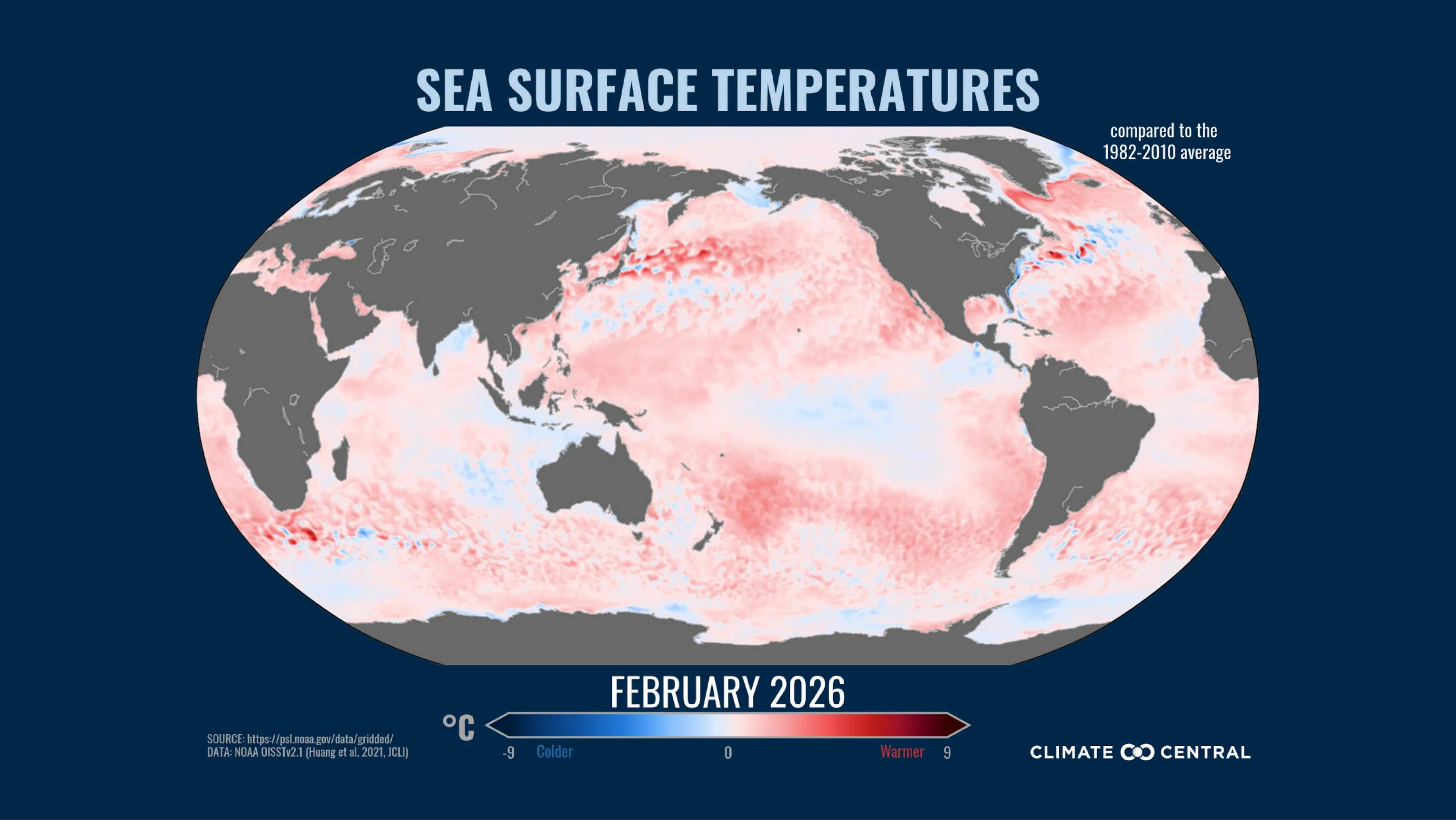
Global average temperatures over ocean areas were the second-warmest on record in February.
Both hemispheres experienced one of their warmest Februaries on record, ranking fifth-warmest in the Northern Hemisphere and third-warmest in the Southern Hemisphere.
The last time February’s global mean temperature (land and ocean combined) was cooler-than-normal (compared to the 20th century average) was in 1979.
February 2026 Highlights: Other Climate Indicators
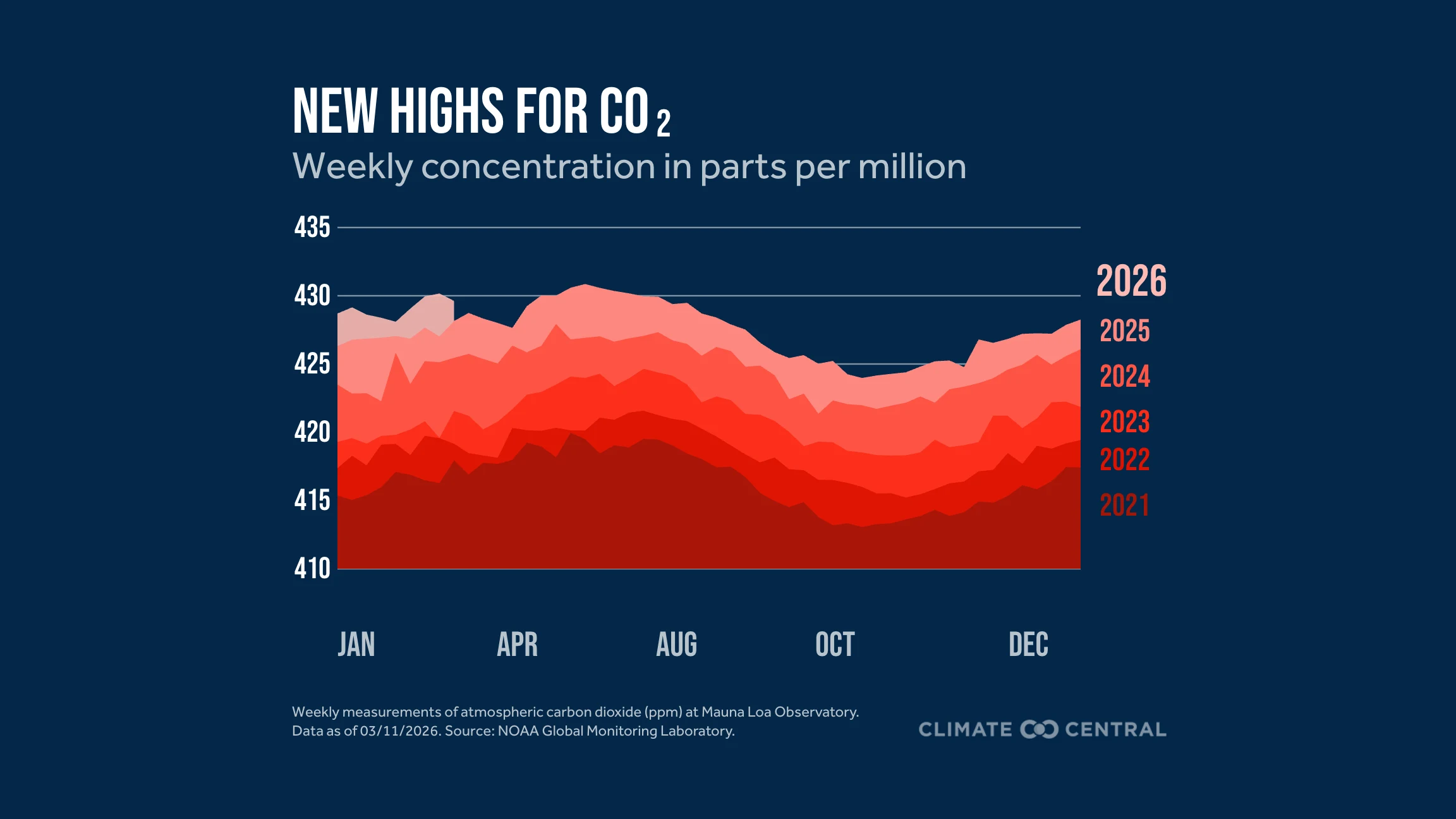
The average February carbon dioxide level measured at Mauna Loa, Hawaii was 429.4 ppm.
February snow cover across the Northern Hemisphere was the third-lowest on record. Records have been kept for 60 years.
Arctic sea-ice extent, which usually peaks in coverage around the beginning of March, ranked as the third lowest on record for February.
Antarctic sea-ice extent ranked as the 21st-lowest (tie) on record for February, which is close to the annual minimum extent around the end of austral summer.
U.S. Climate
Winter 2025-2026 In Review:
Temperature:
Winter 2025-2026 (December, January, February) ranked as the second-warmest winter on record for the contiguous United States. Records have been kept for 132 years.
The winter was the warmest on record for average maximum (daytime) temperatures and sixth-warmest (tie) for average minimum (nighttime) temperatures.
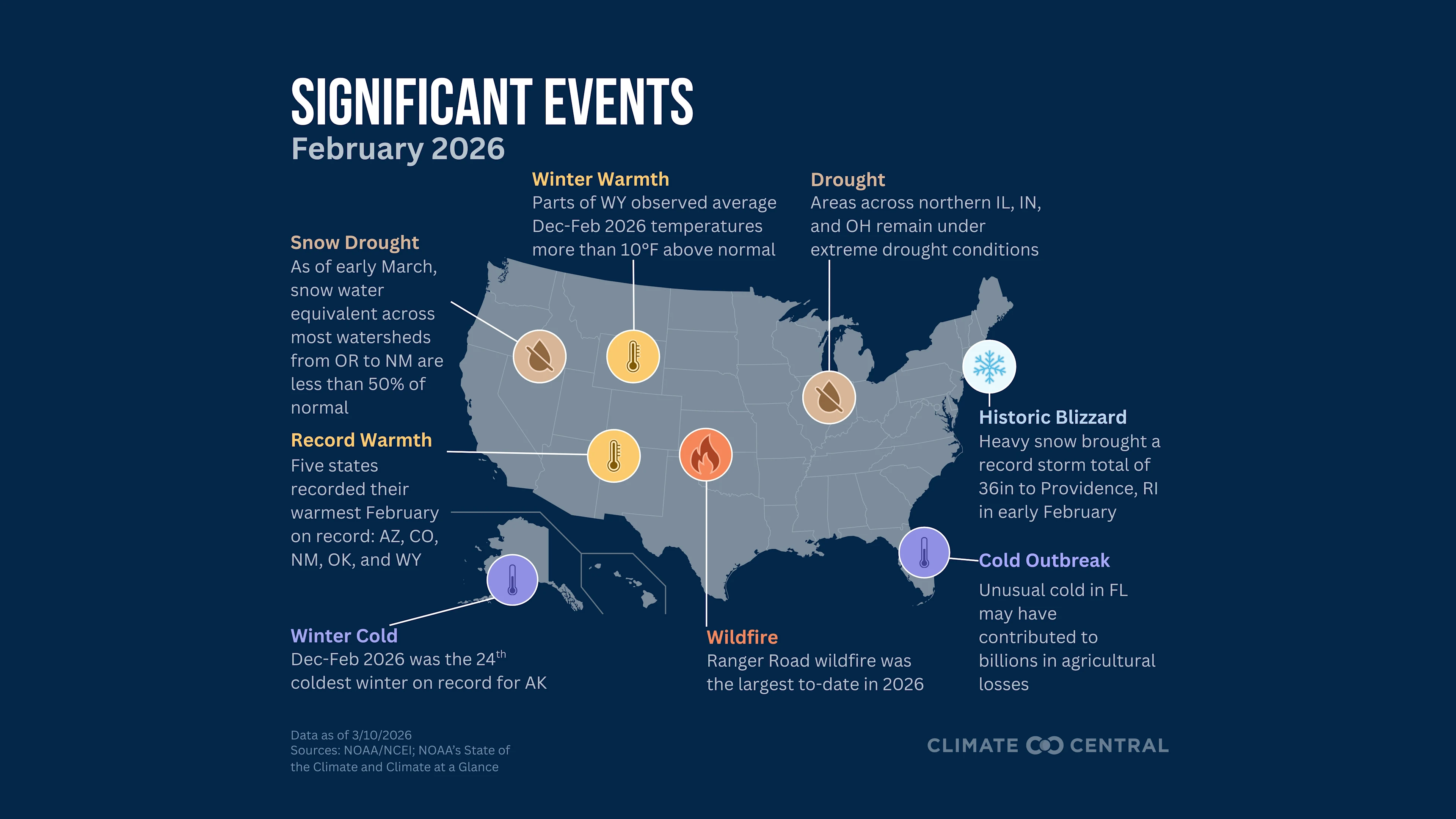
Nine states recorded their warmest winter on record: Arizona, Colorado, Nevada, New Mexico, Oklahoma, Oregon, Texas, Utah, and Wyoming.
In terms of ranking, the most unusually cold state in the Lower 48 was Delaware with their 28th-coldest winter on record.
In Alaska, winter 2025-2026 ranked as the 24th-coldest on record.
Precipitation:
The winter ranked as the fifth-driest on record for the contiguous U.S., which was the driest in 45 years.
Arkansas and Missouri saw their second-driest winter on record.
Much of the central U.S. received only 25-50% of normal winter precipitation, with parts of eastern Nebraska and Texas dropping to less than 10% of normal.
February 2026 Highlights: Temperature
February 2026 ranked as the fourth-warmest February on record for the contiguous U.S.
February was the second-warmest for average maximum temperatures and eighth-warmest for average minimum temperatures.
Five states recorded their warmest February on record: Arizona, Colorado, New Mexico, Oklahoma, and Wyoming.
The average temperature over the last six months was the warmest on record for the contiguous U.S. (September 2025 to February 2026).
February 2026 Highlights: Precipitation
February 2026 ranked as the fifth-driest February on record for the contiguous U.S.
Mississippi had its driest February on record and Maine its second-driest, with 11 states overall ranking among their 10 driest Februarys on record.
Snow water equivalent remains below 50% of the 1991-2020 normal in most watershed basins from Oregon to New Mexico.
As of Mar 5, 2026, at least 77% of the contiguous U.S. is experiencing abnormally dry or drought conditions.
Climate Moment of the Month with Zack
By Dr. Zachary Labe, climate scientist at Climate Central
Large parts of the western U.S. experienced their warmest winter on record, associated with high pressure and a persistent upper-level ridge. This type of weather pattern typically brings warmer and drier-than-normal conditions, limiting winter storms and reducing snowfall across the region’s mountains. As a result, one of the most significant climate stories of the past few months has been a historic snow drought across much of the West. This raises concerns because mountain snowpack serves as a critical source of water for communities, agriculture, energy, and ecosystems throughout the region. For example, 95% of Utah’s water supply comes from their snowpack.
By early January 2026, snow drought conditions were already well underway across the western United States. Satellite observations show that the snow-covered area was only 34% of normal in January, the lowest on record for the month. Unusually warm conditions continued into February, producing another record low snow-cover across the West. Snow cover duration was 63% below normal by the end of February, the lowest in the 26-year satellite record. The largest departures from normal occurred across much of Wyoming and in the higher elevations of Colorado, Idaho, Montana, Oregon, and Utah, where some locations experienced up to 60 fewer snow-covered days.
Another important metric for understanding water availability across the West is snow water equivalent (SWE) at the peak of the water season, which typically occurs in early April. Snow water equivalent refers to the amount of liquid water stored in the snowpack and is monitored through a network of automated snow telemetry stations (SNOwpack TELemetry Network; SNOTEL) operated by the Natural Resources Conservation Service. These stations measure hourly conditions including snow depth, snow water equivalent, precipitation, air temperature, soil moisture, streamflow, reservoir conditions, and soil temperature. More than 800 SNOTEL stations operate across the western U.S., primarily in remote, high-elevation areas where mountain snowpack accumulates.
Given the current outlook (see Climate Outlook) for unusually warm and dry conditions over the Southwest, several indicators point to worsening drought and declining water stored in the snowpack. As of early March, average snow water equivalent is a record low for this time of year in Colorado and close to the daily record minimum in Arizona, New Mexico, Oregon and Utah. Across most of these individual watersheds, snow water equivalent is currently below 50% of the 1991-2020 median, and no basins are observing above-average snow water equivalent. Conditions are also particularly concerning in the Colorado River Basin, a critical water source for the Southwest, where snow water equivalent was near a record low at most SNOTEL stations. Snow melt has even been reported as high as 10,000 feet here.
As discussed in our briefing from last month, this snow drought has been primarily driven by unseasonably warm temperatures, with drier-than-normal precipitation playing a secondary role. Additional analysis of western water conditions will be included in an upcoming Climate Matters.
Weather Extremes
Notable temperature event: Dozens of weather stations across the western half of the U.S set new records for their warmest winter on record this year (December, January, February). Particularly notable was the widespread number of stations reporting their highest average winter daytime maximum temperatures, spanning from Oregon to Arkansas.
In Phoenix, Arizona, the average winter temperature reached 64°F, surpassing the previous record set just last year (2025). By late February and into early March, daytime high temperatures already climbed into the lower 90s across the Phoenix metro area, setting additional daily high records.
Notable precipitation event: Salt Lake City, Utah set a record for its warmest winter and recorded its lowest winter snowfall on record, with just 2.5 inches in total. Of that, 2.4 inches of snow fell in February (ranking as the 23rd-lowest February). January recorded only a trace of snow, which was tied for the lowest January total on record. The snowfall deficit was driven primarily by unusually warm temperatures, not just a lack of precipitation. Total winter precipitation ranked only as the 13th-lowest on record (tie), indicating that much of what fell came as rain rather than snow.
Climate Change Influence
Winter 2025-2026:
Every day from December 2025 to February 2026, more than one in six people on the planet experienced temperatures with a strong climate change influence. This is according to Climate Central’s analysis using the Climate Shift Index (CSI).
In 54 U.S. cities, mostly in the western U.S., the average resident experienced at least two weeks’ worth of winter temperatures made at least two times more likely by climate change (CSI 2), with the state of Arizona having the highest number of days (more than 40 days).
More than two-thirds of winter days in Puerto Rico had a strong climate change influence (CSI 2 or higher).
Learn more about the influence of climate change on winter’s temperatures in Climate Central’s new report.
Winters are shortening as spring arrives earlier in the year. A new analysis from Climate Central finds that human-driven climate change is the primary cause of spring warming in 98% of the 241 U.S. cities examined between 1970 and 2025.
February 2026:
Despite recent cold outbreaks and winter storms, February is warming over the long term across the U.S. Of 192 locations analyzed, about 90% (173) have experienced rising temperatures since 1970. The fastest warming trend in February is found across the Southeast U.S. and northern Alaska.
One of the most widespread climate change-fueled heat events in February occurred across most of western North America during the first week of the month, with unseasonable temperatures (up to 25°F above normal) made at least three times more likely for about 44 million people.
Another strong climate change signal emerged in late February, according to analysis using the Climate Shift Index. The last five days of the month saw temperatures made at least five times more likely due to climate change (CSI 5) across large parts of Arizona, Colorado, and New Mexico.
Twelve out of 192 cities analyzed across the contiguous U.S. in February 2026 experienced at least one week’s worth of days with temperatures made at least twice as likely by human-caused climate change (CSI 2).
Cities in the Southwest saw the most February days with temperatures made at least twice as likely by human-caused climate change (CSI 2), led by Tucson, Arizona, with 20 days.
Arizona, California, Colorado, and Utah each had several cities log at least two weeks’ worth of CSI level 2 or higher days in February.
Salt Lake City(6 days) saw the highest number of CSI level 5 days in February, indicating exceptional warmth driven by climate change.
Learn more about how climate change altered February’s temperatures in our latest monthly attribution overview. Climate Central also has a new explainer on attribution science and how it works.
Climate Outlook
Global temperature: Forecasts from the North American Multi-Model Ensemble (NMME) suggest global temperatures will remain relatively steady over the next few months before increasing again by late boreal summer. The multi-model mean projects global temperatures rising well above 1.5°C above the 1850-1900 preindustrial baseline by the end of 2026, likely influenced by seasonal forecasts indicating the development of El Niño conditions in the tropical Pacific. Although uncertainty remains at this lead time, the latest NMME outlook indicates at least a 70% probability of above-normal temperatures across most of the U.S. for the upcoming summer (June, July, August). NMME forecasts also show well above-average sea surface temperatures across much of the North Pacific by late 2026, which may further contribute to the projected global warmth and regional weather patterns over North America.
El Niño-Southern Oscillation (ENSO): All regularly updated seasonal forecast models from the NMME suggest at least weak El Niño conditions could develop by the end of the year. However, ENSO forecasts remain highly uncertain at this lead time due to the “spring predictability barrier,” a period when models historically have greater difficulty predicting the following winter’s ENSO state. In addition, long-term warming has increased average sea surface temperatures across the Tropics. As introduced in last month’s briefing report, a newer metric called the Relative Oceanic Niño Index (RONI) helps account for this background warming when assessing ENSO variability. Depending on the metric used, traditional indices may therefore overstate the apparent strength of El Niño conditions. Given the strong relationship between El Niño and global temperature variability, we will continue closely monitoring the latest forecasts in the coming months.
U.S. Drought: As of early-March, more than 54% of the contiguous U.S. is in at least moderate drought conditions, and about 6% of that region is seeing extreme or exceptional drought. Precipitation during the past 30 days has been well below normal across most states, with the south-central U.S. and Southeast seeing the largest swaths of extreme drought persisting through the winter. U.S. Geological Survey stream gauges are reporting widespread unusually low flows (below the 10th percentile) across the Southeast up through the Mid-Atlantic regions. One of the only areas with higher-than-normal stream flows in the contiguous U.S. is currently across parts of southern New England, which is mostly in response to recent snow and ice melt. The longer-term seasonal drought outlook highlights that some drought improvement is likely across the central U.S. and Mississippi River Valley, while conditions are forecast to worsen in Arizona, Colorado, New Mexico, eastern Kansas, and eastern Texas.
U.S. Temperature: A strong East-West temperature divide is forecast across the contiguous U.S. through at least the end of March, with warmer-than-normal conditions favored west of the Central Plains and cooler-than-normal temperatures possible to the east. Alaska is favored to be colder than normal, while Hawaii is expected to be warmer than normal.
U.S. Precipitation: A strong forecast signal over the next two weeks (into late March) points to wetter-than-normal conditions in Hawaii and drier-than-normal weather across the Southwest. These warmer and drier conditions could further worsen the region’s snow drought, particularly in lower-elevation mountain areas where snowpack is more sensitive to temperature. This could have significant implications for regional water supplies.
U.S. Energy: The Northwest and West climate regions recorded their lowest number of heating degree days on record for winter 2025-2026. Heating degree days measure how much temperatures fall below a baseline needed for heating, so fewer heating degree days indicate an unusually warm winter with reduced heating demand. The Upper Midwest, however, recorded the highest count of heating degree days relative to normal, ranking as its 38th coldest winter. This indicates the region experienced more cold temperature-driven heating demand. February itself was also the warmest on record for the Northwest climate region in terms of lowest heating degree days. Unusually warm temperatures that are forecast across the western U.S. will continue to lower the energy demand for heating through the end of March.
Contact Experts
Our team of scientists can help interpret these findings and answer your questions. Contact us here.
To request a media interview with a Climate Central scientist about this briefing, please contact Abbie Veitch, aveitch@climatecentral.org.
Methodology
Global and U.S. climate statistics are provided by NOAA’s National Centers for Environmental Information (NCEI), including through the Climate at a Glance tool. All climate regions and divisions follow the standard definitions established by NOAA NCEI. Data is also provided by the Applied Climate Information System (ACIS) using ThreadEx, which is developed, maintained, and operated by NOAA’s Regional Climate Centers. We recognize that climate ranking statistics can vary slightly between datasets, and there are higher uncertainties in temperature data prior to 1900.
Drought information is available through the U.S. Drought Monitor, and western U.S. snowpack data is provided by the USDA National Water and Climate Center. Weekly and seasonal temperature and precipitation outlooks are from the NOAA Climate Prediction Center. Sea ice data statistics are from the National Snow and Ice Data Center’s Sea Ice Index v4. Carbon dioxide concentration data is from the NOAA Global Monitoring Laboratory.
Additional Graphics
Additional Resources
Relevant Climate Matters: