Climate Matters
Warmer Growing Season, Longer Allergy Season
Warming trends in 173 U.S. cities are giving plants more time to grow and release pollen. That means longer allergy seasons for millions in the U.S. with seasonal allergies.
Climate Matters•March 11, 2026•Reuse this content
As spring warms and thaws earlier, the temperature cues that signal spring’s arrival to plants and animals are also shifting earlier.
Data from the USA National Phenology Network shows that the first leaves of spring now emerge earlier across most of the U.S., compared to 1981.
The first spring leaves now emerge earlier in 88% (212) of 242 major U.S. cities — six days earlier on average.
Warmer springs and earlier leaf emergence can worsen seasonal allergies, disrupt ecological events like migration, and potentially put valuable crops at risk of damage.
This Climate Matters analysis is based on open-access data from the USA National Phenology Network. See Methodology for details.
The start of spring is marked not only by the calendar but also by various cues in nature.
As winter gets shorter and spring warms up and thaws earlier, the temperature-based cues that signal spring’s arrival to plants and animals are also shifting earlier.
Leaf-out — the time that leaves emerge on early spring plants — is a common marker that scientists use to track the ecological start of spring and a key indicator of how climate change is affecting allergies, ecosystems, and crops.
The USA National Phenology Network’s first leaf index models when the first spring leaves emerge each year across the U.S. as heat accumulates and sends growth signals to plants.
The first leaf index is based on leaf-out in honeysuckles and lilacs and reflects the earliest biological activity for early-spring plants and insects.
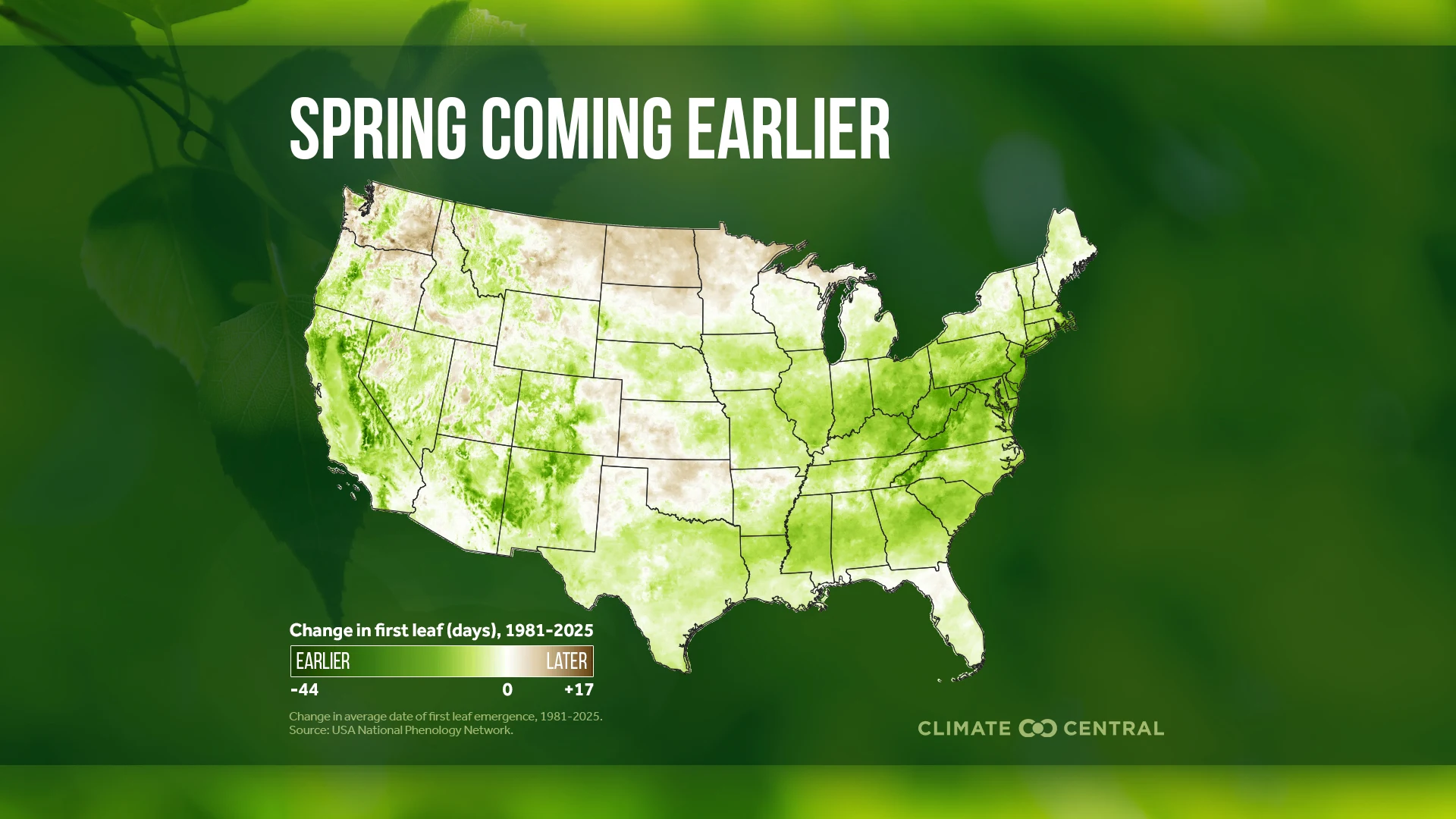
Data from the USA National Phenology Network indicates that warming trends are driving an earlier leaf-out for much of the U.S.
From 1981 to 2025, the first leaves of spring have trended toward an earlier arrival across most of the contiguous U.S. The main exception is the Northern Rockies and Plains, where spring temperatures have either cooled or warmed relatively slowly since 1970.
These broad patterns are also reflected in data for 242 major U.S. cities. The first leaves of spring now arrive earlier in 88% (212) of these cities — six days earlier on average, compared to the early 1980s.
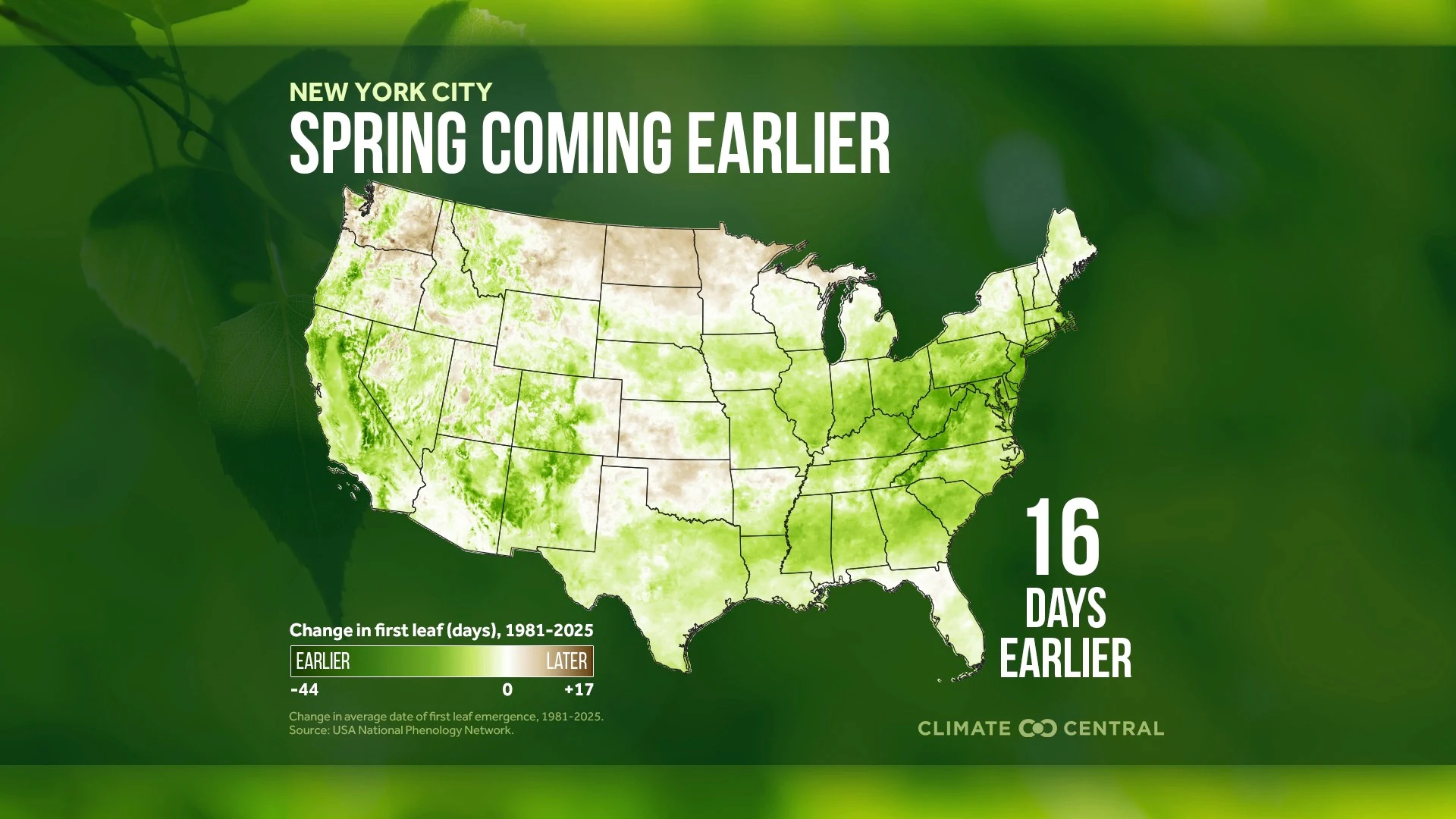
On average, cities across the Northeast, Ohio Valley, and Southeast have seen leaf-out shift earliest since 1981.
Seven of the top 10 U.S. cities now see the first leaves of spring emerge at least two weeks earlier than in the early 1980s.
Table 1. Top 10 U.S. cities with the largest shift in leaf-out.
City | Shift in first leaf date, 1981-2025 (days) |
|---|---|
New York City | 16 days earlier |
Newark, NJ | 16 days earlier |
Washington, D.C. | 15 days earlier |
Bluefield, WV | 15 days earlier |
Wheeling, WV | 14 days earlier |
Huntington, WV | 14 days earlier |
Clarksburg, WV | 14 days earlier |
Atlantic CIty, NJ | 13 days earlier |
Boston, MA | 13 days earlier |
Hagerstown, MD | 13 days earlier |
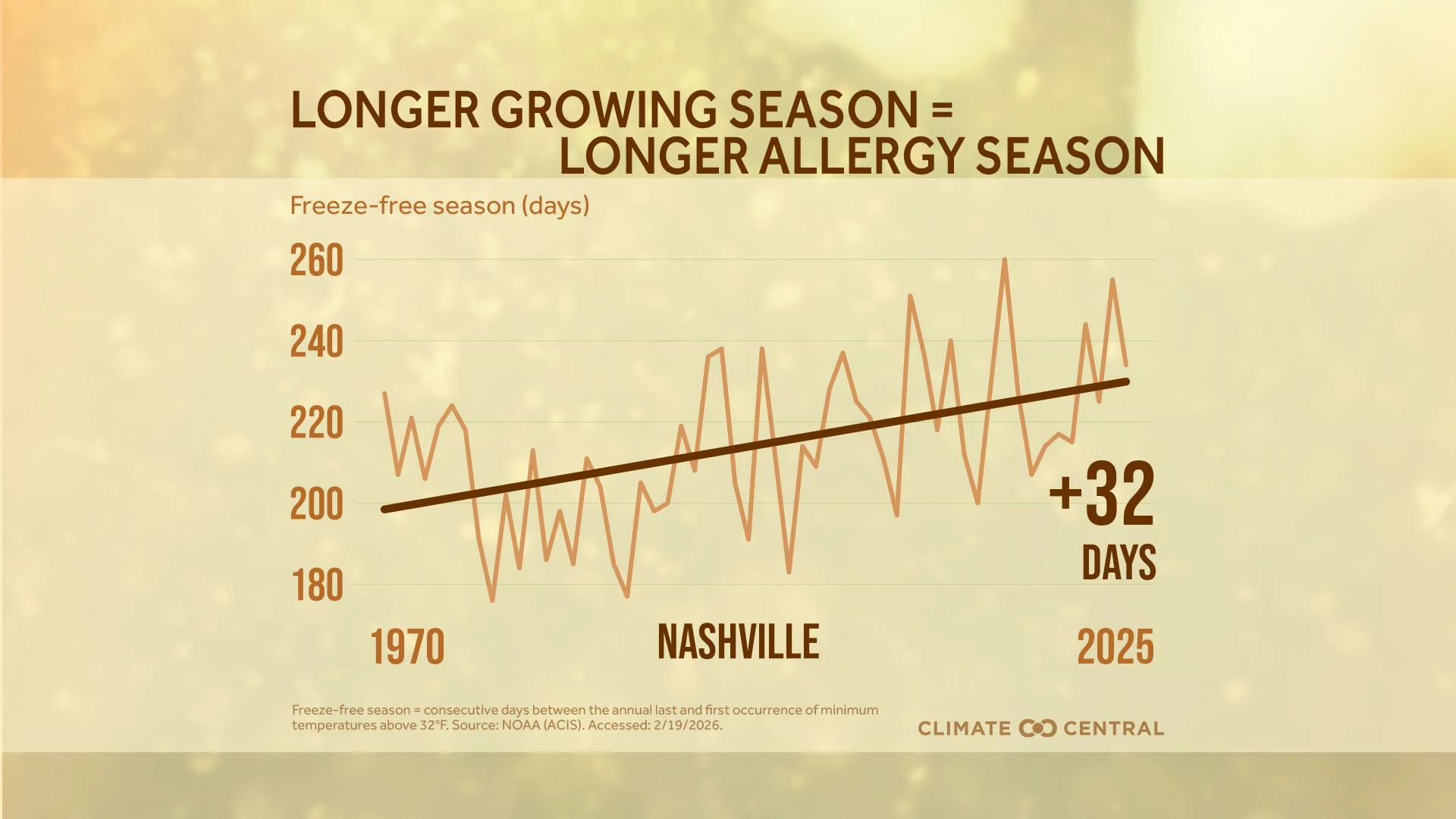
Affect human health: Warmer springs and earlier leaf-out gives plants more time to grow and release allergy-inducing pollen. From 1970 to 2025, the freeze-free growing season has stretched 21 days longer on average across 173 major U.S. cities. That’s bad news for people with seasonal allergies — about one-quarter of adults and one-in-five children in the U.S.
Put valuable crops at risk: Earlier springs can make plants more vulnerable to damage if a hard freeze follows leaf-out —a phenomenon known as a false spring. These events can be very costly. In 2017, a false spring in the southeastern U.S. caused about $1 billion in fruit crop losses across the region. Scientists are still studying how climate change may affect false springs. While some studies suggest that false springs have become less common across most of the U.S., parts of the Great Plains and Midwest could face higher risk in the future if heat-trapping pollution increases.
Disrupt ecosystems: Earlier springs can cause a mismatch in the availability of food and other resources for animals during critical stages in their life cycle. In complex ecosystems, such mismatched timing can have cascading effects across species that rely on each other. For example, spring warming is generally associated with earlier spring migration in birds across the contiguous U.S. Certain birds that migrate earlier may fall out of sync with the peak abundance of insects they eat or the flowers they pollinate.
See when spring will arrive at your location with First Leaf and First Bloom indices from the USA National Phenology Network, which predicts the first activity of plants across the contiguous U.S. Citizen scientists, educators, and others can track changes in the timing of plant and animal seasonal activity in your local area as part of the USA National Phenology Network’s Nature's Notebook program. Learn about regional campaigns in your area, find resources for educators, and explore the Nature's Notebook data collection app (and a new version available for beta testing in late March 2026).
The U.S. Department of Agriculture’s Southwest Climate Hub’s USDA AgRisk Viewer provides county-level and state-level data showing past (1989-2024) economic losses by crop and hazard including freezes.
To request an interview with a Climate Central expert about this analysis, please contact Abbie Veitch, aveitch@climatecentral.org.
Theresa M. Crimmins, Ph.D. (she/her)
Director, USA National Phenology Network
Associate Professor, School of Natural Resources and the Environment
University of Arizona
Related expertise: plant phenology and climate change
Contact: theresam@arizona.edu
Dr. Crimmins will be the guest speaker for Climate Central’s Monthly Climate Brief webinar on March 19, 2026 at 12 p.m. ET.
Submit a request to SciLine from the American Association for the Advancement of Science or to the Climate Data Concierge from Columbia University. These free services rapidly connect journalists to relevant scientific experts.
Browse maps of climate experts and services at regional NOAA, USDA, and Department of the Interior offices.
Explore databases such as 500 Women Scientists, BIPOC Climate and Energy Justice PhDs, and Diverse Sources to find and amplify diverse expert voices.
Reach out to your State Climate Office or the nearest Land-Grant University to connect with scientists, educators, and extension staff in your local area.
Modeled estimates of annual leaf emergence dates (1981-2025) for the contiguous U.S. were obtained from USA National Phenology Network’s Spring First Leaf Index maps.
Annual data for 242 major U.S. cities was extracted from the gridded maps using the coordinates of the weather station associated with each city. Trends for each city are based on linear regression of annual first leaf emergence dates from 1981 to 2025, and were rounded to the nearest whole number in text and graphics. Trends in the area surrounding any given city may vary. Please refer to the national map (also available in KML format) to see the spatial variation near you.
First leaf index data are only available for the contiguous U.S. Alaska, Hawaii, and Puerto Rico were therefore not included in this analysis.
Climate Matters © 2026 by Climate Central is licensed under CC BY 4.0
This license grants permission to use, distribute, and reproduce all text, graphics, and multimedia content published on this page in any medium, provided that Climate Central is credited per the CC BY 4.0 license.
Permission to use data and other materials published on this page is granted for non-commercial uses, commercial news purposes, and educational purposes as governed by Climate Central's Terms of Use.