Climate Matters
2025 Winter Package
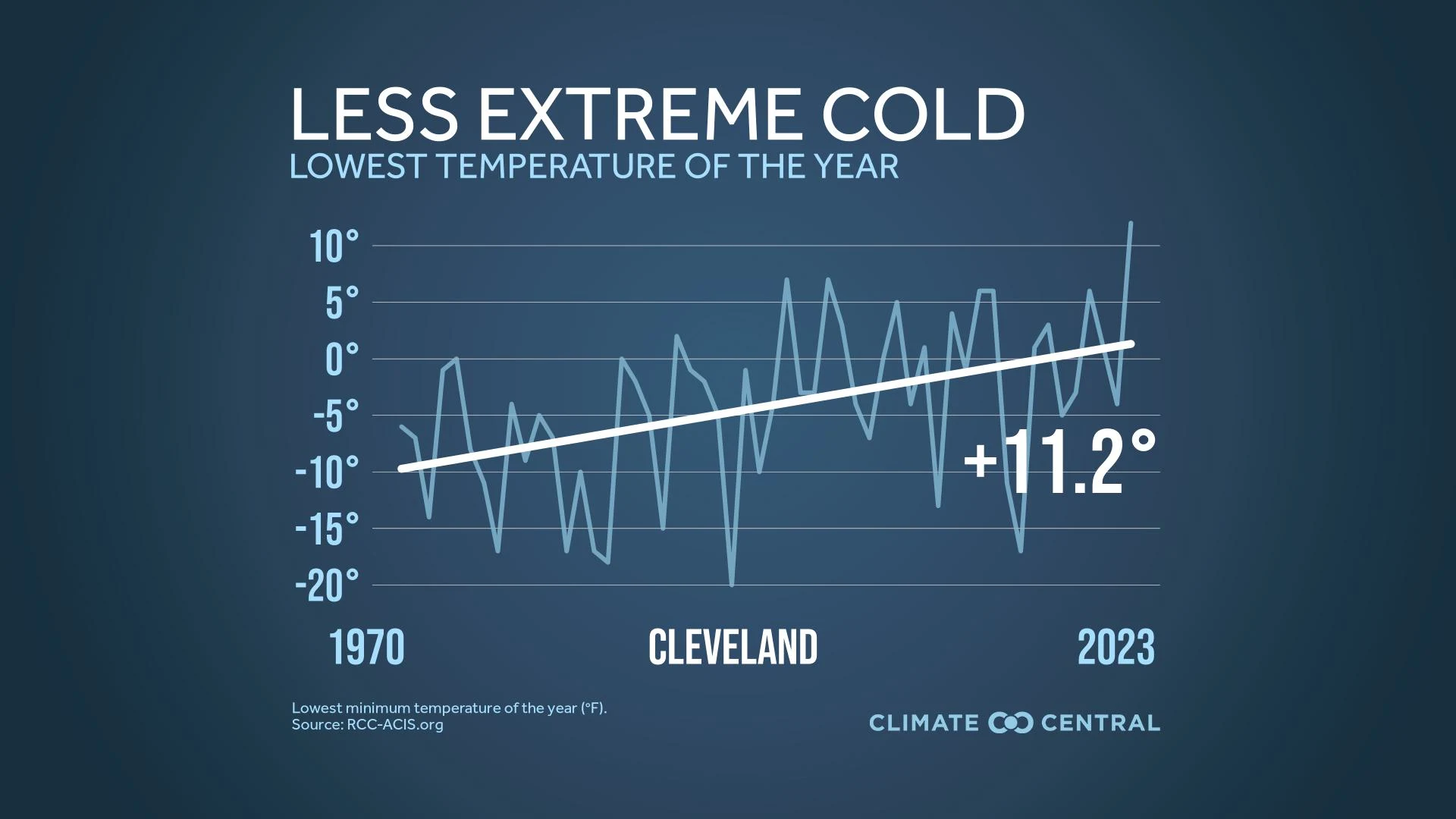
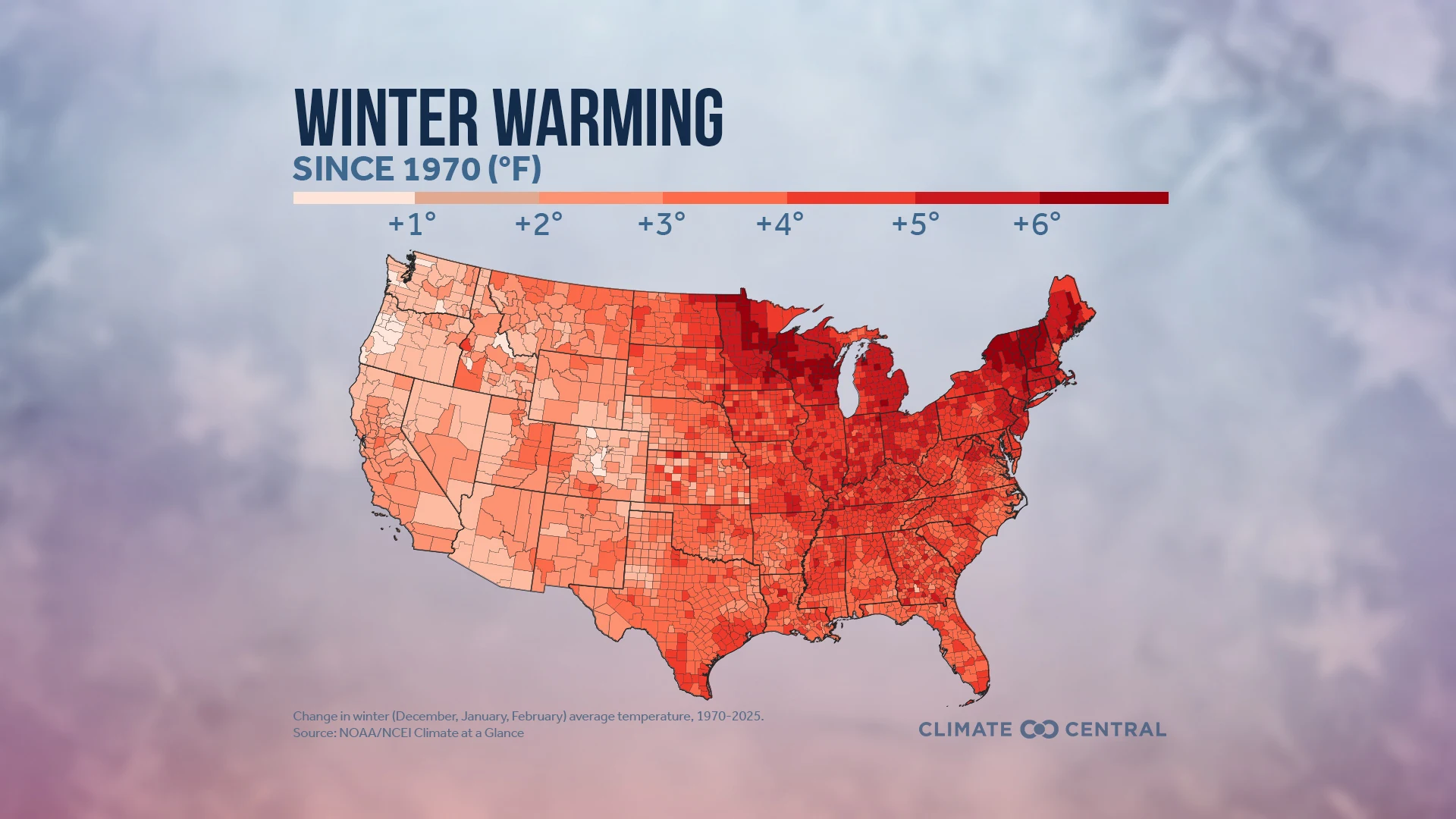
Winters have warmed by 3.9°F on average across 239 U.S. cities since 1970. Warmer, shorter winters have lingering effects on health, water supplies, and agriculture throughout the year.
Climate Matters•February 11, 2026•Reuse this content
In our warming climate, winters are getting shorter in 195 (80%) of 245 major U.S. cities analyzed by Climate Central.
The coldest time of year is now nine days shorter, on average across these 195 cities, than during 1970-1997.
The temperatures that have historically defined winter are now starting later and/or ending earlier in most U.S. cities — especially across the Southeast, Northeast, Upper Midwest, and South.
Shorter, warmer winters have direct effects on winter recreation — and lingering effects on health, water supplies, ecosystems, and agriculture throughout the year.
This Climate Matters analysis is based on open-access data from the National Oceanic and Atmospheric Administration (NOAA). See Methodology for details.
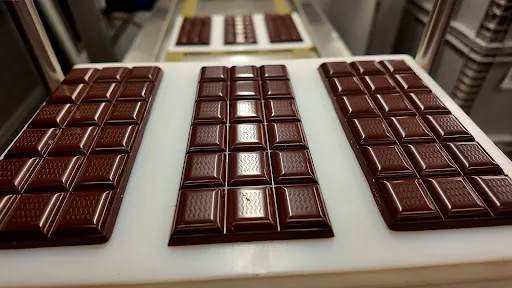
Click to download this ready-to-air video, Chocolate Crunch: Bittersweet News For Chocolate Lovers. This fully produced news story can be used by media outlets at no cost for broadcasts, streaming, and digital stories. Click here for other available packages. |
|---|
As the planet warms, all four seasons are warming and the seasonal clock itself is warping — with the hottest time of year lasting longer and the coldest time of year shrinking.
There are several different ways to define a season and measure how they’re changing as our planet warms.
Time-based seasons. Meteorological seasons — the default for climate science and Climate Central analyses — divide the year into four quarters of equal length. For example, meteorological winter is defined as the three-month period of December, January, and February. And all four meteorological seasons are warming across the U.S.
Temperature-based seasons. Seasons can also be defined based on temperature — for example defining winter as the coldest days of the year based on historical data — to understand how warming trends affect season length.
In a new analysis, Climate Central used temperature-based seasons to assess how the length of the winter season has changed with climate warming since 1970.
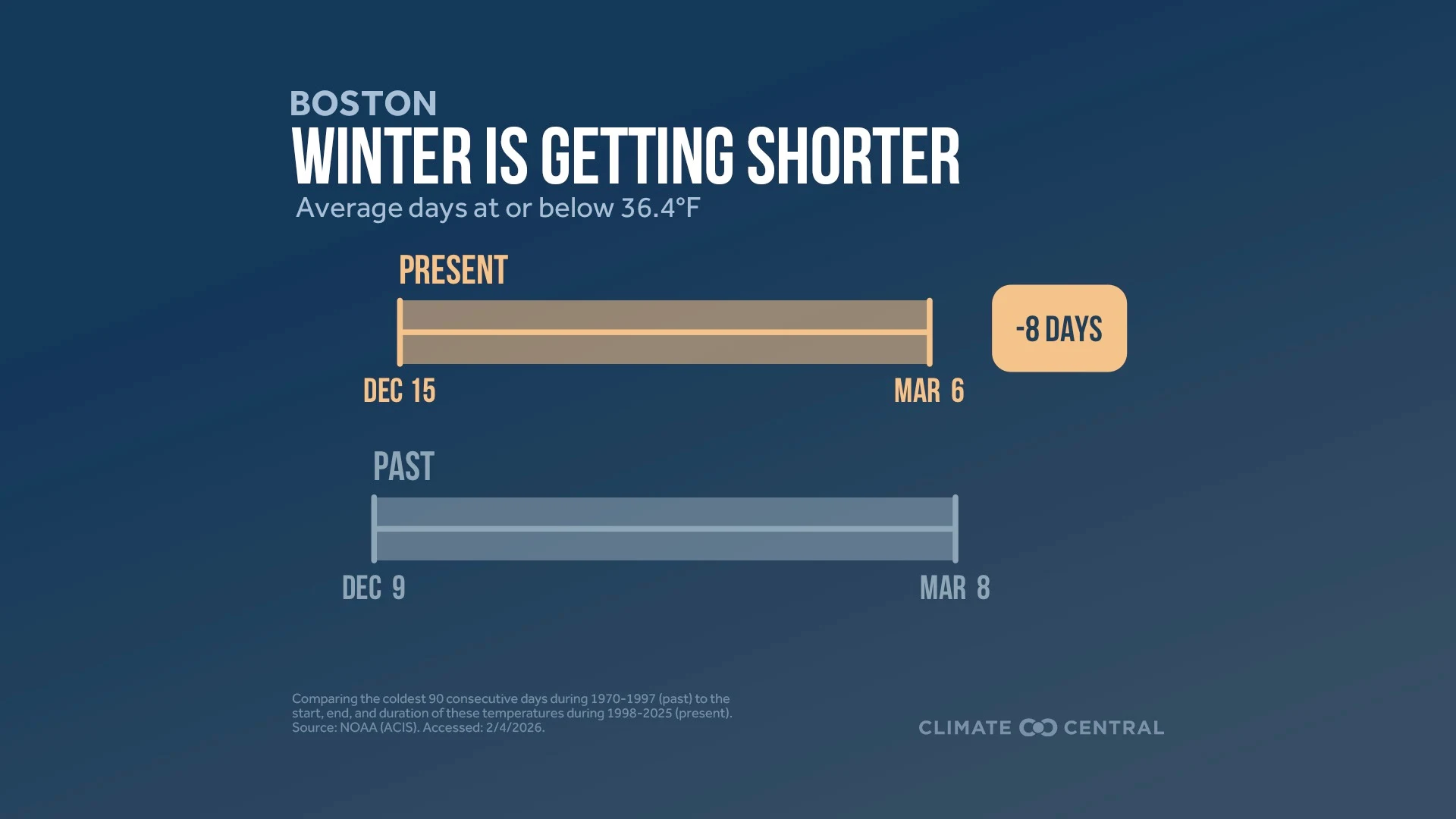
Climate Central used weather station data from 245 major U.S. cities to define a temperature-based winter season in each location.
This analysis defined winter as the coldest 90 consecutive days of the year during the past (1970-1997) and then compared the frequency of these winter-like temperatures during the most recent 28-year period (1998-2025). See Methodology for details. Results show that:
Winters have gotten shorter in 195 (80%) of the cities analyzed.
The annual period with historically winter-like temperatures shrunk by nine days, on average across these 195 cities.
In many places, the temperatures that have historically defined winter are now both arriving later and ending earlier than during 1970-1997.
For example, in Erie, Pennsylvania — where winters are now 16 days shorter — winter-like daily temperatures (33.2°F or lower) now: start an average of 10 days later (starting Dec. 22 instead of Dec. 12) and end an average of six days earlier (March 5 instead of March 11) than during 1970-1997.
Explore data and graphics for all 245 cities to see how the winter season has shifted with warming since 1970.
Within the contiguous U.S., cities across the Southeast, Northeast, Upper Midwest, and South have experienced the largest average decrease in winter days.
Juneau and Anchorage, Alaska have seen winters shrink the most (by 62 and 49 days, respectively), consistent with exceptionally rapid warming in Alaska and other high-latitude locations.
Some 37 (15%) of the cities analyzed saw winters lengthen — particularly in coastal California (where the ocean’s influence limits large seasonal temperature swings) and in the Ohio Valley. But those cities were the exception to the national trend, which is consistent with prior studies.
Research shows that the trend toward longer, hotter summers and shorter, warmer winters across the Northern Hemisphere is mainly due to heat-trapping carbon pollution.
Warming winters can reduce mountain snowpack — a critical source of spring meltwater that refills reservoirs, irrigates crops, and helps meet peak water demand across the western U.S. during summer. Snow drought like the western U.S. has experienced this year can also boost fire risk during the following growing season.
Warm winters disrupt sports, recreation, and related local economies. The multi-billion dollar winter recreation industry faces challenges from rising temperatures and reduced snow and ice cover. In some areas of Colorado, ski resort visits are down 20% this year amid severe snow drought. All of the Winter Olympics host cities since 1950 have warmed since then — threatening the reliability, safety, and fairness of outdoor winter sports competitions.
Warmer, shorter winters can affect summer crop yields. Fruit and nut crops — a nearly $27 billion industry in the U.S. — depend on winter chill. Climate Central analysis found that this necessary winter chill has decreased since 1980 in top-producing counties for 10 most valuable non-citrus fruit and nut crops (especially in California, Washington, Florida, Oregon, South Carolina, and Georgia).
Cold winters can keep the populations of disease-carrying pests like mosquitoes in check. But warmer, shorter winters can worsen pest-related health risks.
Warmer, shorter winters impact the growing season and allergies. And earlier spring thaw and later fall freeze gives plants more time to grow and release allergy-inducing pollen earlier in spring and later into the fall.
Climate Central’s Climate Shift Index (CSI) system provides tools, data, custom maps, and local alerts to answer this question in real-time. Here are three ways to use the CSI:
Explore and share the map. Climate Central’s Climate Shift Index map tool shows the influence of human-caused climate change on daily minimum, maximum, and average temperatures across the globe, every day. Check and share the map for your local area today, tomorrow, and any day in the recent past.
Create custom CSI maps. Get access to CSI data in KML format using the panel links in the map tool.
Sign up for alerts. Sign up here to receive custom email alerts when significant CSI levels are detected in your local area.
Submit a request to SciLine from the American Association for the Advancement of Science or to the Climate Data Concierge from Columbia University. These free services rapidly connect journalists to relevant scientific experts.
Browse maps of climate experts and services at regional NOAA, USDA, and Department of the Interior offices.
Explore databases such as 500 Women Scientists, BIPOC Climate and Energy Justice PhDs, and Diverse Sources to find and amplify diverse expert voices.
Reach out to your State Climate Office or the nearest Land-Grant University to connect with scientists, educators, and extension staff in your local area.
Daily average temperature data (1970-2025) for 245 U.S. weather stations were obtained from the Applied Climate Information System, which is developed, maintained, and operated by NOAA’s Regional Climate Centers.
This 56-year period was divided into two 28-year climatologies representing the average annual temperature cycle in each location during the past (1970-1997) and recent (1998-2025) periods. Both daily average temperature climatologies were smoothed to capture the seasonal cycle and reduce day-to-day variability (using R package “mgcv”).
The coldest 90-day window in the smoothed past (1970-1997) climatology was identified and used to define a baseline winter period. The warmest day during this 90-day window was used to define the temperature threshold below which days are considered to have historically winter-like temperatures.
Using the smoothed recent (1998-2025) climatology, we identified the start and end dates at which daily average temperatures remained at or below the historically winter-like temperature threshold (as defined above). The number of days that span the period between the start and end date (inclusive) represents the length of the recent winter period.
The difference in the number of days between the recent winter period and baseline winter period represents the change in winter at a given location.
This analysis is based on an analysis by Brian Brettschneider, summarized in a 2020 blog post (Are Summer/Winter Longer/Shorter Than They Used To Be?) and covered in a 2025 article in The Washington Post (See how much longer summer is in your town).
References to U.S. regions refer to the nine U.S. Climate Regions defined by NOAA (NCEI).
Climate Central's local analyses include 247 U.S. weather stations. For reported data summaries herein, however, only 245 stations are included due to data completeness measures that were not met by two stations: Hazard, Ky. and Wheeling, W.Va.
Climate Matters © 2026 by Climate Central is licensed under CC BY 4.0
This license grants permission to use, distribute, and reproduce all text, graphics, and multimedia content published on this page in any medium, provided that Climate Central is credited per the CC BY 4.0 license.
Permission to use data and other materials published on this page is granted for non-commercial uses, commercial news purposes, and educational purposes as governed by Climate Central's Terms of Use.