Climate Matters
Climate Change is Disrupting Air Travel
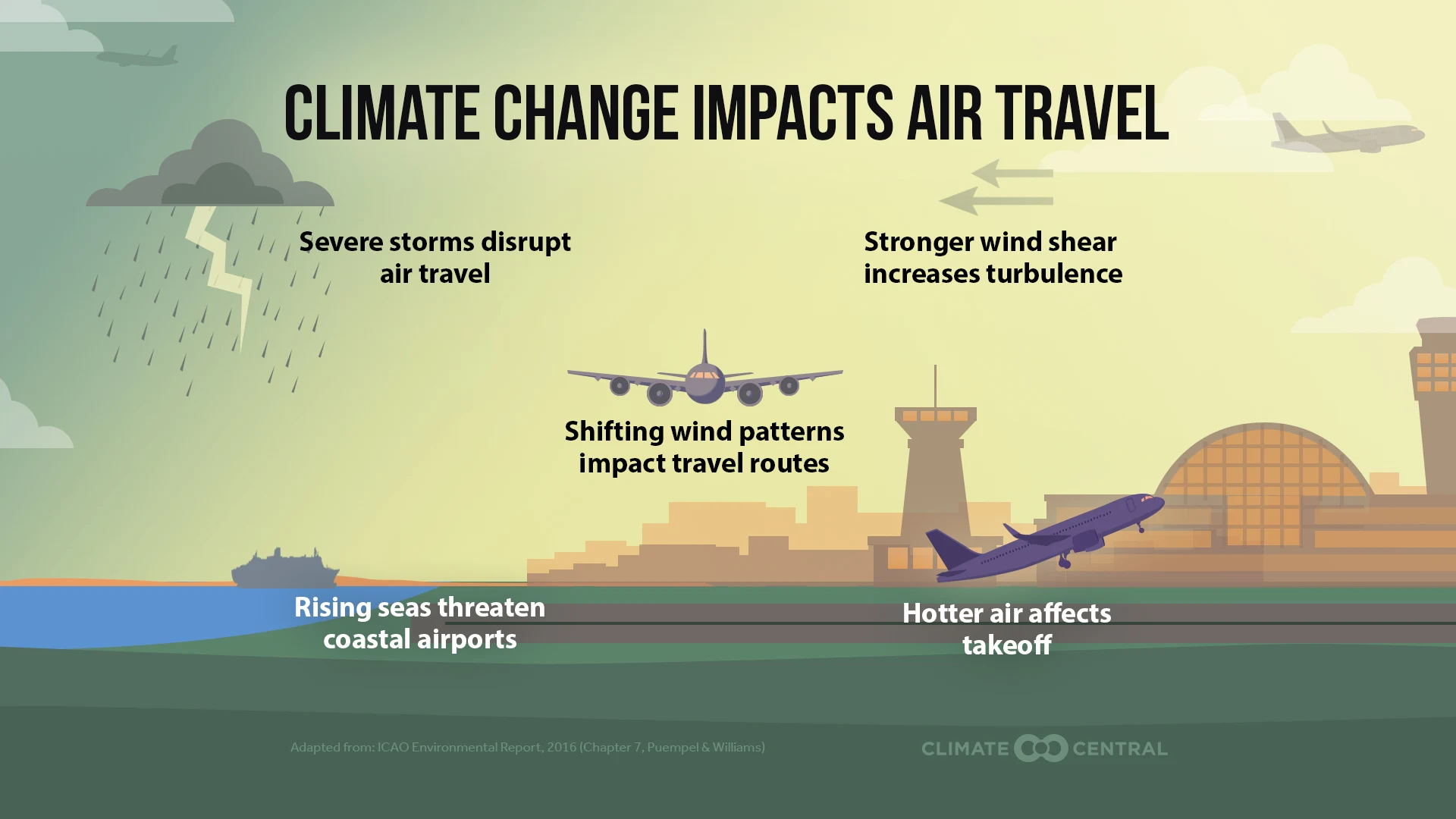
Aviation causes heat-trapping pollution — and the resulting warming is disrupting air travel.
Climate Matters•February 4, 2026•Reuse this content
Roads, railroads, bridges, ports, and airports underpin the economy and are all vital for daily life.
But transportation systems face growing challenges in our changing climate — from heat-related delays to flooding damage.
This brief explains how extreme heat, wildfires, heavy rainfall, hurricanes, and sea level rise can damage and stress the aging U.S. transportation systems that we rely on daily.
Using heat-resistant asphalt and growing living shorelines are ways to limit — but not completely avoid — the rising disruption, safety concerns, and maintenance costs from climate change.
In June 2025, a climate change-driven heat wave caused roads to buckle in multiple states. The same heat caused train tracks to warp, resulting in major delays for rail commuters across the East Coast. And throughout 2025, coastal flooding worsened by rising sea levels shut down roads from South Carolina to Washington.
Travel disruptions like these are likely to become more common as heat-trapping pollution intensifies extreme weather and tests the physical limits that transportation systems were built to withstand.
Transportation systems — including roads, railroads, bridges, airports, and shipping ports — move people and goods around the world, and are critical for modern life and the economy. But these systems are aging and underinvested, making them even more vulnerable to changing climate conditions.
The impacts of climate change on transportation systems can be acute (damage from a hurricane or wildfire) or chronic (resulting from the long-term rise in temperatures or sea levels) — causing travel disruptions, safety concerns, and rising costs for repairs and maintenance.
Below is a review of the rising risks that extreme heat, wildfire, heavy rainfall, sea level rise, and hurricanes pose to U.S. transportation systems — as well as some options for more climate-resilient transportation systems.
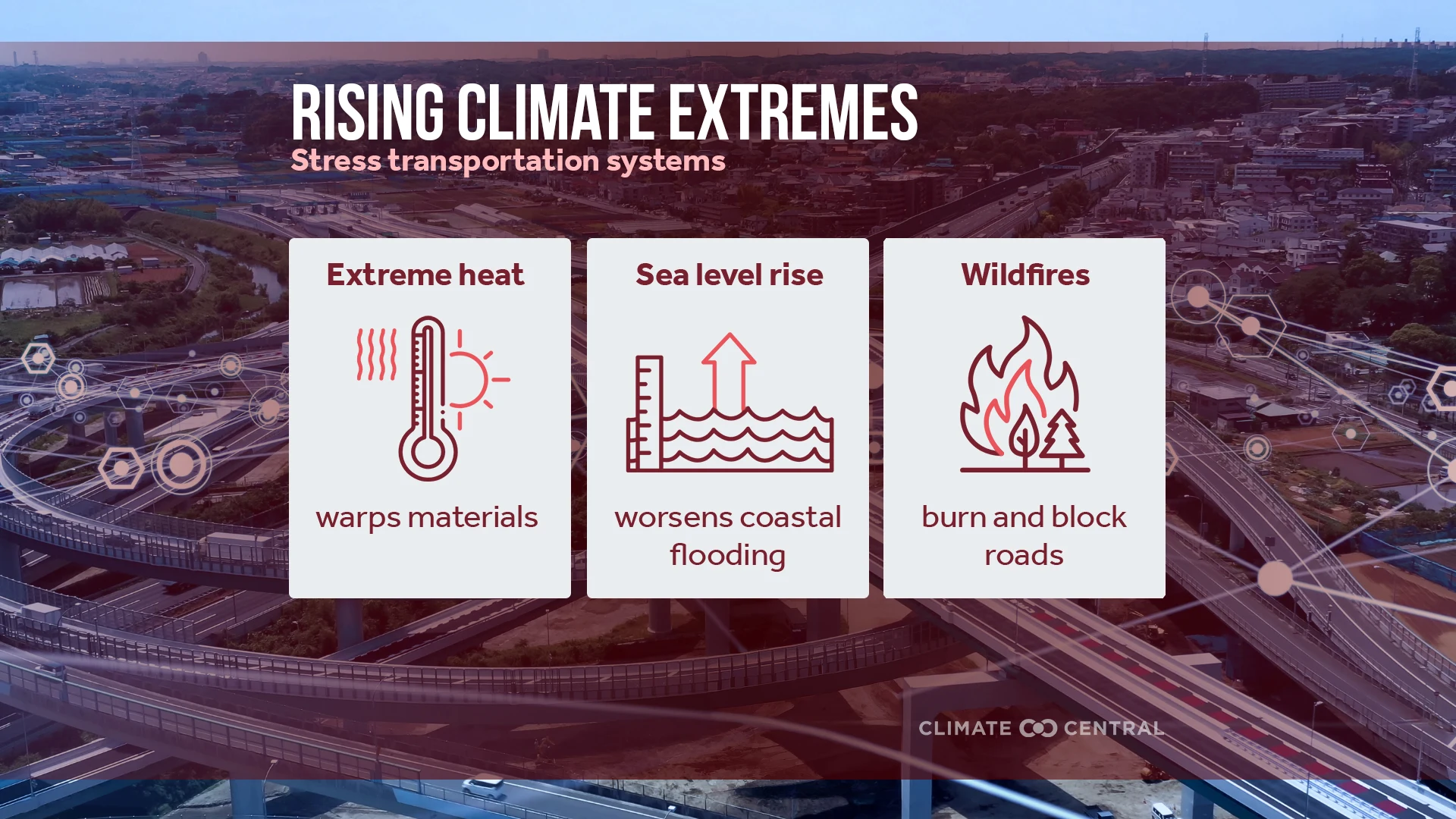
As climate change makes extreme heat more frequent and intense, the chances of heat damage to transportation infrastructure rise. Most transportation infrastructure was not built for the extreme heat that many areas now face.
Extreme heat can change the properties of materials, leading to destructive processes like expanding, warping, buckling, and faster aging due to softening.
Infrastructure with mechanical parts, such as movable bridges, are especially vulnerable to extreme heat, which can cause parts to malfunction and not fit together.
Extreme heat is costly for transportation systems. Under an intermediate emissions scenario, future warming is projected to add $21.8 billion to asphalt pavement maintenance costs by 2070. And heat-related railroad delays could cost up to $60 billion cumulatively by 2100.
In Alaska, rising temperatures are melting the frozen ground (permafrost) that roads are built on — decreasing the conditions essential for wintertime ice roads and forcing communities to rethink how they stay connected.
Climate change is causing wildfire seasons to lengthen and intensify, particularly in the western U.S. This brings a greater risk of the impacts of fires, including damage to roadways.
During 2000-2019, more than 256,000 miles of roads across the contiguous U.S. were exposed to large fires. That’s more than 10 times the circumference of the Earth.
Scorching temperatures from wildfires can melt the binder material that holds asphalt together, leading to premature aging of roads. And days to months after wildfires, landslides that are made more likely by the fire that destabilizes land can take out roads.
This compounds fire-related transportation risks, since roads are essential evacuation routes during wildfires.
Warmer air holds more moisture, leading to heavier rainfall extremes as the climate warms.
Heavy rainfall and flash flooding can obstruct roads or railroads, wash out the ground underneath roads and bridges, and cause other physical damage to transportation systems.
Extreme precipitation worsened by climate change also threatens underground transportation systems such as tunnels and subways. During Hurricane Sandy in 2012, flooding closed 150 New York CIty subway stations for days to weeks, and led to $5 billion in repairs to tunnels connecting Manhattan to Brooklyn.
Up to 100,000 U.S. bridges — particularly in the eastern U.S. — are vulnerable to future flooding from increased river flows linked to heavier rainfall. Adapting these bridges to avoid increased climate-related damage could cost $140 billion to $250 billion by 2100.
Rising sea levels threaten coastal transportation systems, including the roughly 60,000 miles of U.S. highways in coastal areas.
Sea level rise worsens coastal erosion, which can wash out the ground underneath roads, railroads, and bridges.
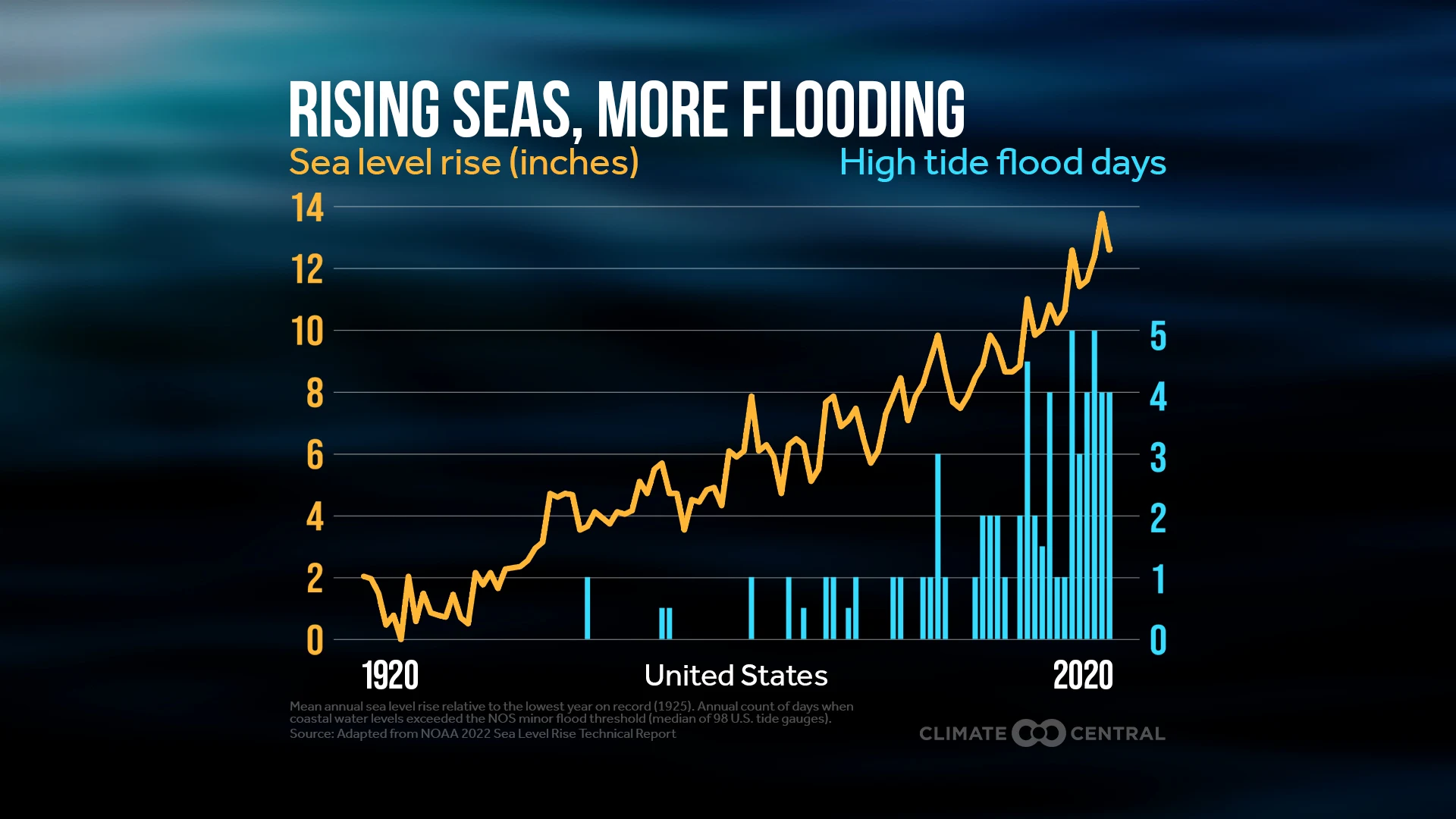
As global sea levels rise, water levels along the coast rise too. As daily tides cycle over higher baseline water levels, high tide lines migrate farther inland or upslope — regularly flooding coastal areas that previously would have flooded only during storms or extreme rainfall events.
The resulting high tide flooding — sometimes called nuisance flooding or sunny day flooding — is becoming more common along U.S. coasts. The annual frequency of high tide flooding in the U.S. has more than doubled since 2000 — and is projected to more than triple again by 2050 as sea levels continue to rise.
High tide flooding can regularly submerge and close roads, causing frequent delays and rising frustrations for commuters. Repeated flooding can also gradually degrade the structural integrity of roads.
Future sea level rise is projected to cause a 10-fold increase in the duration of East Coast traffic delays due to high tide flooding by 2060 (compared to the 2010s). Under an intermediate sea level rise scenario, high tide flooding could occur almost daily by 2056–2065 at sites in Connecticut, New Jersey, Maryland, Washington, D.C., North Carolina, and Florida.
Waters made warmer by climate change fuel stronger hurricane winds. Even small increases in hurricane wind speeds can dramatically increase the resulting damage.
Transportation systems in coastal areas prone to tropical cyclones are vulnerable to significant risks. For example, about one-third of shipping ports globally are located in areas at risk from tropical cyclones.
Sea level rise also primes coastal areas for higher storm surges. These surges are extremely powerful and can sweep out the foundations from roads, railroads, bridges, and other infrastructure. Storm surge can also compound hurricane risks by flooding and blocking essential evacuation routes.
Airport runways in major cities are also at risk of closures, delays, and damage due to storm surges and coastal flooding.
Protecting global ports against rising seas and stronger storm surges could cost billions of dollars annually.
Ultimately, cutting heat-trapping pollution is the most meaningful action to slow the rate of warming and mitigate future impacts of climate change on transportation systems.
Adaptation efforts can also help transportation systems withstand the climate impacts set in motion by the pollution already in the atmosphere.
Transportation systems often have planned lifespans lasting decades (paved roads, rail tracks) to 100 years or more (bridges).
Creating climate-resilient transportation systems involves designing with the climate of the future in mind — incorporating projections of future climate conditions into infrastructure planning.
Here are some ways that community leaders, engineers, governments, and transportation service providers can adapt transportation systems to current and projected future climate change impacts:
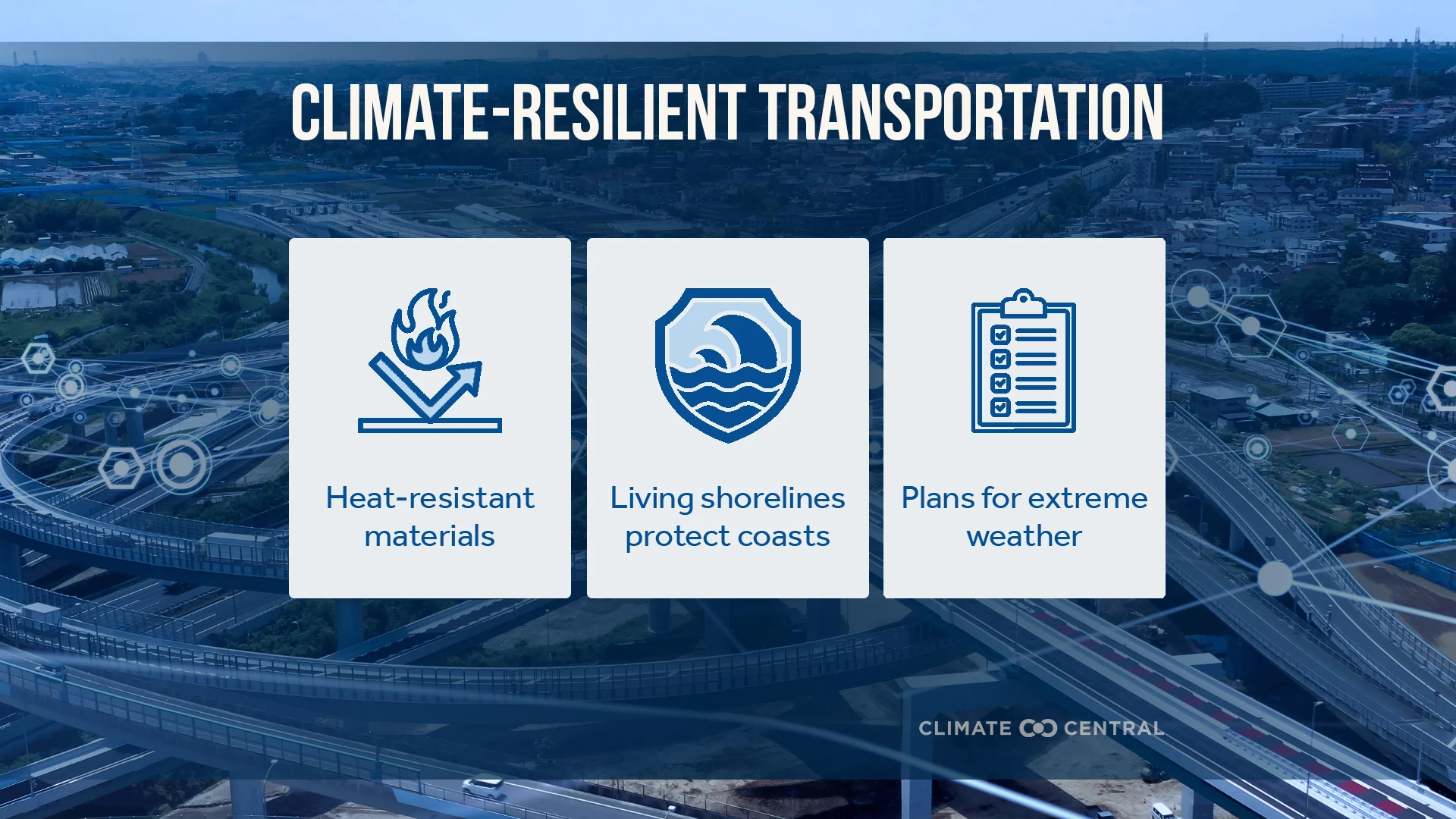
Using materials that are more resistant to extreme temperatures, such as higher heat grades in asphalt roads.
Proactive monitoring and temperature sensors can help engineers identify problems while they are still relatively manageable.
Publicizing plans for operations during extreme conditions. For example, in 2025, Amtrak established a plan to follow when extreme heat disrupts rail service.
Planning to build new infrastructure in areas that are not at risk from future sea level rise.
Employing nature-based solutions, such as living shorelines, to protect shipping ports, roads, and other coastal infrastructure from rising seas.
Engaging with residents to ensure that adaptation efforts meet community needs.
Adaptation efforts will not eliminate climate change impacts on transportation systems, and they can be expensive to implement. But inaction may be even more expensive. Without proactive adaptation efforts, transportation systems are likely to face even more significant future impacts and costly repairs.
A recent study suggests that proactive adaptation efforts could save tens of billions of dollars annually in climate-related costs to U.S. roads and railroads by 2050 (compared to annual costs without adaptation).
The Fifth National Climate Assessment (Liban et al., 2023: Chapter 13) reviews the climate vulnerabilities of various modes of transportation, as well as ways to reduce risks.
Use The Hidden Cost of Heat: Impacts to Bridges, an interactive map developed by Duke University, to explore bridges in your area that are vulnerable to the impacts of climate change.
Use Climate Central’s interactive Coastal Risk Finder to explore infrastructure in your area that might be at risk from future coastal flooding.
Climate Central’s newly-launched RiskViewer site provides a set of photorealistic visualizations of storm surge in coastal locations across 20 states along the Atlantic and Gulf Coasts. Use these images to visualize how future sea level rise and storms could affect coastal transportation infrastructure.
Submit a request to SciLine from the American Association for the Advancement of Science or to the Climate Data Concierge from Columbia University. These free services rapidly connect journalists to relevant scientific experts.
Browse maps of climate experts and services at regional NOAA, USDA, and Department of the Interior offices.
Explore databases such as 500 Women Scientists, BIPOC Climate and Energy Justice PhDs, and Diverse Sources to find and amplify diverse expert voices.
Reach out to your State Climate Office or the nearest Land-Grant University to connect with scientists, educators, and extension staff in your local area.
Climate Matters © 2026 by Climate Central is licensed under CC BY 4.0
This license grants permission to use, distribute, and reproduce all text, graphics, and multimedia content published on this page in any medium, provided that Climate Central is credited per the CC BY 4.0 license.
Permission to use data and other materials published on this page is granted for non-commercial uses, commercial news purposes, and educational purposes as governed by Climate Central's Terms of Use.