Climate Matters
Fastest-Warming U.S. States and Cities
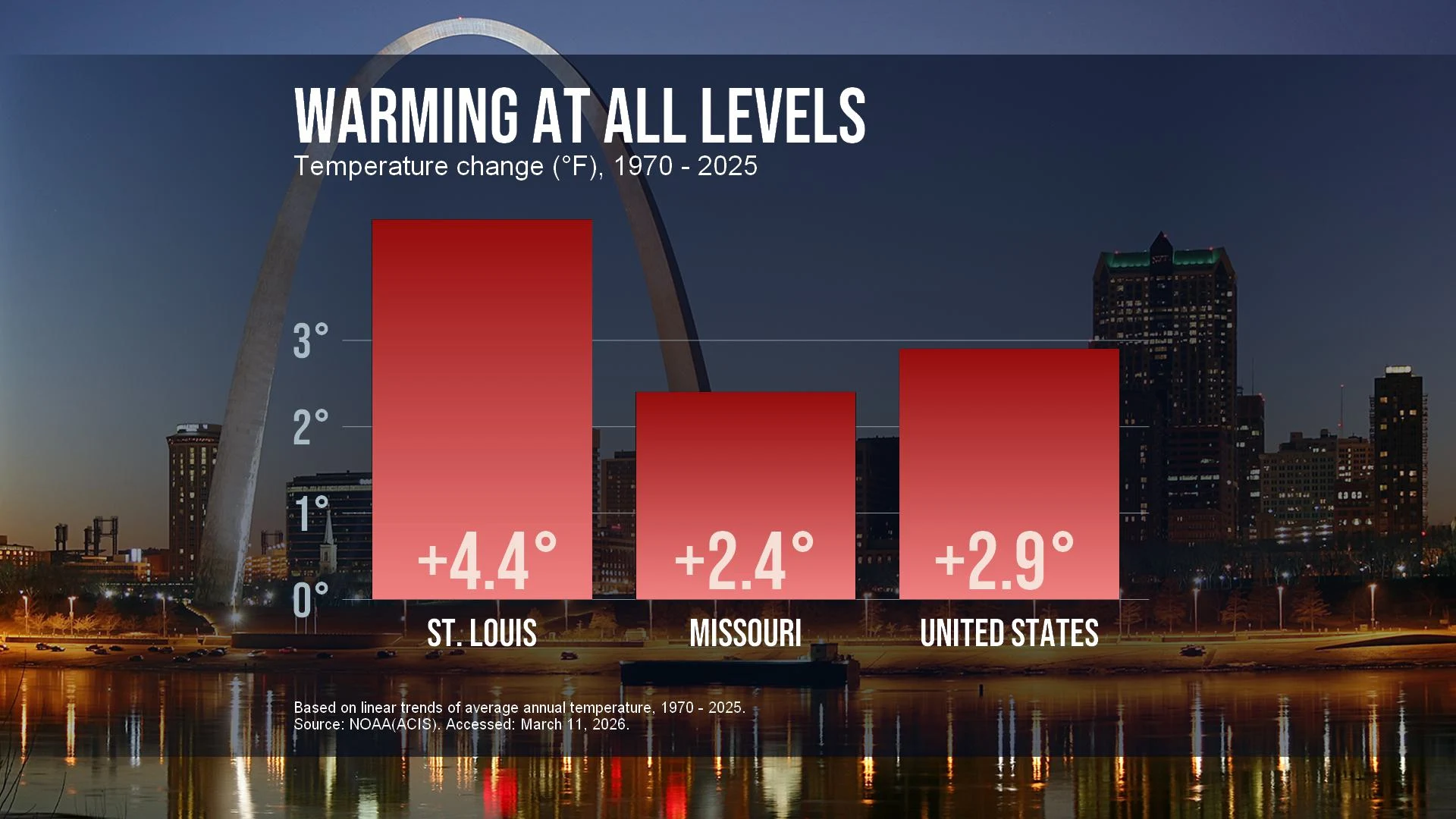
All 50 states and 99% of 242 major U.S. cities analyzed have warmed since the first Earth Day in 1970.

Climate Matters•June 17, 2026
June 20 is Show Your Stripes Day — a time to spread awareness about climate change using the iconic “warming stripes” graphics showing temperature trends over the last 100+ years.
Download and share warming stripes for the globe, the U.S., and individual U.S. states, cities, and more.
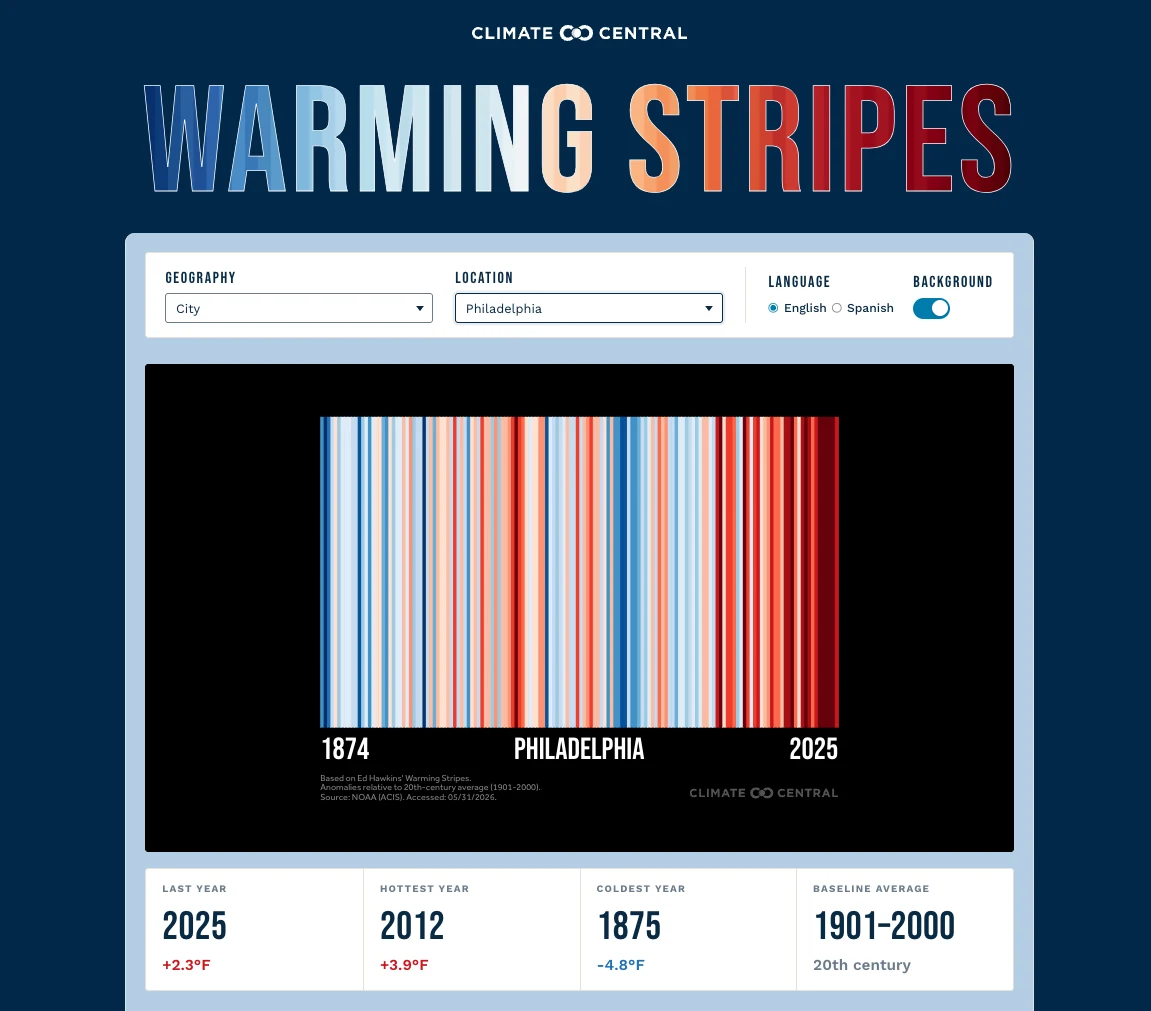
Each colored stripe represents the annual average temperature relative to a long-term average.
Red stripes are years that were hotter than average. Blue stripes are years that were cooler. The strong red shift reflects rapid warming in recent decades.
Climate Central’s new Warming Stripes Dashboard offers custom graphics and data downloads for an expanded range of U.S. geographies.
This Climate Matters analysis is based on open-access data from the National Oceanic and Atmospheric Administration (NOAA). See Methodology for details.
Loading visual assets...
Show Your Stripes Day is a global campaign to spread awareness about climate change using “warming stripes” graphics. This iconic climate data visualization will appear on landmarks, sports jerseys, cars, and more as the world unites to show their stripes on June 20.
The global warming stripes, created by Professor Ed Hawkins, are a visual representation of the long-term rise in global temperatures due to human-caused climate change.
Loading visual assets...
Each stripe represents the global temperature averaged over one year, from 1850 to 2025. Red stripes are years that were hotter than the 1961-2010 average; blue stripes are years that were cooler.
The global warming stripes graphic shows a rapid shift from blue to red stripes in recent decades as heat-trapping pollution has warmed the planet.
Loading visual assets...
Climate Central analyzed historical temperature data through 2025 to produce warming stripes graphics for 199 U.S. cities, 49 states (excluding Hawaii), and the contiguous U.S.
Each graphic shows 100+ years of temperature change relative to the long-term average at the city, state, or national level. See Methodology below for details.
Most U.S. locations show a strong warming trend, especially in the fastest-warming regions such as the Southwest, Northeast, and Alaska.
In 2025, the following cities were warmest relative to the 20th-century average: Phoenix, AZ (6.5°F above average); Reno, NV (6.3°F); Salt Lake City, UT (5.9°); and El Paso, TX (5.1°F).
Visit showyourstripes.info/map to find warming stripes for hundreds of other cities across the globe.
Loading visual assets...
Here are some ways to #ShowYourStripes on June 20 — or any day — to spark climate conversations:
Download your stripes. Climate Central’s new Warming Stripes Dashboard offers free graphics and data downloads for an expanded range of U.S. geographies including cities, states, counties, climate divisions, and regions.
Share your stripes. Share your local warming stripes graphic on social media. Use #ShowYourStripes and tag @ClimateCentral. Set it as your profile picture, drop it in your friends and family group chat, or add it to your workplace Slack or Teams.
Explore your climate story. Climate change is global but the impacts are local. Use Climate Central’s location-based search to see the many ways that your city or state is feeling the effects of our warming.
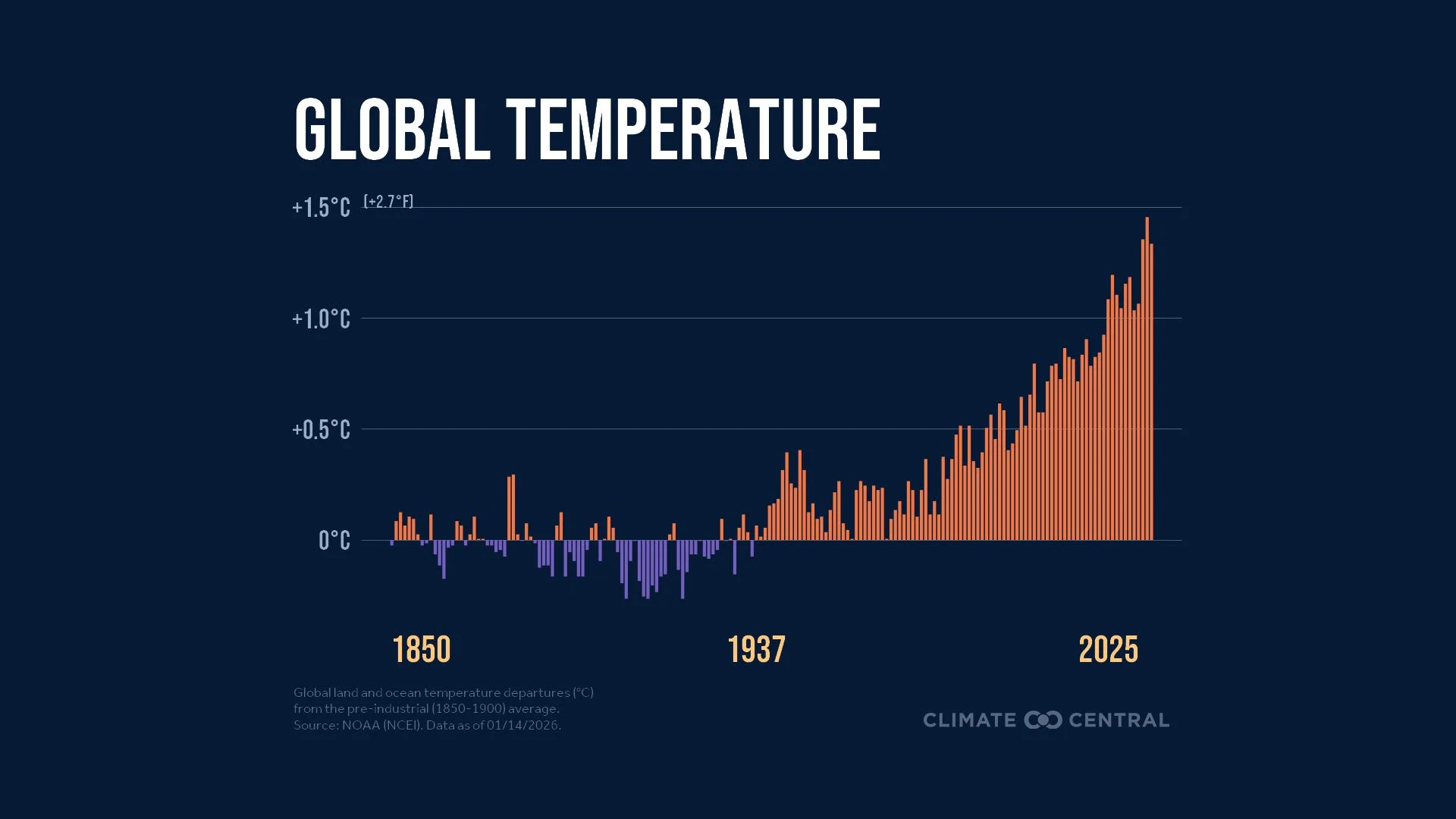
In 2025, Earth experienced the third-warmest year since records began in 1850 — extending an unprecedented global heat streak into its third year. Global temperatures shattered records in 2023 and 2024 by such wide margins that it forced an expansion of the warming stripes color scale earlier than expected.
These recent record-breaking global temperatures — both on the land and in the ocean — have pushed the planet even closer to the internationally-agreed goal to limit warming to 1.5°C (2.7°F) or well below 2°C (3.6°C) above pre-industrial levels.
Exceeding 1.5°C in a single year, which first occurred in 2024, does not mean we’ve breached the 1.5°C limit set by the Paris Agreement. But that limit (which represents a long-term global temperature anomaly averaged over at least 20 years) will be reached in the early 2030s if current rates of warming continue.
Well-established science shows that warming beyond this threshold will result in increasingly frequent and intense extreme weather events, and increasingly disruptive impacts on health, nature, crops, and economies around the globe.
This underscores the urgent need to turn climate conversations — sparked by warming stripes — into climate action.
Warming stripes make it clear that current temperatures are the warmest on record. And stripes going back 2,025 years using paleoclimate data show the unprecedented pace and scale of modern climate change compared to fluctuations over millennia.
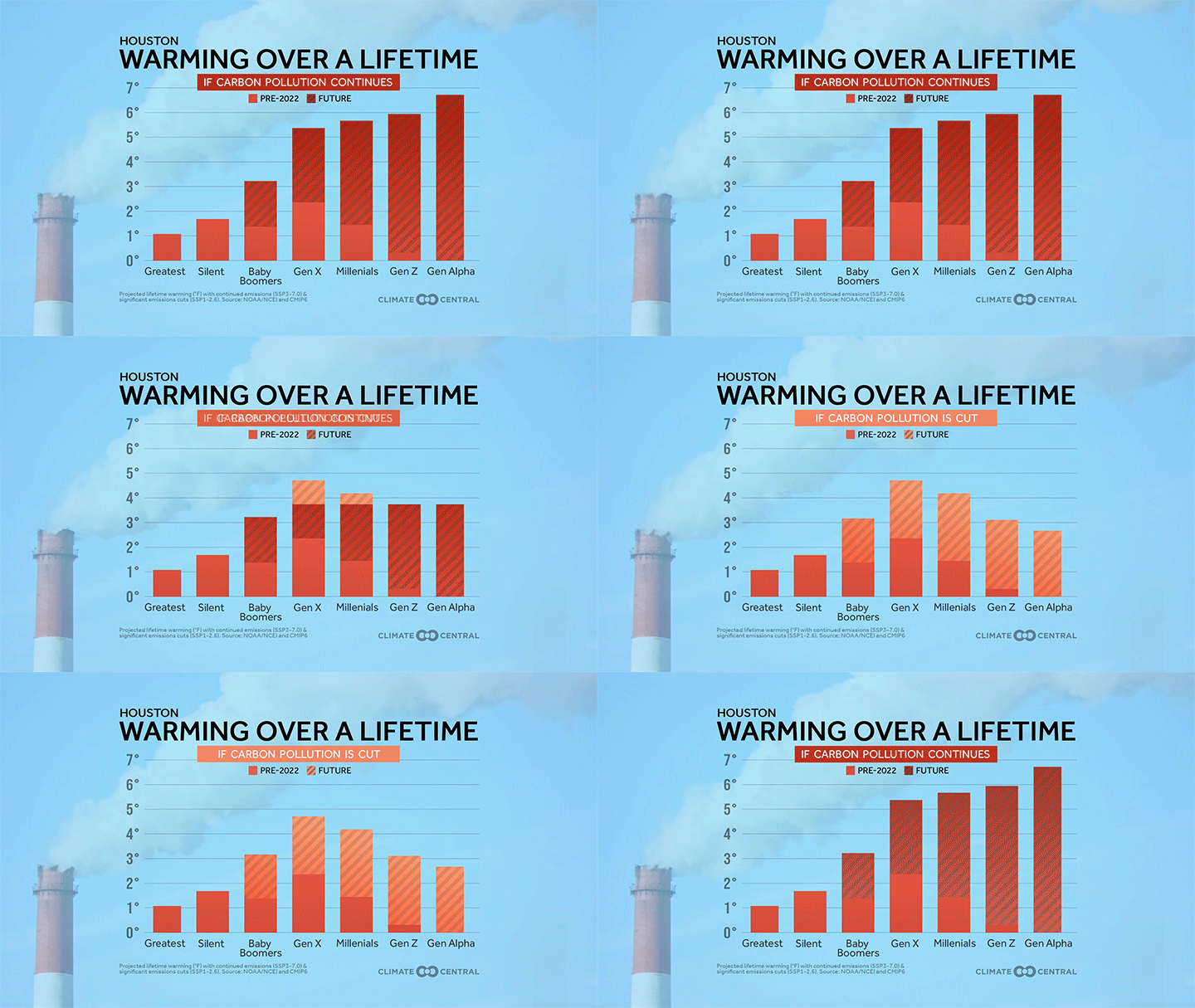
These graphics can also be used to show how our actions today will determine what color stripes younger generations will live through this century as determined by our choices.
Climate Legacies, developed by NASA scientists and based on a recent IPCC graphic, illustrates how different generations experience past and future warming during their lifetimes. Visit the site to create, download, and share your own warming stripes timeline based on your birth year.
A recent Climate Central analysis found that, because of climate change, younger people today are experiencing far more extreme heat during childhood than previous generations did.
An earlier Climate Central analysis shows the powerful effects of the choices we make now. The data show that rapid cuts in carbon pollution would set younger generations on a radically different path — toward a far safer future with less warming and fewer risky extreme events.
The tools we need to choose this cooler, safer future are already available. Talking about climate change is one step. And warming stripes are a great climate conversation starter.
Most Americans (63%) are concerned about climate change. But they also underestimate their neighbors’ climate concern.
These misperceptions can create barriers to talking about climate change with our neighbors. But research suggests that communicating about the human causes of climate change increases public awareness and engagement.
Along with communication, the solutions needed to rapidly cut heat-trapping pollution from transportation, electricity, agriculture, and industry already exist. And investment in clean energy technologies like solar, wind, zero-emission vehicles, and heat pumps has grown rapidly in recent years.
The U.S. produced a record amount of electricity from solar and wind in 2025. These clean energy sources have seen costs decline rapidly in recent decades.
The science is clear: maintaining and accelerating this momentum is essential for a cooler, safer future.
To request an interview with a Climate Central expert about this analysis, please contact Abbie Veitch, aveitch@climatecentral.org.
Submit a request to SciLine from the American Association for the Advancement of Science or to the Climate Data Concierge from Columbia University. These free services rapidly connect journalists to relevant scientific experts.
Browse maps of climate experts and services at regional NOAA, USDA, and Department of the Interior offices.
Explore databases such as 500 Women Scientists, BIPOC Climate and Energy Justice PhDs, and Diverse Sources to find and amplify diverse expert voices.
Reach out to your State Climate Office or the nearest Land-Grant University to connect with scientists, educators, and extension staff in your local area.
The global warming stripes design was developed by Ed Hawkins, Professor of Climate Science at the University of Reading, as described here and in Hawkins et al. (2025).
Within this brief, warming stripes for the globe, the contiguous U.S., 49 states (excluding Hawaii due to insufficient data), and 199 cities are based on annual average temperature anomalies.
Data for the global warming stripes graphic (1850-2025) is from the UK Met Office. The graphic was accessed directly from showyourstripes.info (courtesy of Ed Hawkins, National Centre for Atmospheric Science, University of Reading) and displays global annual temperature anomalies relative to the 1961-2010 average.
In addition, Climate Central produced original warming stripes graphics for the U.S. as follows: For U.S. cities with data beginning in 1901 or before, anomalies are relative to the 20th-century (1901-2000) average. For a subset of 48 U.S. cities whose period of record begins after 1901, annual temperature anomalies are relative to the oldest available 100-year average for each city. Weather stations with less than 100 years of data were excluded. Anomalies for the U.S. (national) and all states except Alaska are relative to the 20th-century average. The baseline for each location (whether the 20th-century average or a custom 100-year period) is indicated in the footnote on each warming stripes graphic.
Stripes graphics for the contiguous U.S. and U.S. states are based on data from NOAA’s NCEI Climate at a Glance. Stripes graphics for U.S. cities are based on weather station data from the Applied Climate Information System, which is developed, maintained, and operated by NOAA’s Regional Climate Centers.
For each location (contiguous U.S., states, cities), the average temperature over the baseline period (either 20th century or custom 100-year period) is set as the boundary between blue and red color scales. The full color scale spans +/- 2.6 standard deviations of each location’s annual average temperature anomalies relative to the baseline period (either 20th century or custom 100-year period). The full color scale uses 16 colors: the eight most saturated classes of the nine-class sequential blue and red color scales.