
Climate Matters
Clean Energy Investment in Every State
Investment in the U.S. clean energy transition has never been higher. Explore which states and clean technologies have seen the most investment.
Climate Matters•March 25, 2026•Reuse this content
The U.S. generated record levels of electricity from solar and wind in 2025 — enough to power the equivalent of more than 79 million average U.S. homes.
This is more than triple the amount generated a decade ago, in 2016.
Together, solar and wind accounted for a record 19% of total U.S. electricity generation in 2025.
The costs of electricity from solar and wind have decreased rapidly since 2010, and solar continues to be the fastest-growing source of electricity in the U.S.
The U.S. clean energy transition faces new headwinds. But expanding clean, affordable electricity from solar and wind will be key to meeting rising energy demands while reducing heat-trapping pollution.
This Climate Matters analysis is based on open-access data from the U.S. Energy Information Administration (EIA). See Methodology for details.
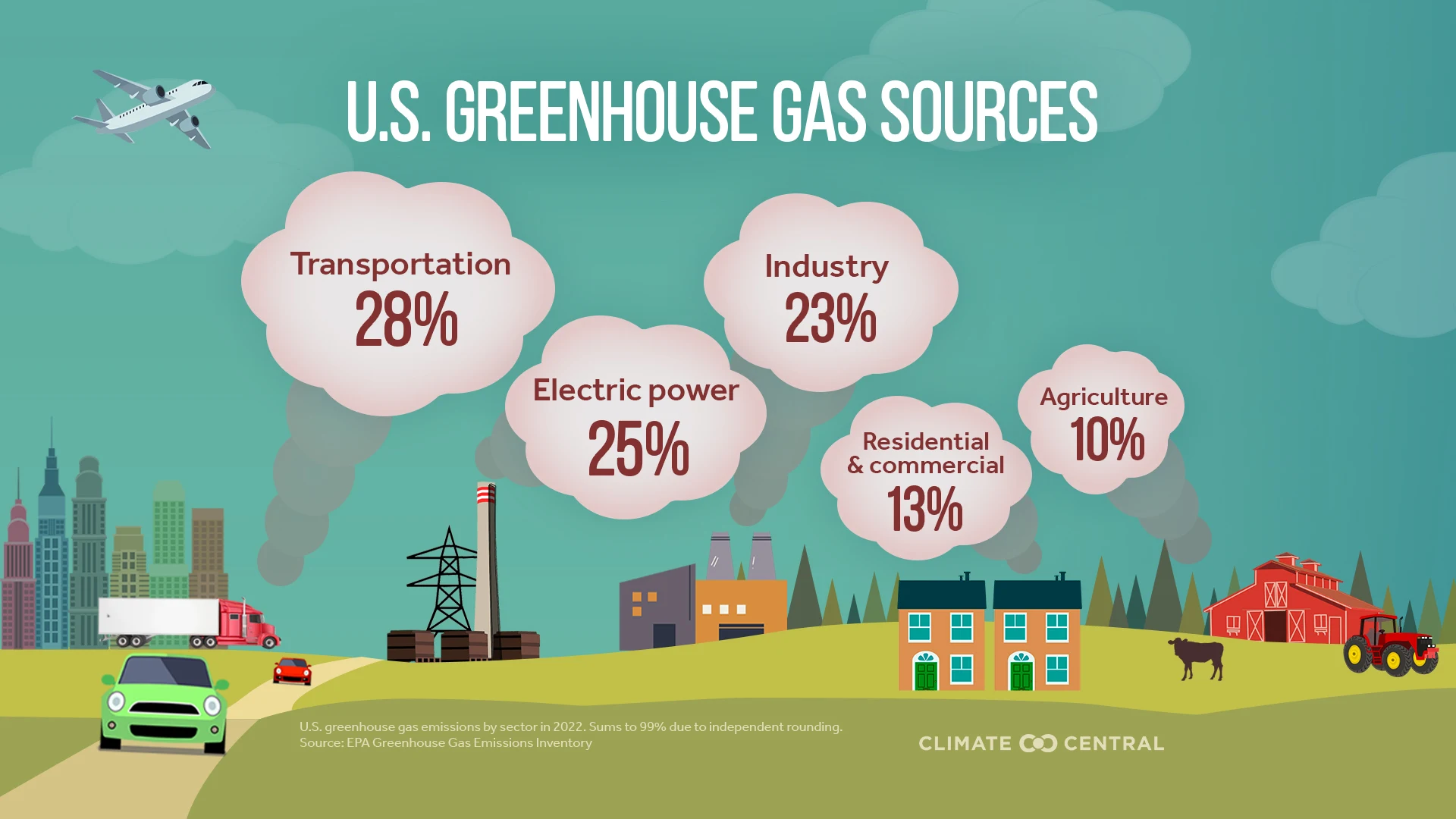
The electric power sector — which generates and distributes electricity to homes, businesses, factories, electric vehicles, and farming operations — produces 25% of all heat-trapping pollution in the U.S.
Most of this pollution comes from burning fossil fuels to produce electricity. Fossil fuels include coal, oil, and methane gas.
The U.S. is in the midst of the largest surge in U.S. electricity demand since 2000, driven by data centers. Producing more clean and affordable electricity from solar and wind will be key to meeting rising demand while reducing harmful heat-trapping pollution.
A rapid transition away from fossil fuels and toward clean, affordable energy sources like solar and wind is essential to limit dangerous warming and ensure a safer future for younger generations.
To gauge progress in the U.S. clean energy transition, Climate Central used the latest U.S. Energy Information Administration data to assess U.S. solar and wind electricity generation in 2025 and its growth over the past decade. See Methodology for details.
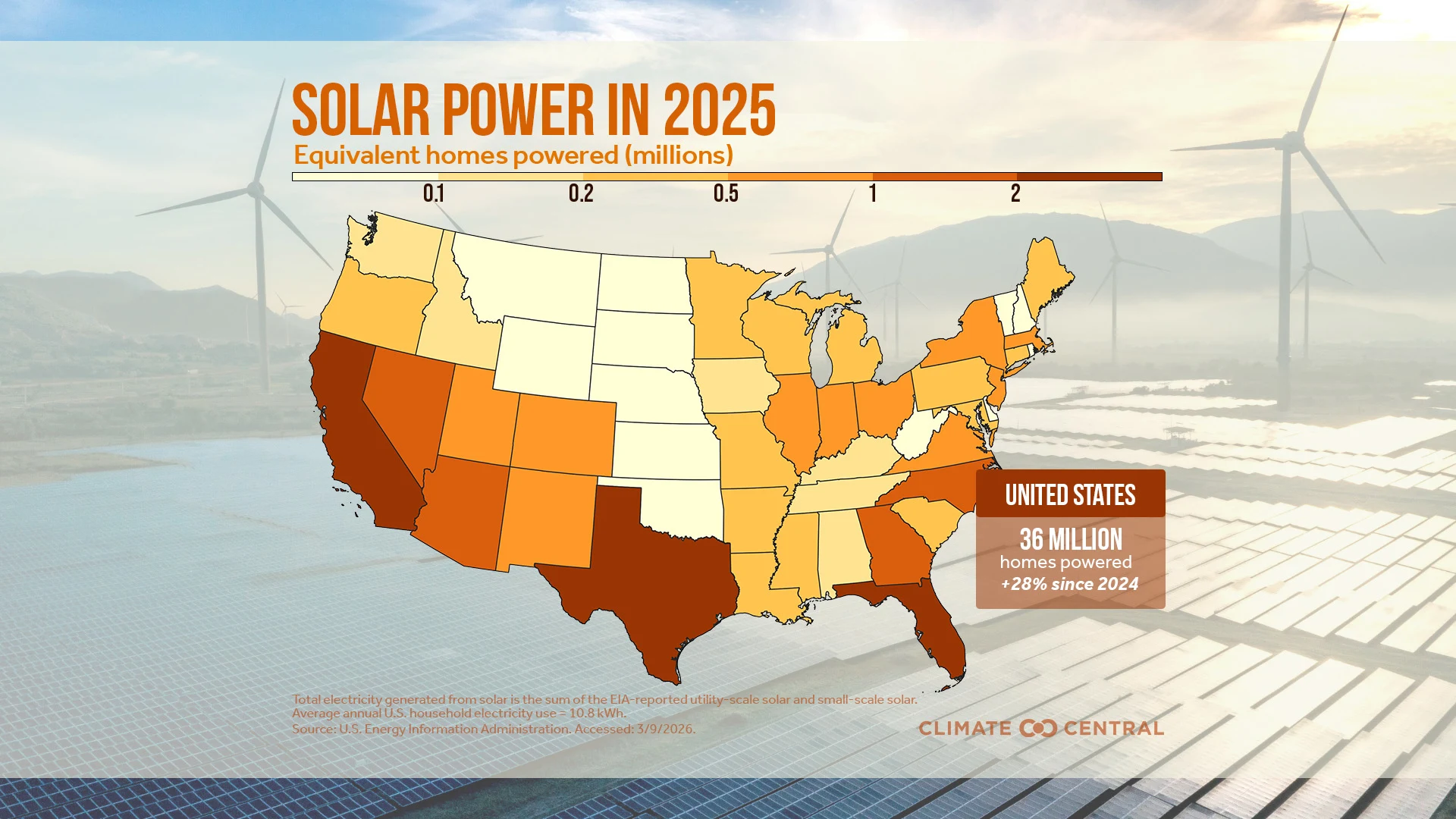
In 2025, the U.S. generated a record 853,210 gigawatt-hours (GWh) of electricity from solar (46%) and wind (54%).
That’s more than triple the amount generated a decade ago, in 2016 — and enough to power the equivalent of more than 79 million average homes in the U.S.
Nationally, solar power grew 28% and wind power grew 3% in 2025 compared to 2024 levels.
California and Texas led in solar power. Together, these two states generated 40% of all U.S. solar power in 2025 (Table 1).
Small-scale solar plays a big role. About 24% of all U.S. solar power generated in 2025 came from small-scale solar installations, such as residential rooftop or community solar systems, which have less than 1 megawatt of capacity.
The middle of the country is a wind powerhouse. Texas alone generated 28% of all U.S. wind power in 2025 — almost three times more than the second-ranked state for wind (Iowa). Wind accounted for 58% of all electricity generated in Iowa last year — a larger share of total in-state electricity generation than any other state.
Table 1. Top 10 states for electricity generated from solar (utility-scale and small-scale) and wind in 2025. Find data for all 50 states and Washington, D.C. in the full dataset.
State | Solar generation in 2025 (GWh) | State | Wind generation in 2025 (GWh) |
|---|---|---|---|
1. California | 90,103 | Texas | 129,458 |
2. Texas | 64,073 | Iowa | 43,738 |
3. Florida | 30,131 | Oklahoma | 38,031 |
4. Arizona | 21,399 | Kansas | 29,634 |
5. Nevada | 15,912 | Illinois | 25,011 |
6. North Carolina | 13,761 | Colorado | 17,118 |
7. Georgia | 11,880 | California | 16,257 |
8. New York | 10,359 | Minnesota | 15,399 |
9. Virginia | 10,153 | North Dakota | 15,378 |
10. Illinois | 8,750 | New Mexico | 14,215 |
U.S. Total | 388,819 | U.S. Total | 464,391 |
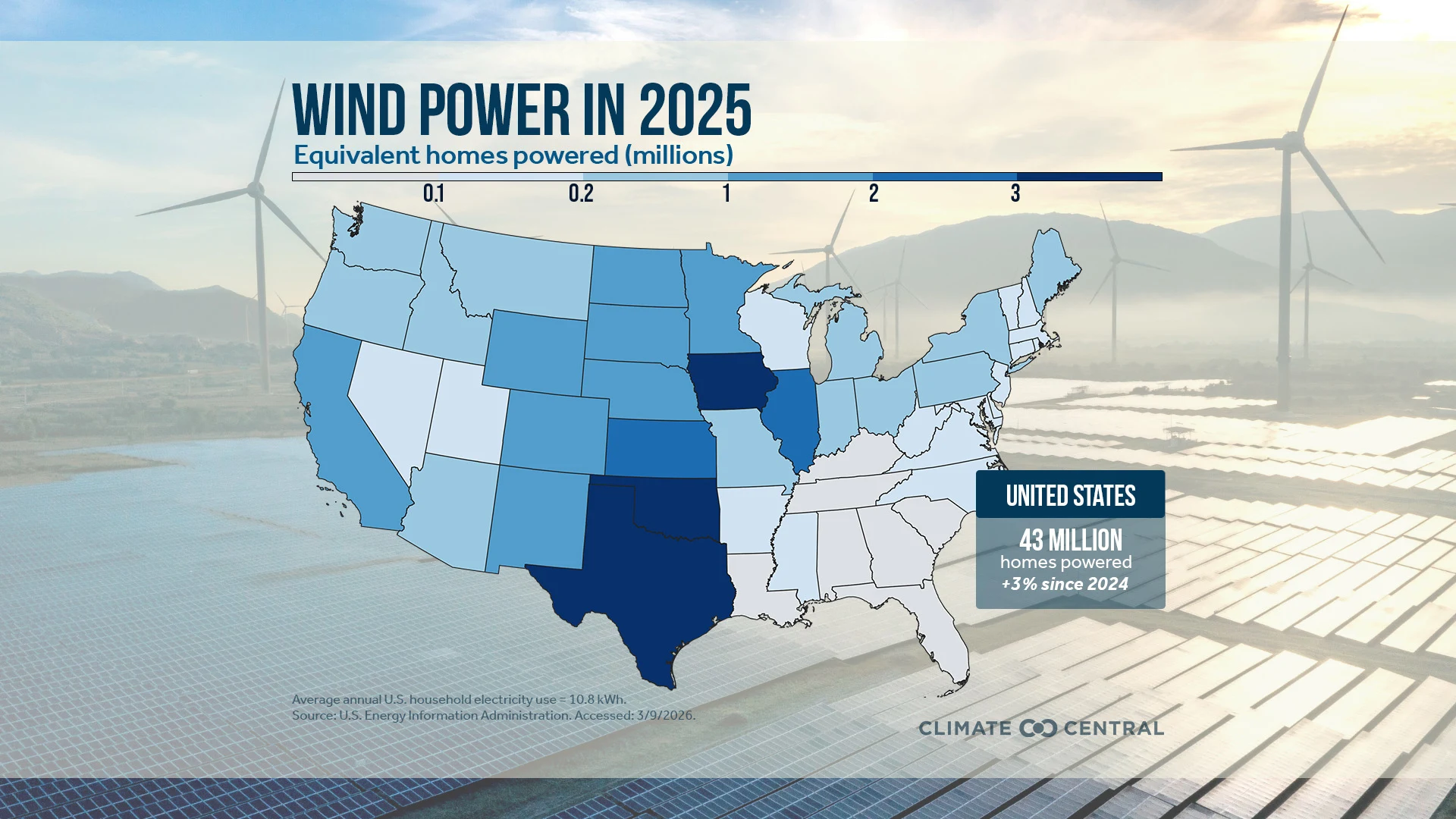
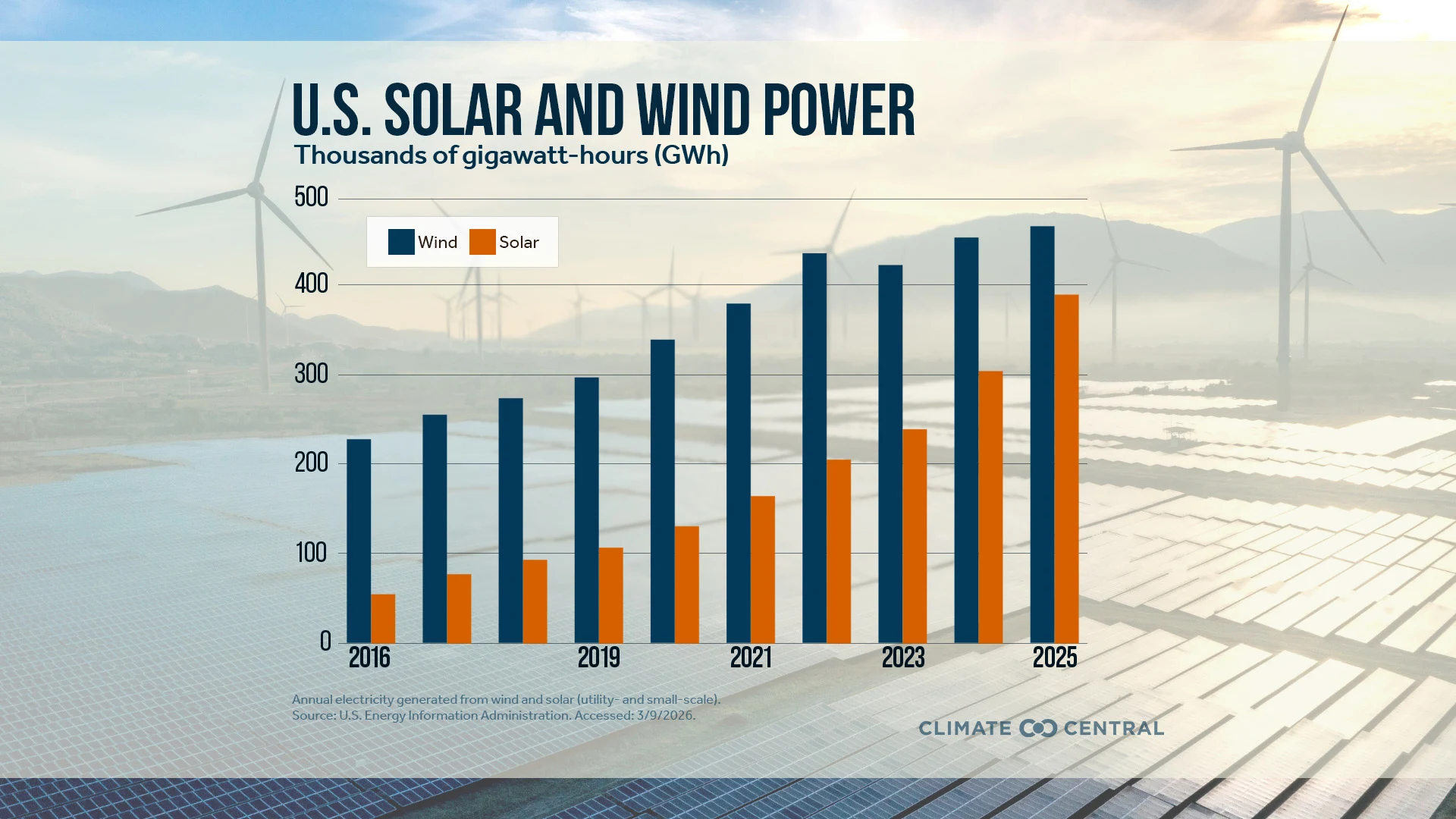
Over the last 10 years, the total amount of U.S. electricity generated from wind and solar more than tripled. Over this period (from 2016 to 2025):
U.S. electricity generated from solar grew more than seven-fold.
U.S. electricity generated from wind doubled.
Over the same period, the two largest sources of electricity in the U.S. (both fossil fuels) grew by 31% (methane gas) and fell by 41% (coal).
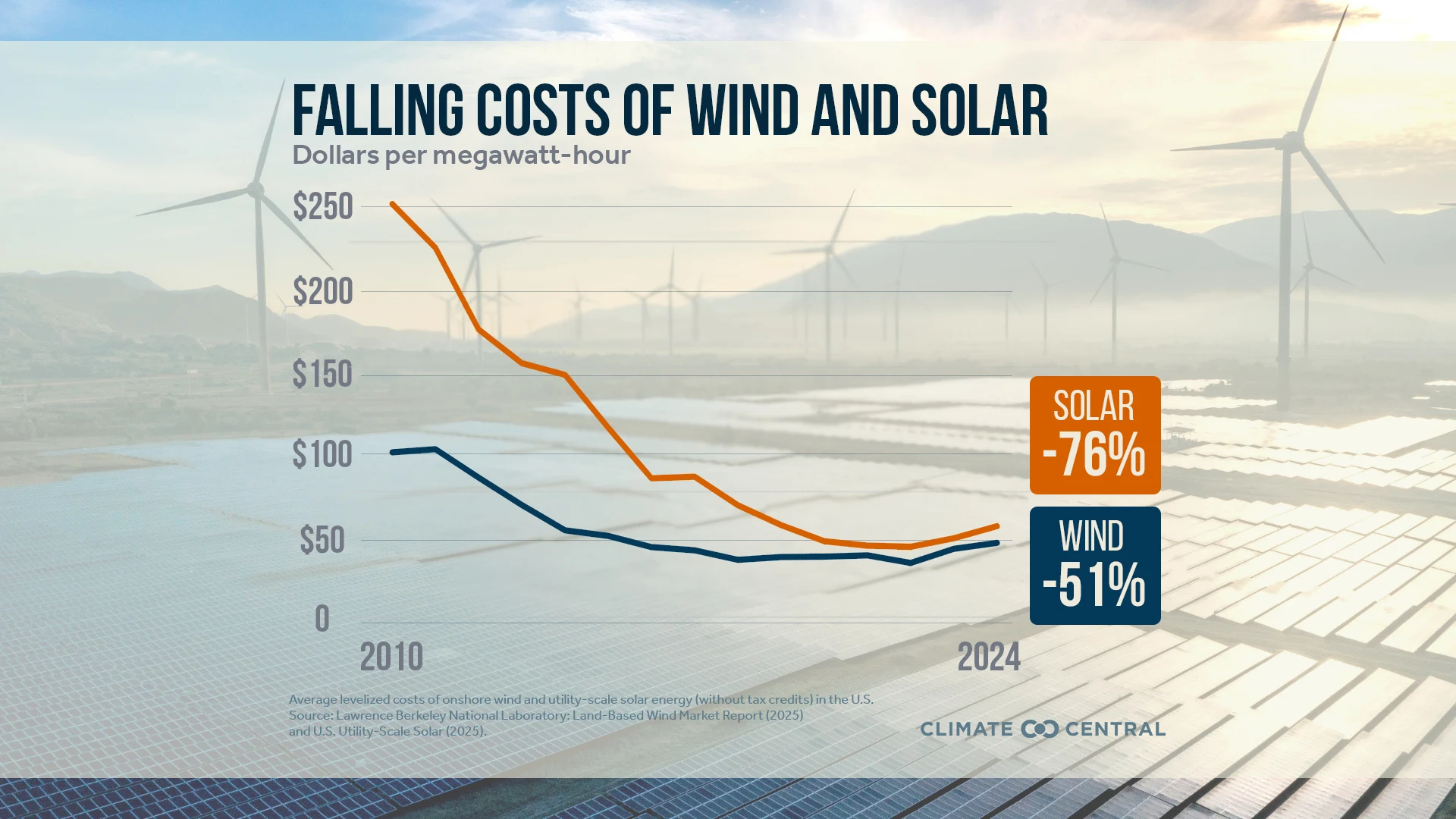
Meanwhile, the costs of electricity from solar and wind have decreased rapidly.
The unsubsidized cost of solar and wind power in the U.S. fell by 76% and 51%, respectively, from 2010 to 2024, due to improvements in technology, manufacturing, and project deployment.
Globally, wind and solar are now the most cost-competitive sources of new electricity generation.
From 2016 to 2025:
Solar generation grew in all 50 states and Washington, D.C.
Wind generation grew in 36 states. (A total of 43 states produce electricity from wind.)
Texas, California, Florida, Iowa, and Illinois had the largest 10-year growth in combined solar and wind generation.
Find 10-year growth data for all 50 states and Washington, D.C. in the full dataset.
An increasing share of the growing demand for electricity is being met by solar and wind — a trend that the U.S. Energy Information Administration forecasts will continue through 2027, led by new solar projects in Texas.
Together, solar and wind accounted for 19% of total U.S. electricity generation in 2025 — a greater share of the electricity mix than ever before.
Although the majority of U.S. electricity still comes from planet-warming fossil fuels (mainly methane gas), the relative contribution of fossil fuels to the overall energy mix is decreasing as solar and wind grow.
Fossil fuels accounted for 57% of U.S. electricity generation in 2025, down from 65% in 2016 and a 21st-century peak of 72% in 2005.
Coal accounted for about half of the electricity mix in the early 2000s compared to 16% in 2025.
The U.S. generated more electricity from solar and wind combined (19%) than from coal (16%) in 2025, after first reaching this milestone in 2024.
In 2025, 31 U.S. states generated at least 10% of their in-state electricity from solar and wind combined.
In Iowa, South Dakota, and New Mexico at least half of all 2025 in-state electricity generation came from combined wind and solar.
Although solar currently accounts for 9% of the national energy mix, it is the fastest-growing source of electricity in the U.S.
Find data for all 50 states and Washington, D.C. in the full dataset.
Despite the growth of solar and wind over the last decade, the U.S. is still catching up to global progress in the clean energy transition. Policy changes and the rise of data centers may affect the pace of renewable energy growth and the cost of electricity in homes.
Here are four key points about wind and solar energy in 2026:
Globally, clean energy is key to meeting growing electricity demands. In 2025, solar and wind grew fast enough to meet all new global electricity demand at least through September, displacing some fossil-fuel generated power. In 2024, 70% of the increase in global electricity demand was met with renewable energy like wind and solar. But despite recent gains in solar and wind, the U.S. isn’t keeping up with the pace of global trends in clean energy expansion and heat-trapping pollution reduction.
Rising electricity demand in the U.S. is driven by data centers and electrification. After more than a decade of little change, electricity demand has been rising steadily since 2020. Rising demand is driven primarily by data centers and growth from expanded industrial use of electricity – a trend that is likely to continue in the near-term. Solar is projected to lead growth in new electricity generation in the next two years, but accelerating demands from data centers could lead to an increase in electricity from fossil fuels.
The U.S. clean energy transition faces new headwinds. U.S. wind and solar growth and the broader clean energy transition faced major headwinds in 2025 from new federal policies. The One Big Beautiful Bill Act rolled back landmark 2021-2022 policies to boost clean energy and climate resilience. And in 2026 the U.S. withdrew from the Paris Agreement which aims to limit global warming and reduce the escalating risks to people, ecosystems, and economies. These policy shifts are set to increase U.S. heat-trapping pollution 7% over 2005 levels by 2035. This represents a dramatic reversal from progress toward the prior U.S. goal to cut heat-trapping emissions 50% below 2005 levels by 2030.
Cuts to U.S. clean energy tax credits could increase household energy costs. U.S. households — especially low-income households — are bearing the brunt of rising electricity demand from data centers. Residential electricity prices in the U.S. rose by 31% from 2020 to 2025 amid rising electricity demand. And recent changes in federal policies could result in even higher home energy bills. Analysis suggests that the One Big Beautiful Bill Act of 2025, which repeals nearly all of the clean energy tax credits from the Inflation Reduction Act of 2022, could raise average annual U.S. household energy costs by roughly $165 per household in 2030 and over $280 per household in 2035.
Climate Central’s WeatherPower tool provides a multi-day forecast of solar and wind generation by U.S. state, country, or congressional district.
The U.S. Department of Energy’s annual Energy & Employment Jobs Report includes data on workforce characteristics in electricity generation including solar and wind, as well as county-level data on energy sector employment.
Rebutting 33 False Claims About Solar, Wind, and Electric Vehicles, a 2024 report from Columbia University’s Sabin Center for Climate Change Law, provides quick facts to clarify common points of misinformation and disinformation about solar, wind, and electric vehicles.
The Clean Investment Monitor, a database from Rhodium Group and the Massachusetts Institute of Technology, tracks private and public investment in the manufacture and deployment (including retail purchases) of emissions-reducing technologies in the U.S. Use Clean Investment Monitor’s data dashboards to compare levels of clean investment across states. Climate Central’s 2024 brief, Clean Energy Investment in Every State, summarizes leading clean energy technologies in each state.
The U.S Large-Scale Solar Photovoltaic Database maps the locations of ground-mounted photovoltaic facilities with capacity of 1 megawatt or more. The U.S. Wind Turbine Database maps the locations of all land-based and offshore wind turbines in the U.S. Both databases are developed and maintained by the U.S. Geological Survey and Lawrence Berkeley National Laboratory.
Lori Bird
U.S Director
WRI Polsky Center for the Global Energy Transition
World Resources Institute
Relevant expertise: Clean energy markets and policy, renewable energy grid integration
Contact: lori.bird@wri.org
Daniel Cohan, Ph.D.
Professor
Department of Civil and Environmental Engineering
Rice University
Relevant expertise: Climate change mitigation, wind and solar energy
Contact: cohan@rice.edu
Submit a request to SciLine from the American Association for the Advancement of Science or to the Climate Data Concierge from Columbia University. These free services rapidly connect journalists to relevant scientific experts.
Browse maps of climate experts and services at regional NOAA, USDA, and Department of the Interior offices.
Explore databases such as 500 Women Scientists, BIPOC Climate and Energy Justice PhDs, and Diverse Sources to find and amplify diverse expert voices.
Reach out to your State Climate Office or the nearest Land-Grant University to connect with scientists, educators, and extension staff in your local area.
All national and state-level data on electricity generation from solar and wind come from the U.S. Energy Information Administration (EIA). This analysis is limited to electricity generation, or how much electricity was produced by solar and wind installations.
All electricity generation data for 2016-2025 come from EIA’s net generation statistics in their Electricity Data Browser. Data was accessed on March 9, 2026. Note that the latest EIA data are preliminary estimates. These are replaced by actual values from final data collection typically by the fall following the data collection year (preliminary estimates for 2025 should be final by the fall of 2026). See Electricity Data Browser terms and definitions for details.
To calculate the portion of total electricity generation (nationally, for 50 U.S. states, and for Washington, D.C.) contributed by all solar (utility- and small-scale) and wind, we compared electricity generation for all solar and wind to a combined total reflecting electricity generation from all fuels (utility-scale) plus small-scale solar. Within all fuels (utility-scale), fossil fuels reflect the combined total of coal, natural gas (referred to as methane gas in this brief), petroleum (liquid and coke), and other gases. At the national and state levels, total electricity generation is the sum of electricity generation from all utility-scale fuels (EIA: "All fuels") plus small-scale solar (EIA: "Small-scale solar photovoltaic"). This brief reports the total electricity generated from solar as the sum of the EIA-reported "All utility-scale solar" and "Small-scale solar photovoltaic". Note that, at the national level, this sum total solar generation may differ by up to 1 GWh from the EIA-reported "All solar" generation value as reported in EIA's Electricity Data Browser due to rounding.
The 10-year growth in electricity generated from solar and wind is a direct comparison between generation in 2016 and 2025. Generation was converted from GWh per year to equivalent average U.S. homes powered using EIA’s estimated average of 10,791 kilowatt-hours per year per home.
Estimates of the declining costs of wind and solar energy in the U.S. from 2010 to 2024 are based on the average annual levelized costs (without tax credits) of onshore wind and utility-scale solar energy and come from the 2025 editions of Lawrence Berkeley National Laboratory’s U.S. Utility-Scale Solar and Land-Based Wind Energy Technology Update.
Climate Matters © 2026 by Climate Central is licensed under CC BY 4.0
This license grants permission to use, distribute, and reproduce all text, graphics, and multimedia content published on this page in any medium, provided that Climate Central is credited per the CC BY 4.0 license.
Permission to use data and other materials published on this page is granted for non-commercial uses, commercial news purposes, and educational purposes as governed by Climate Central's Terms of Use.