Report
Monthly Attribution Overview – May 2026
An analysis of how climate change boosted United States temperatures in May 2026
Using Climate Central’s Climate Shift Index (CSI) tool to measure the impact of climate change on daily temperatures across the United States, as well as NOAA’s Applied Climate Information System (ACIS) to find daily temperature information, we have compiled a high-level overview of how climate change has affected temperature trends in April in cities across the United States. (Dataset downloadable as Excel workbook here.)
1. High-level findings
Overall, the U.S. saw slightly below average temperatures in May, with an average anomaly — or difference from normal — of -0.2°F across 192 cities.
While the eastern U.S. was largely below average, the western U.S. saw above-average temperatures.
Six cities experienced one of their top five warmest May temperatures on record. On average, stations have data dating back to 1893.
Elevated temperature anomalies — or differences from normal — occurred in five of the nine U.S. Climate Regions, including the Southwest, West, Northwest, Northern Rockies and Plains, and Southeast.
Although May 2026 was cooler than average, long-term January warming trends show that nearly all cities analyzed have warmed since 1970, consistent with findings from Climate Central’s 2025 Winter Package.
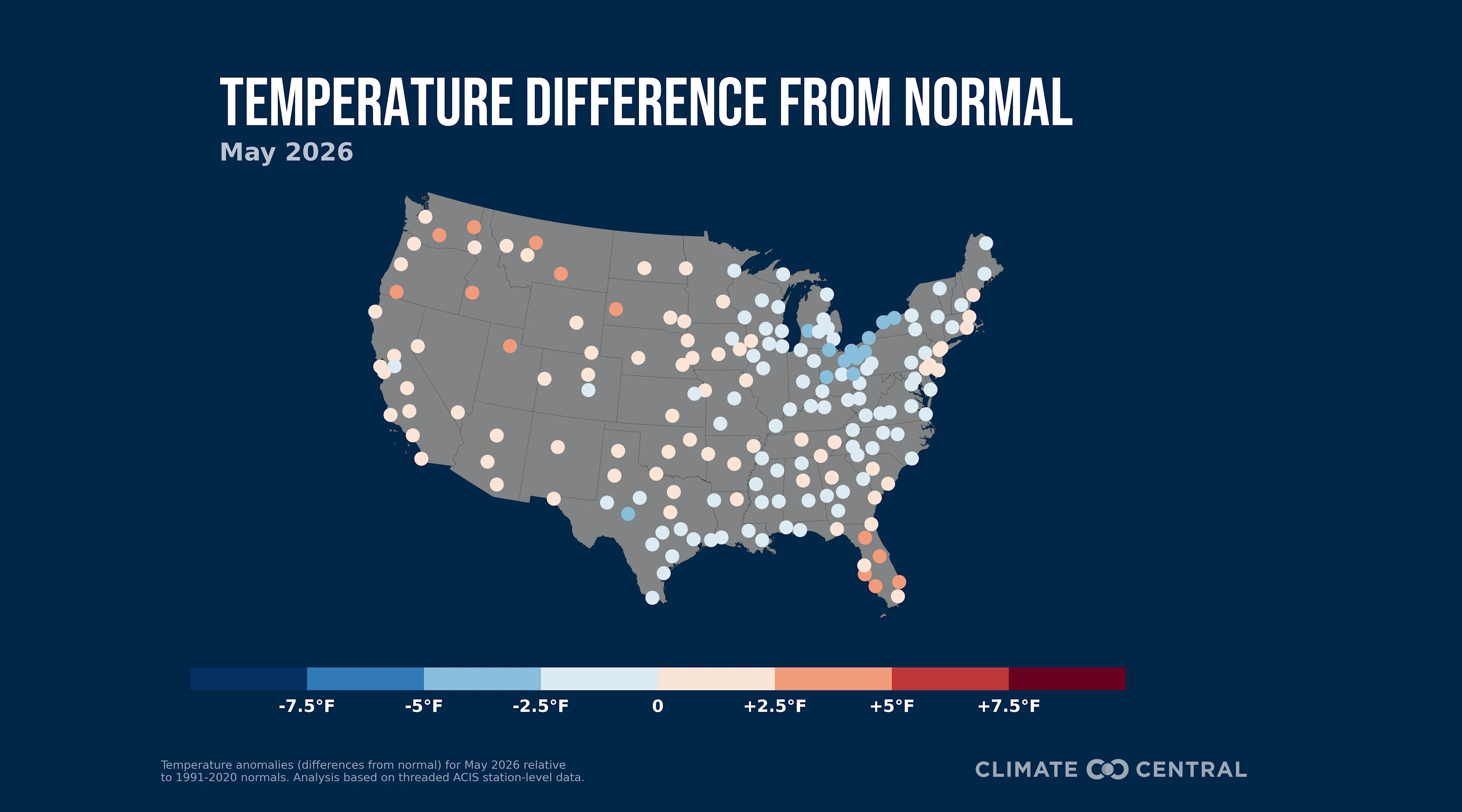
Figure 1. Temperature anomalies (differences from normal) for May 2026 relative to 1991-2020 normals. Analysis based on threaded ACIS station-level data.
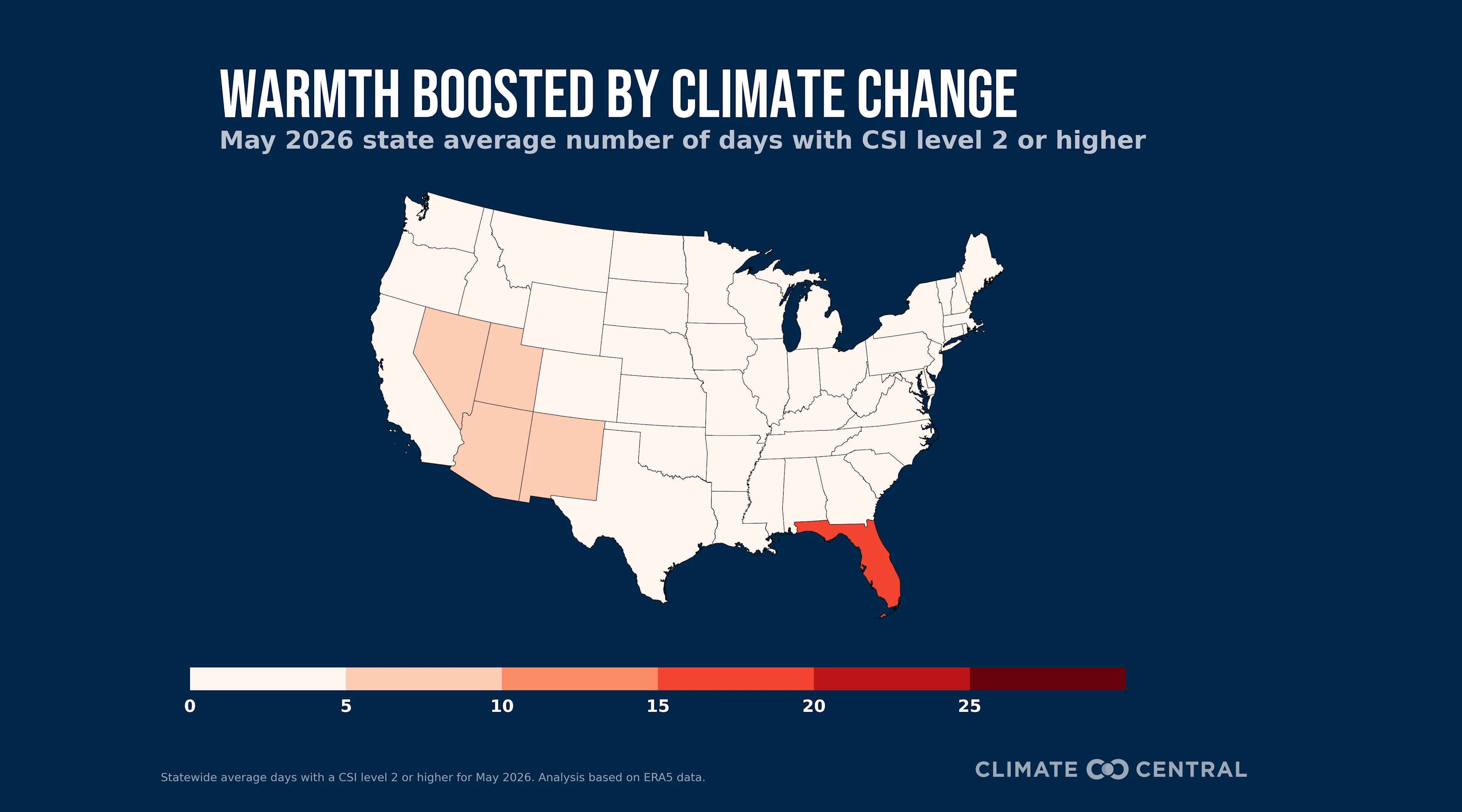
Figure 2. Statewide average days with a CSI level 2 or higher for May 2026. Analysis based on ERA5 data.
2. Local temperature anomaly analysis
The average temperature anomaly — or difference from normal — across the 192 cities analyzed was -0.2°F.
May temperatures leaned cold, with 105 cities recording colder-than-average conditions, compared to 83 cities that experienced warmer-than-average conditions.
Temperatures were elevated across many areas in the Southwest, West, Northwest, Northern Rockies and Plains, and Southeast. The Northern Rockies and Plains stood out as the warmest region, with average temperatures more than 1.6°F above normal.
Twelve cities experienced their top 10 hottest Mays on record.
The most unusually warm city in May was West Palm Beach, Florida, which was 4.1°F warmer than usual.
Of the 192 locations analyzed, most (185) showed long-term warming trends for May, indicating that these cities have warmed on average since 1970.
Reno, Nevada, experienced the greatest increase, with average May temperatures 7.5°F warmer than in 1970.
Table 1. ACIS stations with the highest May 2026 temperature anomaly.
City | State | Temperature anomaly or difference from normal (°F) | Average temperature (°F) | Warming since 1970 (°F) |
|---|---|---|---|---|
West Palm Beach | FL | 4.1° | 82.8° | 3.0° |
Orlando | FL | 3.9° | 81.2° | 2.1° |
Boise | ID | 3.8° | 63.7° | 4.3° |
Billings | MT | 3.7° | 59.1° | 1.1° |
Sarasota | FL | 3.5° | 81.4° | 3.9° |
Great Falls | MT | 3.2° | 54.7° | -1.2° |
Spokane | WA | 3.1° | 59.1° | 4.0° |
Rapid City | SD | 3.1° | 57.2° | -1.1° |
Fort Myers | FL | 3.0° | 82.3° | 3.4° |
Yakima | WA | 3.0° | 61.8° | 3.7° |
Table 2. ACIS stations with the fastest warming May since 1970.
City | State | Warming since 1970 (°F) | Temperature anomaly or difference from normal (°F) | Average temperature (°F) |
|---|---|---|---|---|
Reno | NV | 7.5° | 2.3° | 62.6° |
El Paso | TX | 6.8° | 0.0° | 75.5° |
Las Vegas | NV | 5.5° | 1.6° | 78.9° |
Chattanooga | TN | 5.5° | 0.2° | 70.2° |
Medford | OR | 5.5° | 2.7° | 63.1° |
Tucson | AZ | 5.3° | 0.4° | 77.2° |
Albany | GA | 5.3° | -1.8° | 73.5° |
Huntsville | AL | 4.8° | -2.0° | 69.4° |
Phoenix | AZ | 4.7° | 2.1° | 84.1° |
McAllen | TX | 4.7° | -1.4° | 82.2° |
3. Local Climate Shift Index analysis
San Juan, Puerto Rico, had 28 days at or above CSI 2 in May, indicating that temperatures on those days were made at least two times more likely because of climate change.
Twenty cities across the country experienced at least a week's worth of days at or above CSI 2.
On average, cities in the Southeast experienced the highest number of days (7) with a CSI of 2 or above.
Table 3. ACIS stations with the highest number of days at or above CSI 2 during May 2026.
City | State | Days at CSI 2 or higher | Days at CSI 5 | Average temperature (°F) | Temperature anomaly or difference from normal (°F) |
|---|---|---|---|---|---|
San Juan | PR | 28 | 18 | 82.3° | 0.7° |
West Palm Beach | FL | 25 | 11 | 82.8° | 4.1° |
Sarasota | FL | 24 | 16 | 81.4° | 3.5° |
Miami | FL | 25 | 13 | 82.4° | 2.4° |
Fort Myers | FL | 23 | 11 | 82.3° | 3.0° |
Tampa | FL | 21 | 12 | 81.7° | 2.3° |
Honolulu | HI | 20 | 13 | 78.7° | 0.5° |
Orlando | FL | 18 | 3 | 81.2° | 3.9° |
Gainesville | FL | 12 | 4 | 77.6° | 2.6° |
Reno | NV | 10 | 0 | 62.6° | 2.3° |
Flagstaff | AZ | 9 | 3 | 52.6° | 1.3° |
METHODOLOGY
Calculating the Climate Shift Index
All Climate Shift Index (CSI) levels reported in this brief are based on daily average temperatures and ERA5 data. See the frequently asked questions for details on computing the Climate Shift Index, including a summary of the multi-model approach described in Gilford et al. (2022).
City analysis
We analyzed 192 Applied Climate Information System (ACIS) stations associated with U.S. cities. For each city, we found the CSI time series from the nearest 0.25° grid cell. We calculated the number of days at CSI levels 2, 3, 4, and 5. We used ACIS data to find the average monthly temperatures, temperature anomalies (compared to 1991-2020 normals), and precipitation information, and to derive average monthly warming trends for each city.
Regions
Regions are defined by NOAA’s National Centers for Environmental Information climate regions.