
Climate Shift Index Alert•March 5, 2026
Human-caused climate change fuels early spring heat contributing to increasing severe weather risk across the central United States.
UPDATE: Tornadoes struck Michigan and Oklahoma as a series of severe storms swept the Central U.S. last weekend, leaving at least eight people dead. The National Weather Service confirmed at least 18 tornadoes from last Thursday through Saturday, from Texas to Michigan, eight of which were rated either EF2 or EF3. Climate Central analysis shows that unusually warm early-spring temperatures across the central and eastern U.S., in some places up to 30°F above average. This heat was made at least twice as likely by human-caused climate change. |
|---|
March 5, 2026
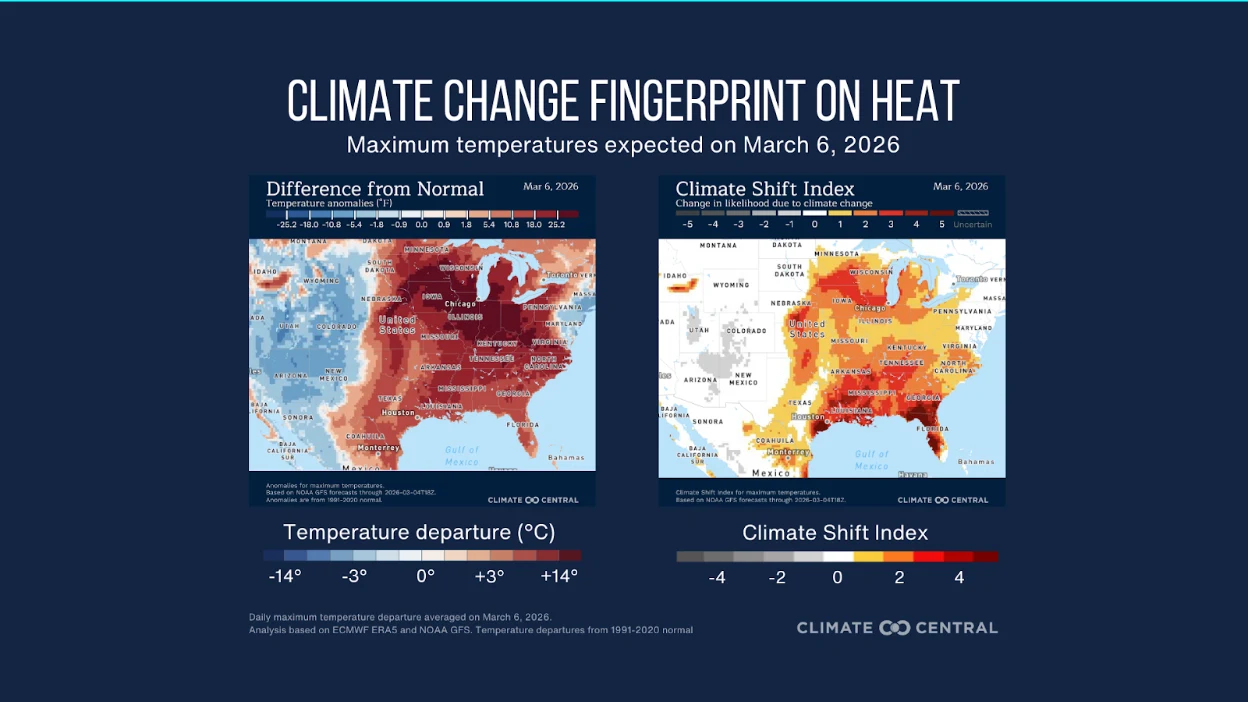
March is coming in like a lion across the central and eastern U.S. with severe weather and widespread abnormal warmth. Climate Central analysis shows that the unusually warm early springtime temperatures forecast for March 6, up to 34°F above-average across the Upper Midwest, are at least twice as likely due to human-caused climate change. The climate change-fueled spring warmth will also help increase the risk for severe weather across the Central Plains, potentially leading to strong thunderstorms, large hail, and tornadoes.
Note: This event may continue beyond March 6. Use the Global Climate Shift Index map to stay updated on heat in your region.
How unusual is the forecasted heat?
Temperatures reaching between 73°F and 90°F (23-21°C) are forecast across the Central and Eastern U.S., especially the Midwest, Mid-Mississippi Valley, and Ohio Valley on Friday, March 6.
These conditions are 14-20°F (8-11°C) above average across the Southern U.S., and up to 34°F above average in the Upper Midwest (based on 1991–2020 climate normals)].
An Enhanced Risk of severe thunderstorms is forecast across eastern Kansas, Oklahoma, and western Missouri and Arkansas Friday afternoon and evening. Warm surface temperatures contribute to atmospheric instability, helping create conditions supportive of thunderstorms when combined with moisture and strong winds aloft.
Convective Available Potential Energy (CAPE) – A measure of the atmospheric energy available for the formation of thunderstorms – has increased with warming.
Since 1979, springtime has seen 10-15 more days each year with CAPE values exceeding 1,000 J/kg in parts of the central and eastern U.S.
How has climate change influenced this heat?
Climate Shift Index (CSI) levels of 3 are forecast in Houston, Memphis, and Chicago, meaning human-caused climate change made this extreme heat at least three times more likely, signaling a significant climate change event.
For March 6th, 116 million people across the eastern U.S. will experience a CSI 2 or higher, indicating a strong influence from climate change.
Temperatures made at least two times more likely by human-caused climate change are expected to impact around 2.8 million square kilometers of land — roughly the size of Argentina — during this time.
To request an interview with a Climate Central scientist, please contact Tom Di Liberto at tdiliberto@climatecentral.org.
How do we know climate change is influencing this heat?
The Climate Shift Index uses peer-reviewed methodology and real-time data to estimate how climate change has increased the likelihood of a particular daily temperature.
Reporting resources
For quick facts about extreme heat in the U.S. → Extreme Heat Toolkit
For an in-depth guide about how to report on attribution science and extreme weather types → World Weather Attribution’s reporting guide
For the latest research-backed messaging to use while reporting on climate change →Potential Energy’s Guide to Reporting on Unnatural Disasters