Report•April 3, 2025
Monthly Attribution Overview March 2025
An analysis of how climate change boosted United States temperatures in March 2025
Using Climate Central’s Climate Shift Index (CSI) tool to measure the impact of climate change on daily temperatures across the United States, as well as NOAA’s Applied Climate Information System (ACIS) to find daily temperature information, we have compiled a high-level overview of how climate change has affected temperature trends in March in cities across the United States. (Full report downloadable as PDF here; dataset downloadable as Excel workbook here.)
1. High Level Findings
March temperature anomalies in the U.S. were elevated across the board: 178 out of 191 analyzed cities were warmer than normal. The highest anomalies stretched from Texas to the Midwest and eastwards to the Northeast (Figure 1).
The average temperature anomaly across all cities was 3.9°F. For 48% of stations (75 cities), this ranked amongst the top 10 warmest March monthly temperatures on record (average stations have data reaching back to 1893).
Climate Shift Index values, meanwhile, were highest in different areas. Texas and the Southwest stood out as regions with the most days experiencing days at or above a CSI of 2, indicating that temperatures on these days were made at least twice as likely to occur as a result of climate change. 28 cities across the country experienced at least a week of days at or above a CSI of 2.
The long-term warming trends during March (see our 2024 Spring Package) show the long-term temperature trends for each city in this analysis, where almost all cities have gotten warmer since 1970.
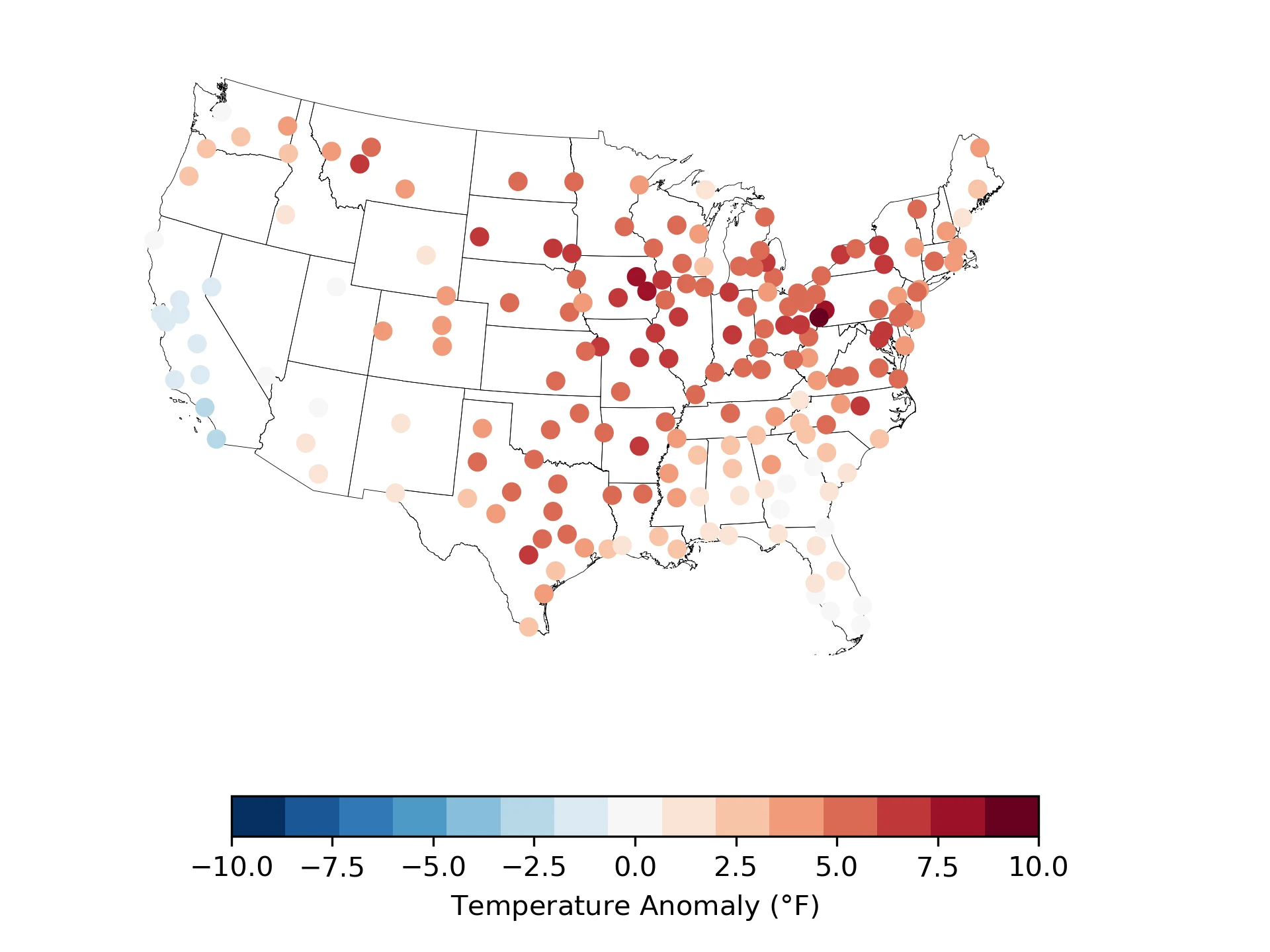
Figure 1. Threaded ACIS temperature anomalies for March 2025 relative to the 1991-2020 standard normal period. Analysis based on ACIS data.

Figure 2. Days with a CSI of 2 or higher for March 2025 for ACIS threaded stations. Analysis based on ERA5 data (March 1-29) and GFS data (March 30-31).
2. Local Temperature Anomaly Analysis
The most unusually hot city in March was Wheeling, West Virginia, where it was 9°F hotter than normal. Wheeling is the fastest-warming ACIS station for March, warming 11.5°F on average since 1970.
80 cities had temperature anomalies greater than 5°F. These included eight in Texas and six in Ohio.
It was the hottest March on record for Honolulu, Hawaii.
The average temperature anomaly across all cities was -0.3°F.
189 out of 191 ACIS stations analyzed had positive temperature trends for March, indicating that these cities have been warming on average since 1970.
City | State | Temperature Anomaly (°F) | Average Temperature (°F) | Warming Since 1970 (°F) |
|---|---|---|---|---|
Wheeling | WV | 9.00 | 49.50 | 11.5 |
Cedar Rapids | IA | 8.04 | 44.57 | 3.8 |
Pittsburgh | PA | 7.69 | 47.40 | 3.2 |
Waterloo | IA | 7.41 | 44.11 | 5.2 |
St Louis | MO | 7.30 | 53.95 | 5.6 |
Anchorage | AK | 7.24 | 33.03 | 1.3 |
Syracuse | NY | 7.06 | 40.85 | 2.2 |
Utica | NY | 7.06 | 40.85 | 2.2 |
Quincy | IL | 7.02 | 49.06 | 4.1 |
Helena | MT | 6.88 | 42.94 | 3.4 |
Table 1. Top 10 ACIS stations with the highest March 2025 temperature anomaly.
City | State | Warming Since 1970 (°F) | Temperature Anomaly (°F) | Average Temperature (°F) |
|---|---|---|---|---|
Wheeling | WV | 11.5 | 9.00 | 49.50 |
Las Vegas | NV | 6.0 | -0.21 | 60.58 |
Chattanooga | TN | 5.9 | 2.95 | 56.10 |
Albany | GA | 5.6 | 0.47 | 60.82 |
El Paso | TX | 5.6 | 1.57 | 60.27 |
St Louis | MO | 5.6 | 7.30 | 53.95 |
LaCrosse | WI | 5.5 | 5.55 | 41.34 |
Duluth | MN | 5.5 | 3.37 | 30.37 |
Tucson | AZ | 5.5 | 1.08 | 62.98 |
Rockford | IL | 5.4 | 5.58 | 42.87 |
Table 2. Top 10 ACIS stations with the fastest warming March since 1970.
3. Local Climate Shift Index Analysis
San Juan, Puerto Rico had 27 days at CSI 5, indicating that temperatures on those days were made at least 5 times more likely because of climate change.
28 cities across the country experienced at least a week of days at or above a CSI of 2. The top six cities with the highest number of days with a CSI at or above 2 all experienced at least two weeks of such days.
City | State | Days at CSI = 2 or higher | Days at CSI = 5 | Average Temperature (°F) | Temperature Anomaly (°F) |
|---|---|---|---|---|---|
Honolulu | HI | 31 | 27 | 77.77 | 3.13 |
San Juan | PR | 30 | 20 | 80.56 | 2.01 |
Anchorage | AK | 24 | 7 | 33.03 | 7.24 |
Colorado Springs | CO | 15 | 4 | 44.98 | 3.88 |
Grand Junction | CO | 15 | 5 | 48.60 | 3.60 |
Victoria | TX | 14 | 3 | 67.55 | 3.09 |
Denver | CO | 13 | 1 | 45.77 | 4.17 |
Juneau | AK | 13 | 1 | 36.52 | 3.62 |
Salt Lake City | UT | 13 | 5 | 45.62 | -0.24 |
Waco | TX | 12 | 0 | 64.05 | 5.25 |
Albuquerque | NM | 11 | 4 | 50.94 | 1.43 |
Table 3. Top 10 ACIS stations with the highest number of days at or above a CSI of 3 during March 2025.
METHODS
Calculating the Climate Shift Index
All Climate Shift Index (CSI) levels reported in this brief are based on daily average temperatures and ERA5 data from March 1 to March 29 2025, and GFS data from March 30 to March 31, 2025. See the frequently asked questions for details on computing the Climate Shift Index, including a summary of the multi-model approach described in Gilford et al. (2022).
City Analysis
We analyzed 191 Applied Climate Information System (ACIS) stations associated with U.S. cities. For each city, we found the CSI time series from the nearest 0.25° grid cell. We calculated the number of days at CSI levels 2, 3, 4, and 5. We used ACIS data to find the average monthly temperatures, temperature anomalies, and precipitation information, and to derive average monthly warming trends for each city.