Climate Matters
Coldest Days Warming Up
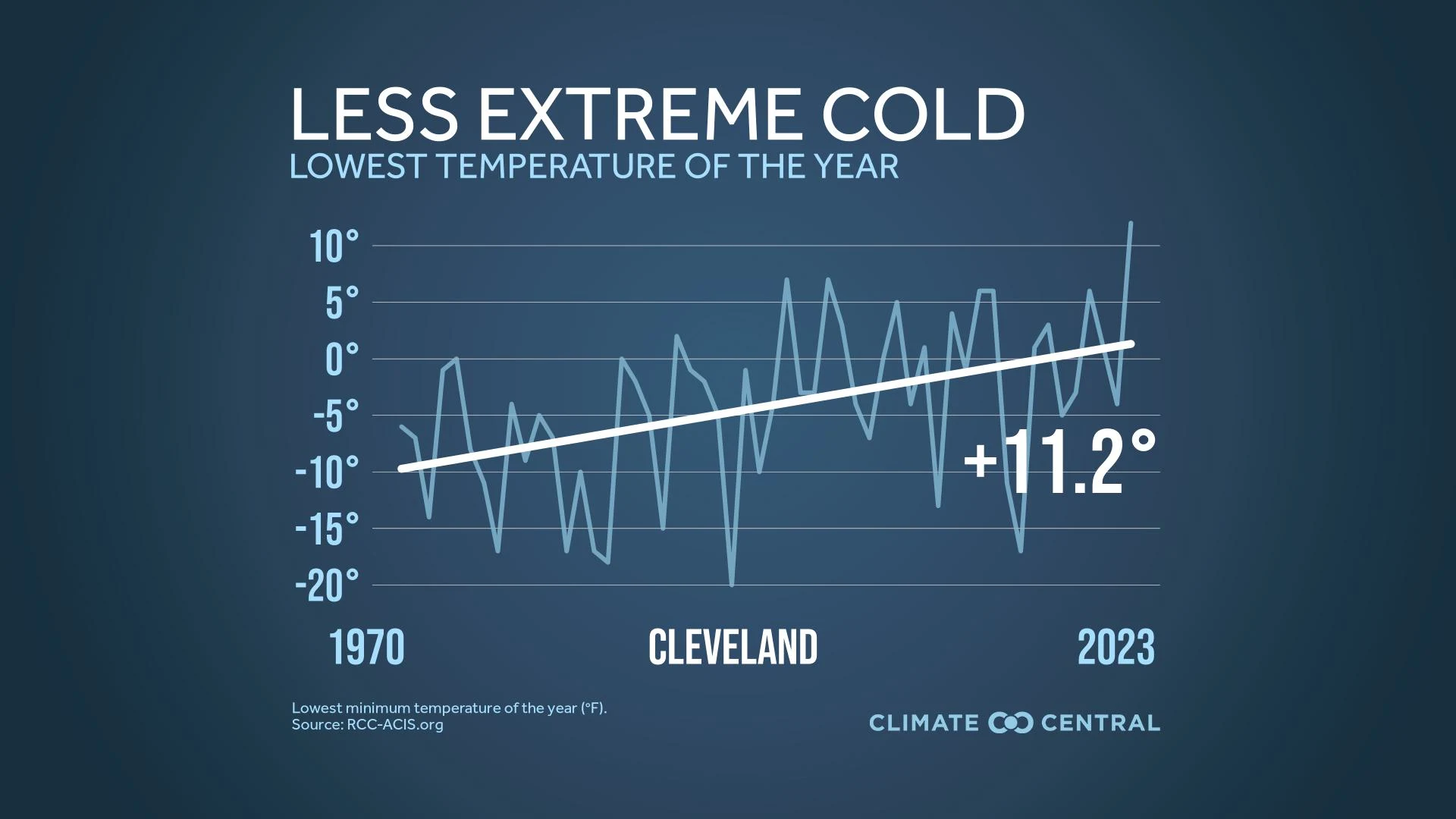
The coldest day of the year has warmed by 7°F on average across 242 U.S. locations since 1970.
Climate Matters•January 28, 2026•Reuse this content
Despite the size and severity of a recent U.S. winter storm, long-term trends show that the planet is overheating, winter is warming quickly, and the coldest days of the year are losing their chill.
That’s the difference between weather and climate. As the cold extremes of winter thaw, the warm extremes of winter are on the rise.
Most (86%) of the 244 U.S. cities analyzed by Climate Central now experience more extremely warm winter days than in the 1970s — six more days on average.
Cities across the Upper Midwest have seen the sharpest rise in extremely warm winter days, with seven more such days now than during the 1970s.
Warming winters have year-round effects on seasonal allergies, winter sports, fruit and nut crops, water supplies, and more.
This Climate Matters analysis is based on open-access data from the National Oceanic and Atmospheric Administration (NOAA). See Methodology for details.
Much of the U.S. typically experiences the coldest day of the year in mid- to late-January.
That’s what many experienced heading into the last week of January 2026 as a significant winter storm brought heavy snow, sleet, and dangerously cold wind chills over an area extending from the Southern Plains to the Northeast.
Despite the severity of this recent winter storm and the serious hazards and safety concerns it brought — from widespread travel disruptions to power outages and tree damage — long-term climate trends show that the planet is overheating, winter is warming quickly, and the coldest days of the year are losing their chill.
That’s the difference between weather and climate.
As the cold extremes of winter thaw, the warm extremes of winter are on the rise. So far in 2026 (through January 26), major U.S. cities have set over four times more daily record-high temperatures (171) than daily record-low temperatures (40).
That’s according to Climate Central’s Local Records Tracker based on weather station data for 247 U.S. cities.
New Climate Central analysis shows that unusually warm winter days are becoming more common across the U.S. — consistent with what we’d expect in our rapidly warming climate.
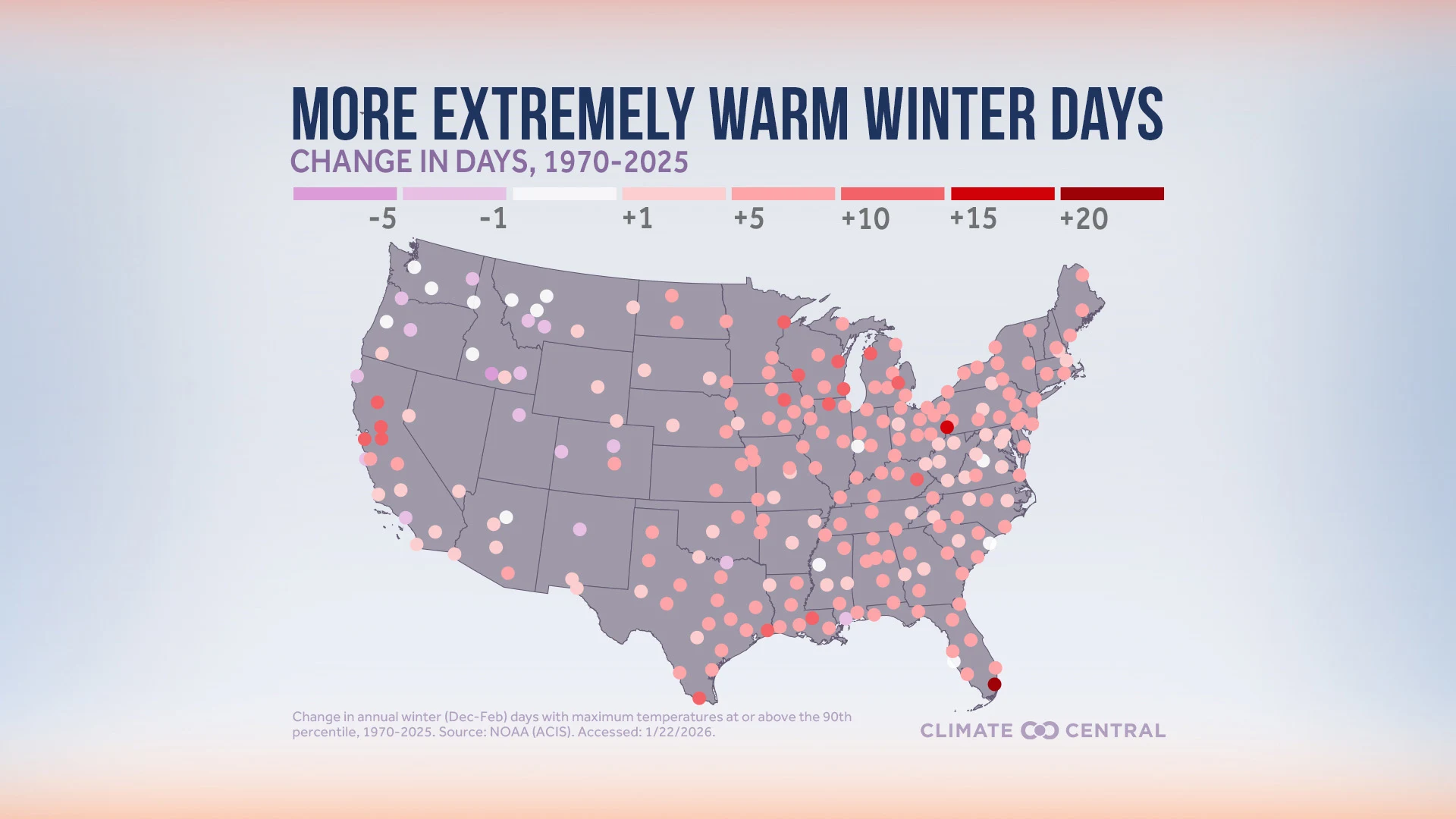
Using data from 244 U.S. weather stations, Climate Central analyzed the change in the number of winter days with extremely warm temperatures since 1970.
Extremely warm winter days have maximum temperatures that are warmer than 90% of all winter daily highs measured from 1970 to 2025 (see Methodology for details).
The number of extremely warm winter days has increased since 1970 in most (86% or 210) of the locations analyzed.
On average, these 210 locations now experience six more extremely warm winter days than they did in the 1970s.
Upper Midwestern cities have seen the sharpest rise in very warm winter days, with an average of seven more such days now than during the 1970s. The Upper Midwest’s many ski areas may be affected by more extreme winter warmth.
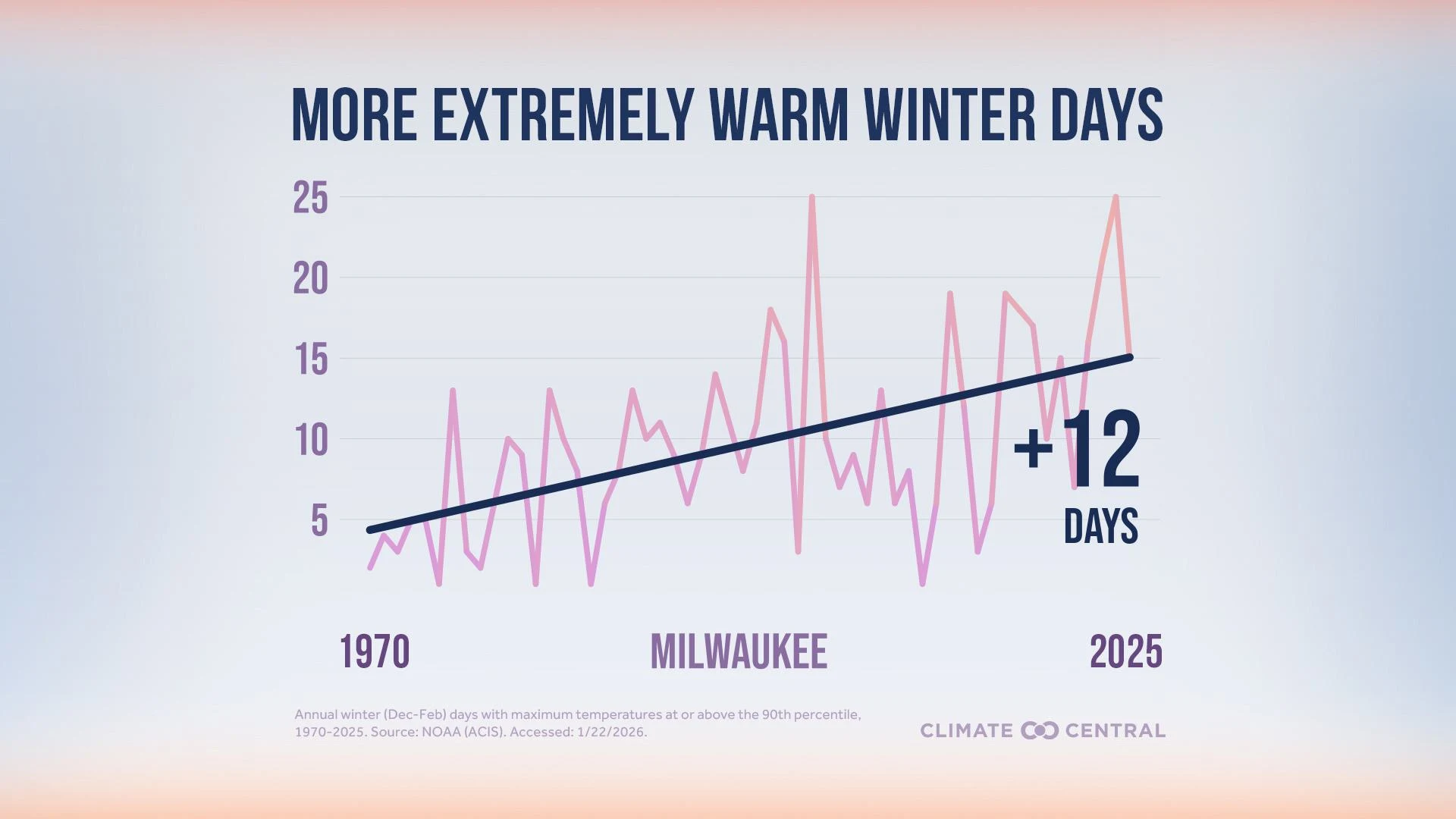
The following cities have seen the largest increase in unusually warm winter days since 1970:
Location | Unusually warm winter days threshold (°F) | Change in unusually warm winter days, 1970-2025 |
|---|---|---|
Miami, Fla. | 83° | +20 days |
San Jose, Calif. | 67° | +13 days |
Beaumont, Texas | 77° | +13 days |
McAllen, Texas | 86° | +12 days |
Milwaukee, Wisc. | 45° | +11 days |
Green Bay, Wisc. | 41° | +11 days |
Only 19 (8%) of the locations analyzed now experience fewer unusually warm winter days — about two fewer days on average — than in 1970. These stations were concentrated in the Northwest and Southwest.
Climate Central’s analysis of U.S. weather station data is consistent with national trends. According to NOAA’s Climate Extremes Index, over the last 30 years (1996-2025), winter maximum temperatures have been exceptionally warm for 21% of the contiguous U.S. — more than double the expected rate in a stable climate.
The most rapid warming in the U.S. has generally occurred when and where it’s coldest, including at night, in northern parts of the country, and during winter.

Winter (December, January, February) is the fastest-warming season for the majority (76%) of U.S. locations analyzed by Climate Central.
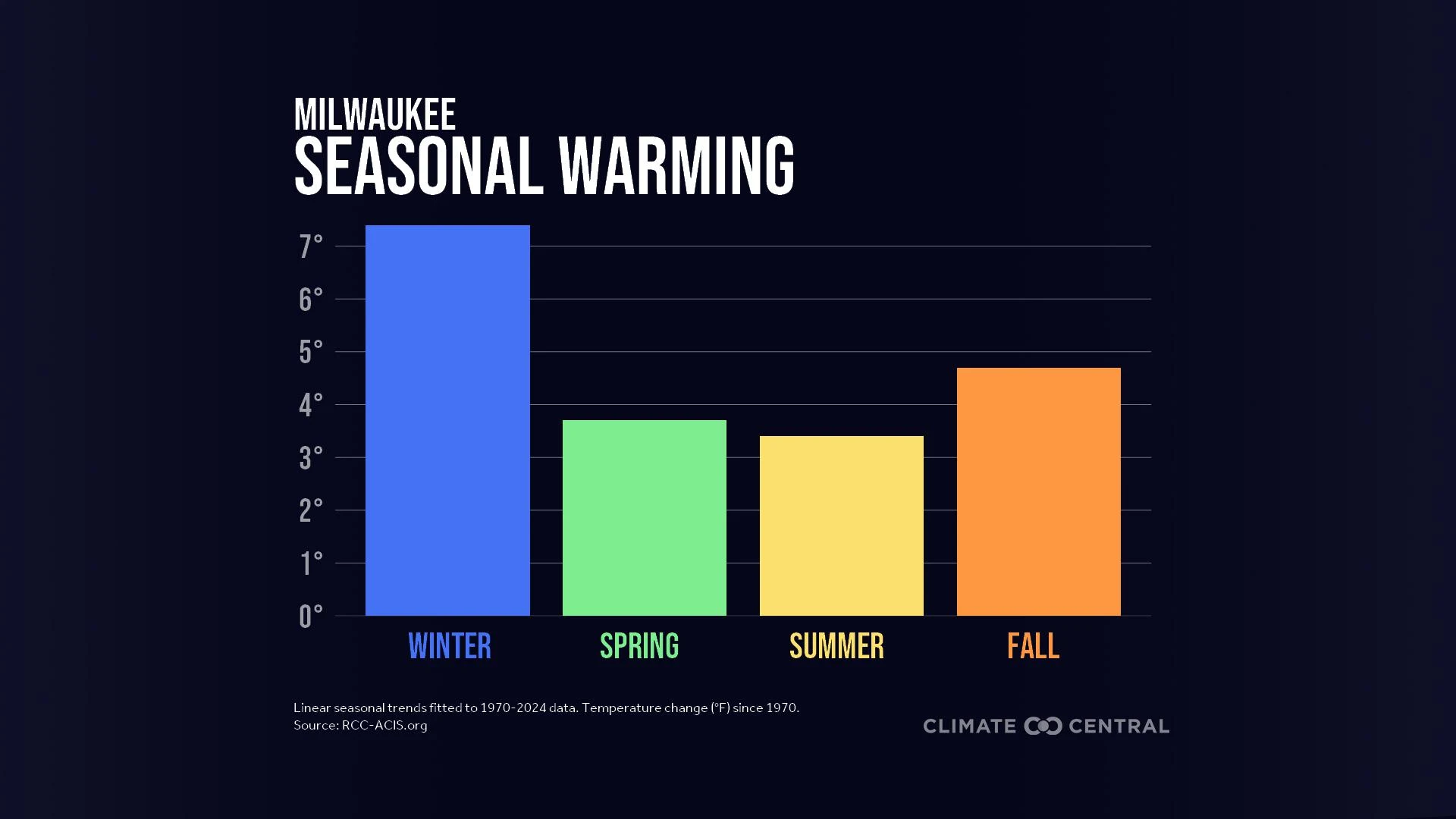
Locations with the fastest winter warming since 1970 are found from coast to coast, but especially in the Northeast and the Great Lakes region.
Still freezing nights — but fewer of them.
The annual number of freezing nights has dropped in 210 U.S. locations from 1970 to 2024.
These 210 cities now experience an average of 15 fewer freezing nights than during the early 1970s.
Still cold streaks — but shorter ones.
Winter cold streaks are shrinking in 98% of 24o U.S. locations analyzed (1970-2023).
On average, winter cold streaks are now six days shorter across all locations analyzed.
Still extremely cold days — but not as cold.
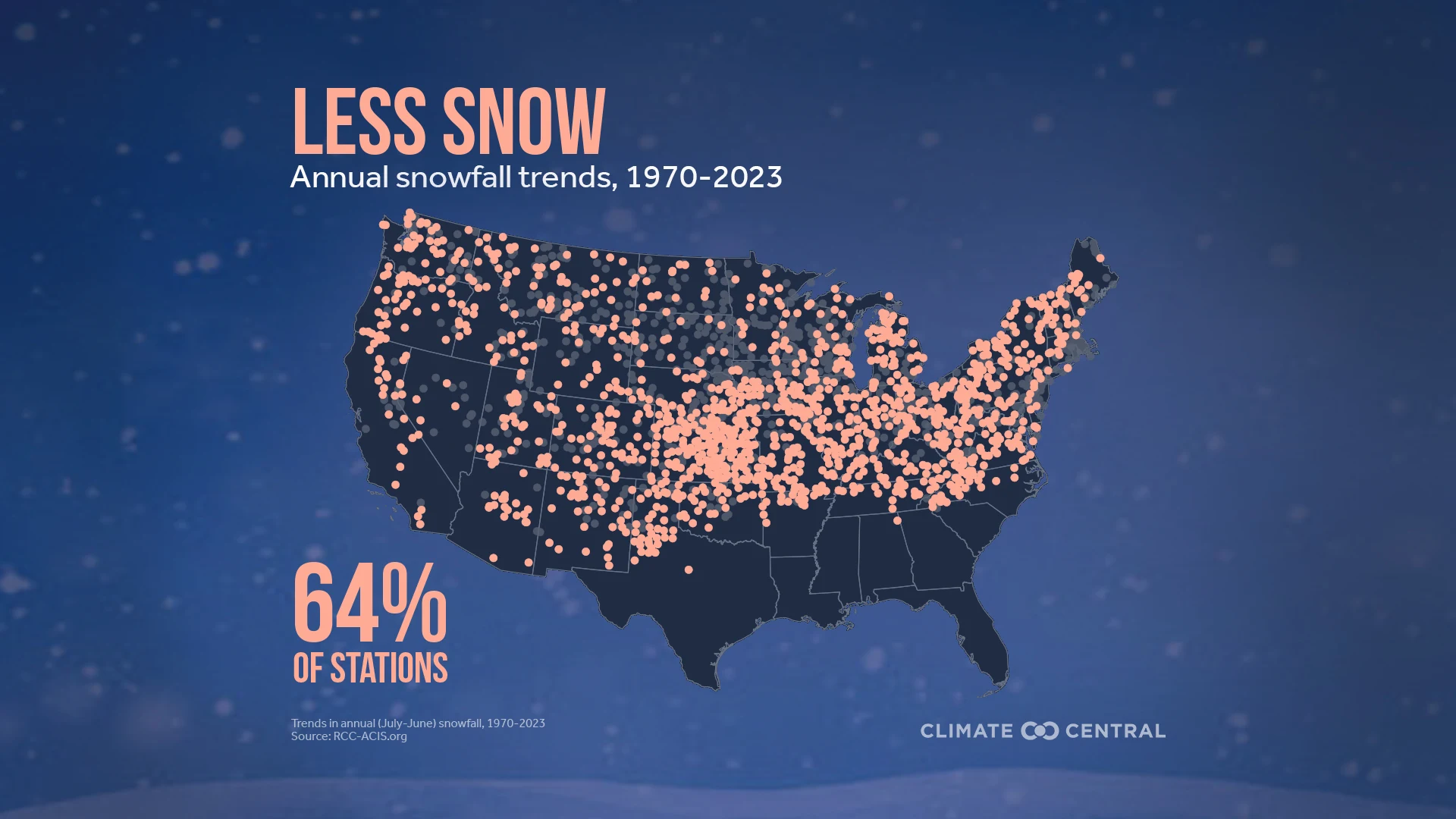
The coldest day of the year has warmed by 7°F on average across 242 U.S. locations analyzed (1970-2023).
Since 1970, the coldest temperatures of the year rose at least 1°F in nearly all (97%) locations.
Contributing to longer growing seasons and longer allergy seasons.
Disrupting the chill that valuable fruit and nut crops depend on.
Changing the timing, location, and amount of snowfall — as well as spring snowmelt and water supplies.
Decreasing home heating demand, which may be offset by longer, higher cooling demand during warm seasons.
Allowing mosquitos to thrive for longer periods each year.
Threatening the reliability and safety of cold-weather sports around the world.
Check NOAA’s one-month to three-month outlooks for the probabilities of above- and below-normal temperatures and precipitation across the U.S. in the months ahead.
Climate Central’s Climate Shift Index (CSI) system provides tools, data, custom maps, and local alerts to answer this question in real-time. Here are three ways to use the CSI:
Explore and share the map. Climate Central’s Climate Shift Index map tool shows the influence of human-caused climate change on daily minimum, maximum, and average temperatures across the globe, every day. Check and share the map for your local area today, tomorrow, and any day in the recent past.
Create custom CSI maps. Get access to CSI data in KML format using the panel links in the map tool.
Sign up for alerts. Sign up here to receive custom email alerts when significant CSI levels are detected in your local area.
Submit a request to SciLine from the American Association for the Advancement of Science or to the Climate Data Concierge from Columbia University. These free services rapidly connect journalists to relevant scientific experts.
Browse maps of climate experts and services at regional NOAA, USDA, and Department of the Interior offices.
Explore databases such as 500 Women Scientists, BIPOC Climate and Energy Justice PhDs, and Diverse Sources to find and amplify diverse expert voices.
Reach out to your State Climate Office or the nearest Land-Grant University to connect with scientists, educators, and extension staff in your local area.
Climate Central assessed local long-term trends (1970-2025) in the annual number of extremely warm winter days. This analysis defines an extremely warm winter day as any day during meteorological winter (December, January, February) with a maximum temperature at or above the 90th percentile. The 90th percentile was calculated based on all winter daily maximum temperatures from the start of winter 1970 (12/1/1969) through the end of winter 2025 (2/28/2025).
Data were obtained on 1/22/2026 for 247 U.S. weather stations from the Applied Climate Information System, which is developed, maintained, and operated by NOAA’s Regional Climate Centers.
For reported data summaries based on linear trends, however, only 244 stations are included due to data completeness measures that were not met by three stations: Bend, Ore.; Hazard, Ky.; Wheeling, W.Va.
Climate Matters © 2026 by Climate Central is licensed under CC BY 4.0
This license grants permission to use, distribute, and reproduce all text, graphics, and multimedia content published on this page in any medium, provided that Climate Central is credited per the CC BY 4.0 license.
Permission to use data and other materials published on this page is granted for non-commercial uses, commercial news purposes, and educational purposes as governed by Climate Central's Terms of Use.