Climate Matters
Climate Change is Heating Up West Africa's Cocoa Belt
New analysis finds that climate change is heating up West Africa’s cocoa belt, with implications for global chocolate supplies.
Climate Matters•February 18, 2026•Reuse this content
Coffee is one of the most popular beverages in the world. But it’s getting harder to produce and more expensive to buy.
Extreme weather in global coffee-growing regions has likely contributed to coffee price spikes in recent years.
New analysis from Climate Central shows that climate change added more coffee-harming heat to the world’s coffee-growing regions during 2021-2025, potentially affecting the quality and quantity of recent harvests.
The 25 coffee-growing countries analyzed account for about 97% of global coffee production — and all of them experienced more coffee-harming heat during the past five years because of climate change.
The top five coffee-growing countries, responsible for 75% of the world’s supply, experienced on average 57 extra days of coffee-harming heat annually because of climate change.
Coffee is one of the most popular beverages in the world; more than 2 billion cups are consumed every day. At least two-thirds of adults in the U.S. drink coffee daily. But this beloved beverage is getting harder to produce and more expensive to buy.
Global coffee prices have been volatile in recent years, reaching record-high prices in December 2024 and again in February 2025. In the U.S., tariffs on imports from Brazil (which supplies about a third of U.S. coffee) also contributed to pricier coffee this past year.
But extreme weather in the global coffee-growing regions (“the bean belt”) is at least partly to blame for recent coffee price surges.
Coffee plants thrive under specific temperature and rainfall ranges. Suboptimal conditions can harm the quality and quantity of bean harvests. And this affects the availability, price, and quality of the drink that so many love.
Climate change is bringing more excessive heat to major coffee-growing regions, according to a new analysis using Climate Central’s Climate Shift Index.
Climate Central analyzed daily temperatures during the past five years (2021-2025) to understand how frequently climate change is pushing temperatures past the coffee-harming heat threshold of 30°C (86°F) in 25 countries across the bean belt (see Methodology for details).
Temperatures beyond 30°C are extremely harmful for growing arabica coffee plants and suboptimal for growing robusta coffee plants. Beans from these two plant species (arabica and robusta) make up the vast majority of the global coffee supply.
For this analysis, we counted the extra days with coffee-harming heat these countries experienced each year because of climate change.
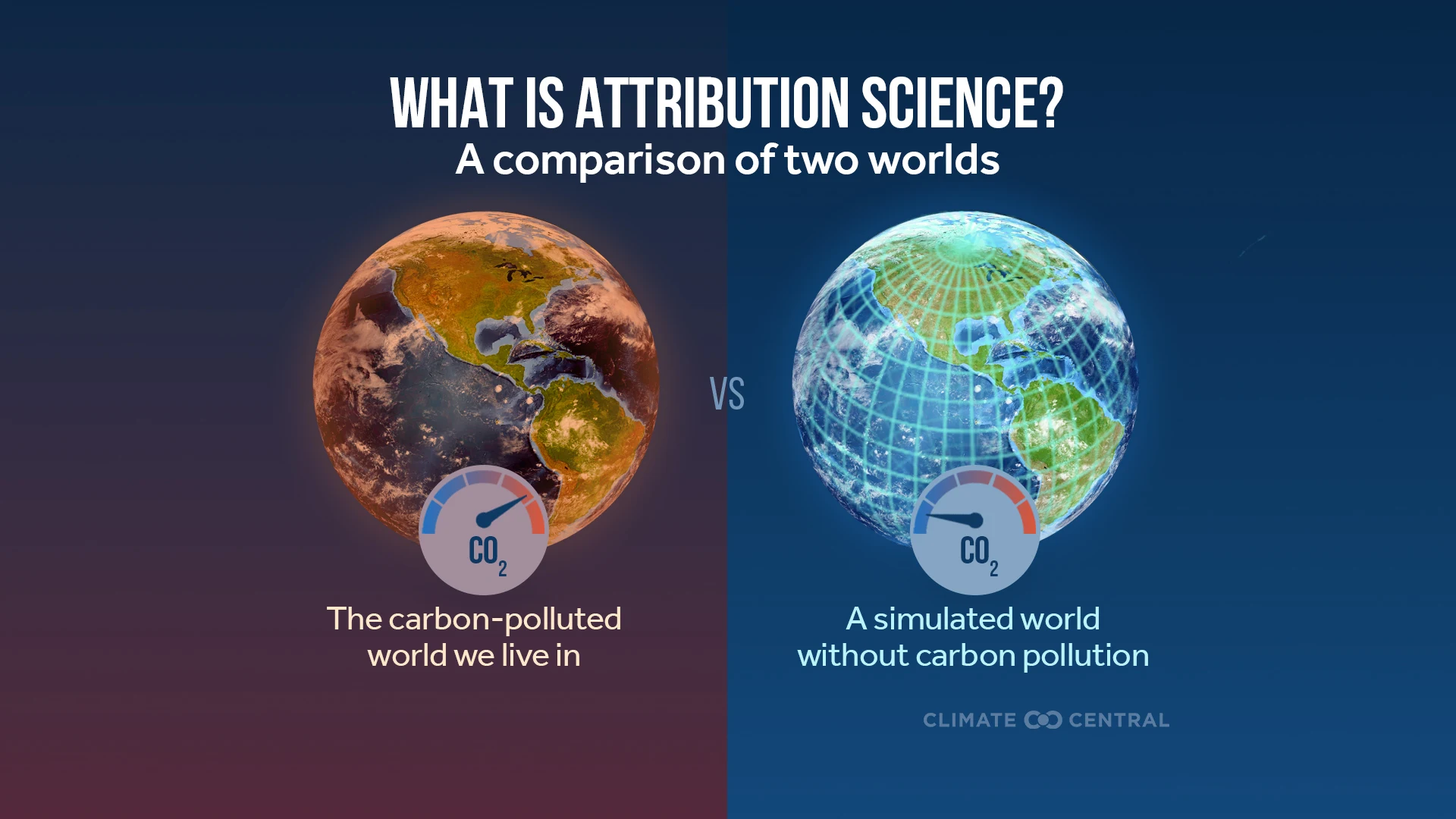
This attribution science analysis includes observed temperature data and estimates of temperatures that would have occurred in a world without carbon pollution derived from Climate Central’s Climate Shift Index.
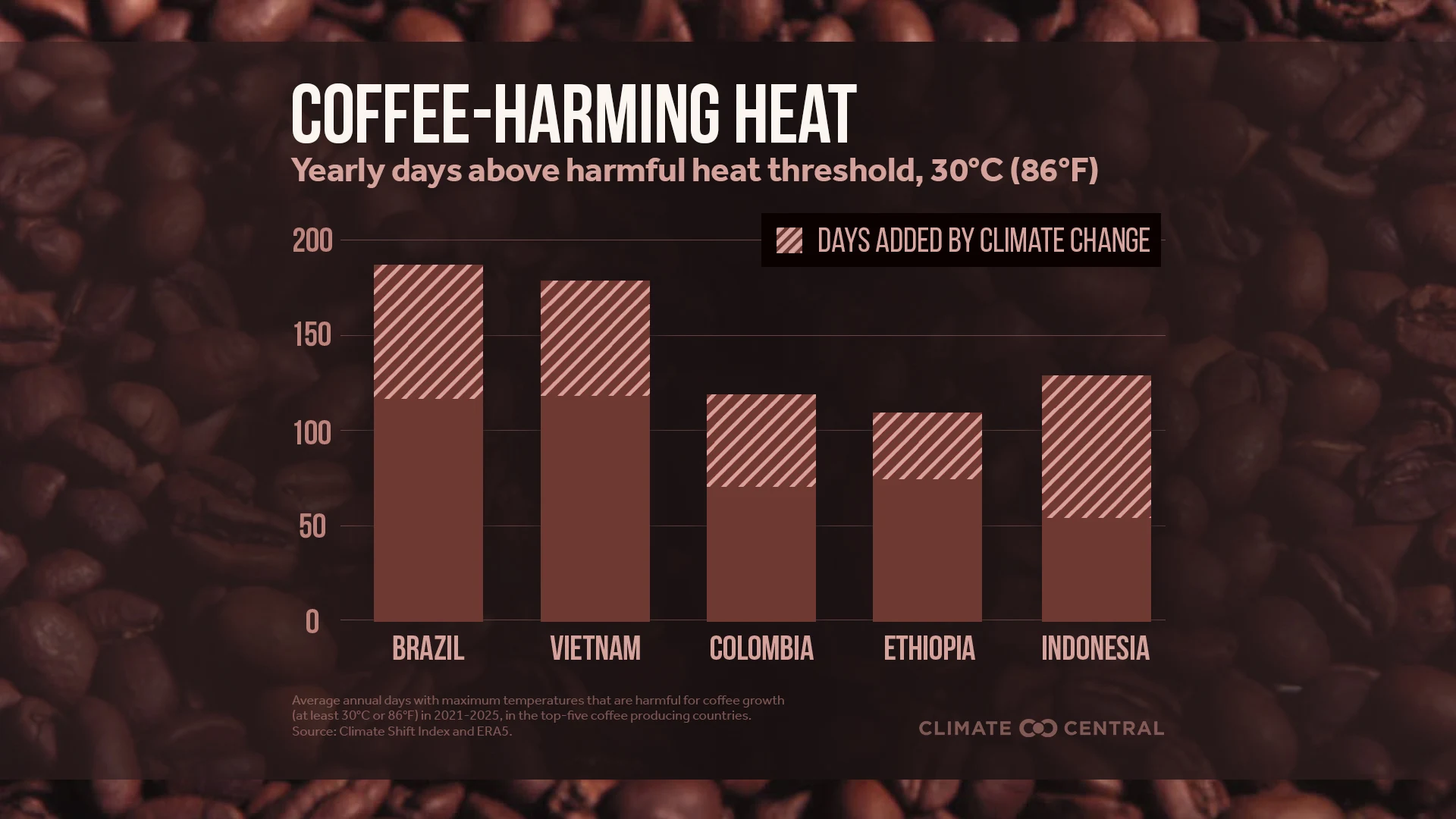
The top five coffee-producing countries (Brazil, Vietnam, Colombia, Ethiopia, and Indonesia) are responsible for roughly 75% of the global coffee supply.
These five countries now experience coffee-harming heat for more than 144 days of the year on average (Table 1). Without the influence of climate change, there would be about 57 fewer days each year with such heat.
Brazil — the world’s top coffee-growing nation — saw 70 extra days of coffee-harming heat on average each year because of climate change. The country’s top coffee-growing state, Minas Gerais, experienced an extra 67 such days each year.
Table 1.
Coffee-harming heat due to climate change in the top five coffee-producing countries.
Country | % of global coffee supply | Average annual days with coffee-harming heat | Average annual days with coffee-harming heat added by climate change |
|---|---|---|---|
Brazil | 37 | 187 | 70 |
Vietnam | 17 | 179 | 59 |
Colombia | 8 | 119 | 48 |
Indonesia | 6 | 129 | 73 |
Ethiopia | 6 | 108 | 34 |
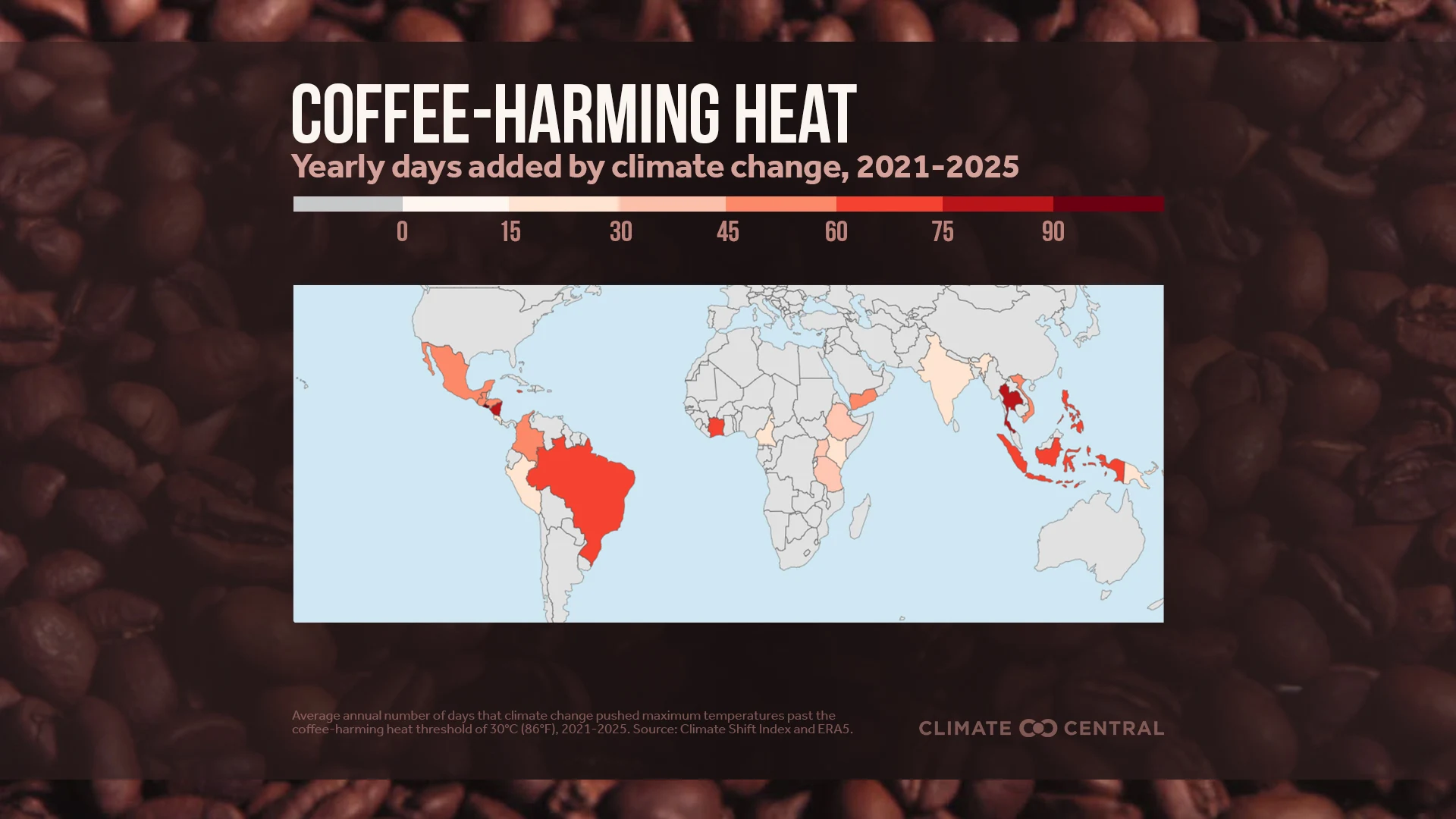
Overall, we analyzed daily temperatures in 25 coffee-growing countries. These 25 countries account for about 97% of global coffee production — and all of them experienced more coffee-harming heat during the past five years because of climate change.
On average, countries experienced about 47 extra days each year of this harmful heat because of climate change.
The countries that saw the most such days were El Salvador (99), Nicaragua (77), and Thailand (75).
Download data for 25 countries and 532 districts or states.
Arabica coffee plants (which account for about 60-70% of the global supply) are more sensitive to heat than robusta varieties. Research shows that even cooler temperatures in the 25-30°C (77-86°F) range are suboptimal for arabica growth.
The results of this analysis (based on temperatures above 30°C) are therefore a conservative estimate of impacts of carbon pollution-fueled heat on arabica coffee.
It’s also important to note that arabica is typically farmed at higher elevations, where temperatures may be cooler than the area-weighted regional average temperatures in this analysis.
Changes to rainfall patterns can further stress coffee plants. Adequate and consistent rain is crucial for their growth. Annual rainfall totals between 59 and 79 inches are optimal and droughts can reduce harvests. A 2023 drought in Brazil has been linked to recent coffee price spikes.
Pests and diseases, such as coffee leaf rust and the coffee berry borer, can also impact the quantity and quality of bean harvests. Shifting temperatures and rainfall patterns can influence their spread and management.
As climate change brings more extreme heat, changes rainfall patterns, and shrinks the land area that can be cultivated, farmers are forced to adapt. Most coffee growers are smallholders (farming less than about 12 acres of land) who may rely on this one crop for their livelihoods, making them particularly vulnerable to the agricultural impacts of climate change.
Changing conditions threaten the amount of land available for coffee production. Land suitable for coffee farming may decrease by 50% by 2050 without adequate adaptation.
The future range for coffee cultivation may migrate due to climate change. Current coffee-growing regions may become too warm over time, especially for heat-sensitive arabica. Regions previously unsuitable for coffee farming, because of elevation and temperatures, may become better-suited in a warming world. While this could open economic opportunities in new areas, it could also result in deforestation as farmers pursue farmland at higher (cooler) elevations suitable for coffee cultivation.
Sustainable agricultural practices can help farmers balance productivity with climate resilience. Planting a taller tree canopy that shades coffee plants can protect them from harmful heat. Plants grown in full sun produce higher yields, but coffee grown under the shade of native trees has additional ecological benefits of providing wildlife habitat (especially for birds) and enriching soil.
Climate Central analyzed observed temperatures using ERA5 reanalysis temperature data. Additionally, this analysis utilized counterfactual temperatures, or the temperatures that would have occurred in a world without carbon pollution. These are estimated using Climate Central’s Climate Shift Index (CSI) system.
For the period of analysis (2021-2025), we counted the number of days each year that would have had maximum temperatures below 30°C (86°F) in a world without carbon pollution (a modeled counterfactual scenario) but were pushed over the 30°C threshold due to the influence of carbon pollution (in the observed ERA5 reanalysis temperature data). This represents the number of coffee-harming days added by climate change.
We arrived at the 30°C temperature thresholds based on peer-reviewed research from Naik et al. (2021) and Cheserek and Gichimu (2012). Research shows that temperatures above 30°C are growth-limiting or extremely harmful for arabica and suboptimal for robusta.
The analysis includes data for 25 major coffee-producing countries and 532 of their districts, states, or regions.
We identified these major coffee-growing areas using the Spatial Production Allocation Model (SPAM) 2020 global coffee dataset, which maps where coffee is produced around the world, and limited our analysis to those locations (the dataset does not include highly localized or very small coffee regions, such as Hawaii and Puerto Rico). We then combined these coffee-growing areas with regional boundaries (using the Global Administrative Areas database) to calculate daily temperatures only where coffee is actually grown within a country.
For each administrative region, we counted how many days per year exceeded 30°C between 2021 and 2025 and averaged spatially across each region. We then averaged those regional results by country to calculate the country-level values reported here.
The Smithsonian’s Bird Friendly® program offers certification to organic coffee (and cocoa) farmers who use sustainable agricultural practices that protect wildlife habitat and forestland. Explore the program and find a list of certified bird-friendly coffees.
To request an interview with a Climate Central scientist about attribution science, please contact Abbie Veitch, aveitch@climatecentral.org.
Climate Matters © 2026 by Climate Central is licensed under CC BY 4.0
This license grants permission to use, distribute, and reproduce all text, graphics, and multimedia content published on this page in any medium, provided that Climate Central is credited per the CC BY 4.0 license.
Permission to use data and other materials published on this page is granted for non-commercial uses, commercial news purposes, and educational purposes as governed by Climate Central's Terms of Use.