Climate Matters•January 28, 2020•Reuse this content
2020 Groundhog Day Trends
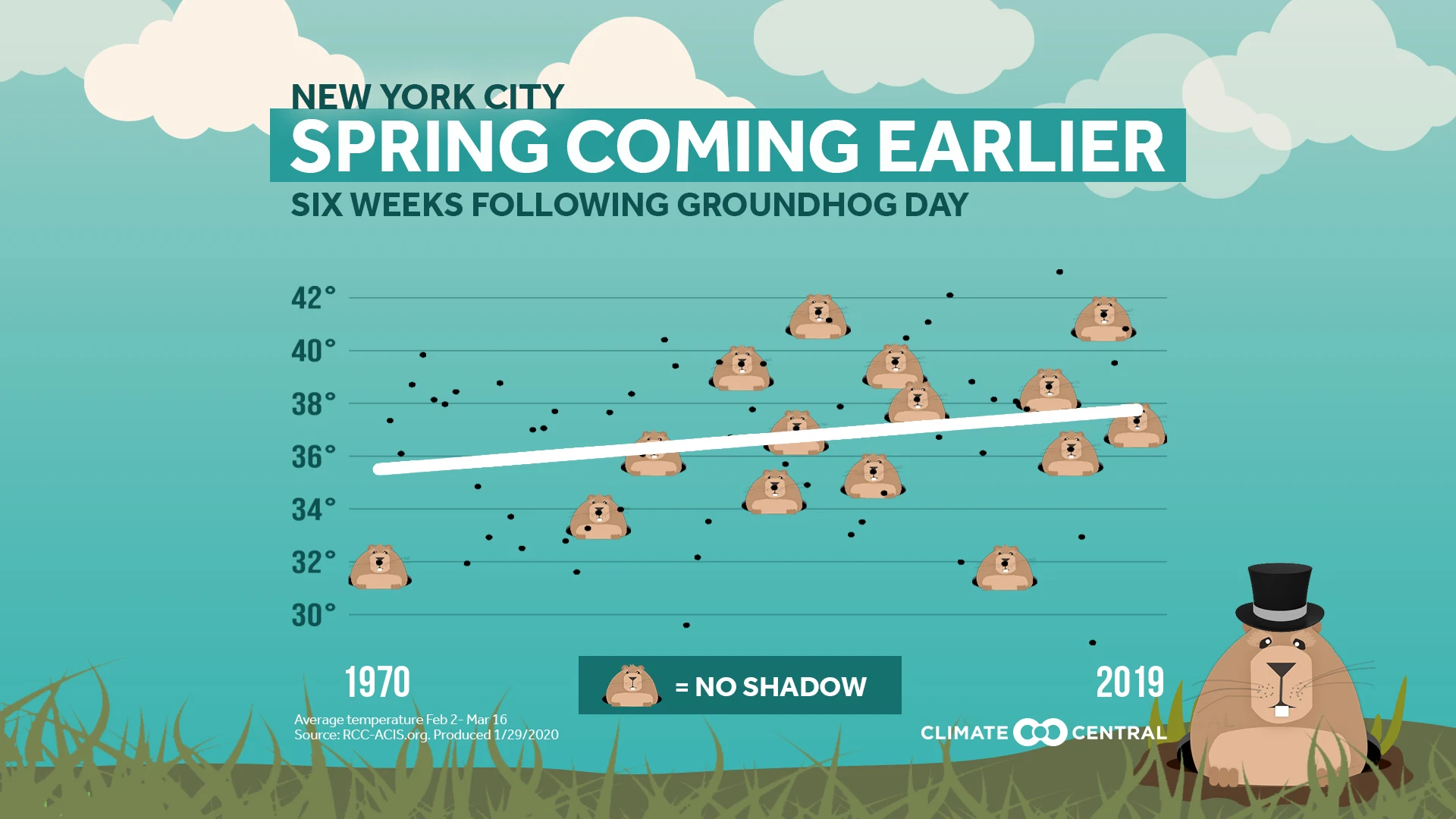

Sunday is Groundhog Day, that fateful holiday when meteorologists must answer to a rodent and its shadow (or lack thereof). Like it or not, Punxsutawney Phil has been predicting earlier springs more often—14 times in the past 50 years, after only 5 times in the 73 years prior. While Phil’s year-to-year predictions are faring worse than a coin flip, his shift toward earlier springs may be onto something; the six weeks after Groundhog Day are warming up in 93% of the 244 cities analyzed. This year is no exception, with leaves appearing in the Southeast weeks before normal. do come at a cost, from early pest outbreaks and mistimed migrations to emboldened groundhogs.
Methodology: Groundhog Day graphics plot the average temperature between February 2 and March 16.
Climate Matters © 2020 by Climate Central is licensed under CC BY 4.0
This license grants permission to use, distribute, and reproduce all text, graphics, and multimedia content published on this page in any medium, provided that Climate Central is credited per the CC BY 4.0 license.
Permission to use data and other materials published on this page is granted for non-commercial uses, commercial news purposes, and educational purposes as governed by Climate Central's Terms of Use.