
Climate Matters
More Frequent Fire Weather
More frequent hot, dry, and windy fire weather conditions are boosting wildfire risks across the U.S.
Climate Matters•December 10, 2025•Reuse this content
Carbon pollution from fossil fuels made record heat, hurricanes, fires, and floods worse in 2025, disrupting lives in the U.S. and beyond. Here are five ways:
In 2025, carbon pollution made 89% of record high daily temperatures set across 247 major U.S. cities more likely — and influenced risky extreme heat events around the globe.
Hurricane Melissa, the strongest Atlantic hurricane of the year, devastated Jamaica after making landfall as a Category 5 storm. Carbon pollution boosted the storm’s peak wind speed, making it even more dangerous.
Carbon pollution also helped fuel the Los Angeles fires of January 2025 (the costliest on record), partly by making fire weather conditions at the time more likely and intense.
The U.S. saw a record number of flash floods in 2025, which included the deadly July floods in Texas. Carbon pollution brings heavier rainfall extremes and more of the inland flood hazards that marked 2025.
U.S. billion-dollar weather and climate disasters — now tracked by Climate Central — had a record-costly start to 2025. Climate Central will release data for the full year early in 2026.
This Climate Matters analysis is based on open-access data from the National Oceanic and Atmospheric Administration (NOAA). See Methodology for details.

Click to download this ready-to-air video, Christmas Trees Feeling the Heat: Science Races to Keep Climate Grinch From Stealing a Holiday Tradition. This fully produced news story can be used by media outlets at no cost for broadcasts, streaming, and digital stories. Click here for other available packages. |
|---|
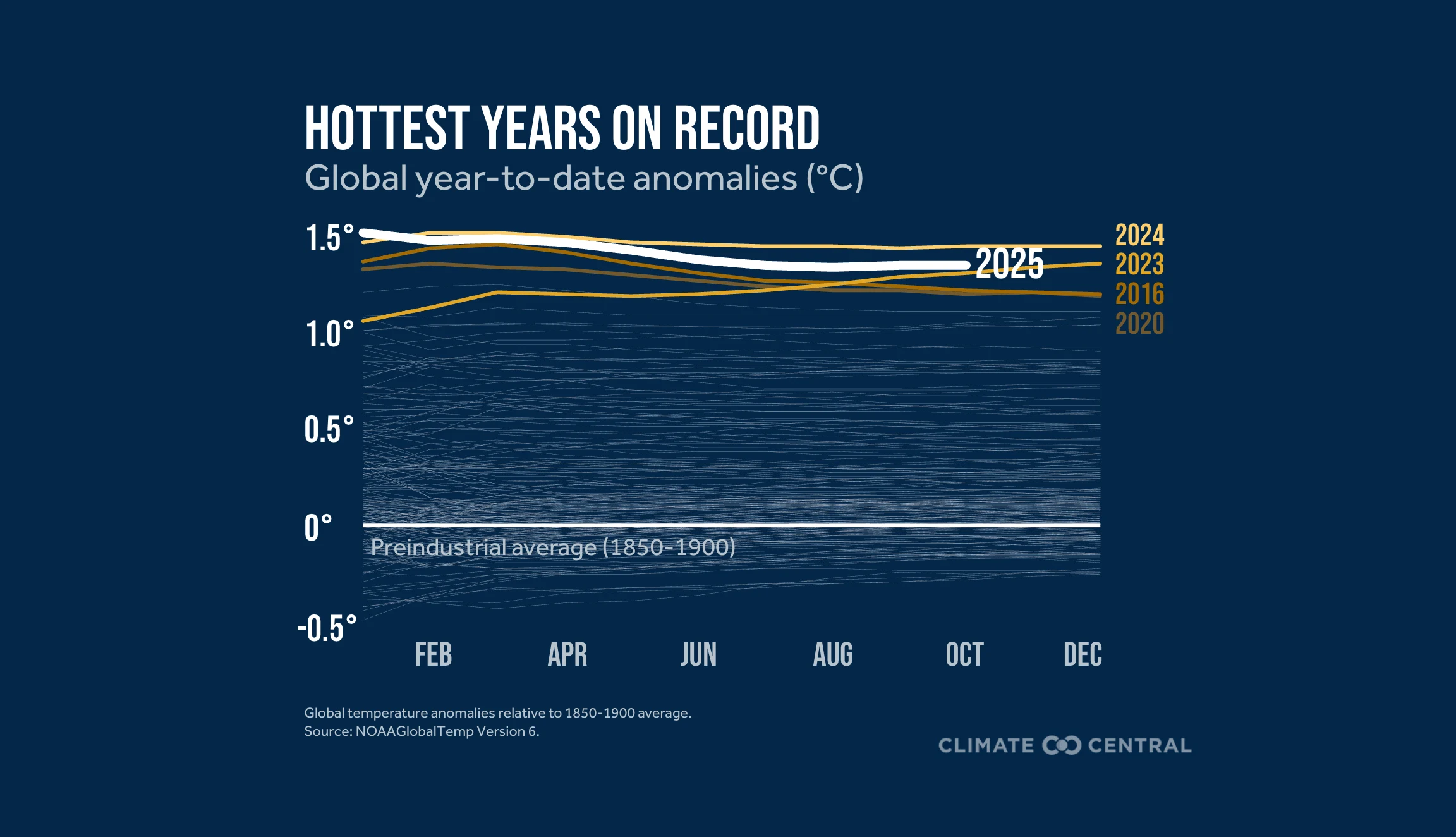
Following back-to-back record hot years, 2025 is virtually certain to rank among the top five hottest years globally.
This is no surprise, given that heat-trapping carbon pollution from fossil fuels (coal, oil, and gas) has continued to rise — and is projected to reach record levels yet again in 2025.
As 2025 draws to a close, we review five ways that human-caused carbon pollution influenced extreme weather and disrupted lives, livelihoods, and vital ecosystems in the U.S. and beyond.
The pollution-fueled devastation witnessed this year will only intensify with continued fossil fuel use. Meeting rising energy demand with clean, affordable sources of energy like wind and solar is essential to ensure a safer, healthier future.
Most of the world is progressing rapidly in this direction. Globally, 70% of the increase in electricity demand in 2024 was met with renewable energy like wind and solar.
But in the U.S., recent progress in the clean energy transition faces significant headwinds. As of fall 2025, the U.S. has rolled back landmark 2021-2022 policies to boost clean energy and climate resilience, and is set to withdraw from the Paris Agreement by January 2026.
Without a change of course, the country is likely to experience more of the extreme heat, wildfires, flash floods, and damaging hurricanes that marked 2025.
As burning fossil fuels heats the planet, the effects are felt locally — including through record-setting temperatures.
In a stable climate, extreme daily highs and lows would each account for about half of all records. But because of human-caused warming, record highs are outpacing record lows across the U.S.
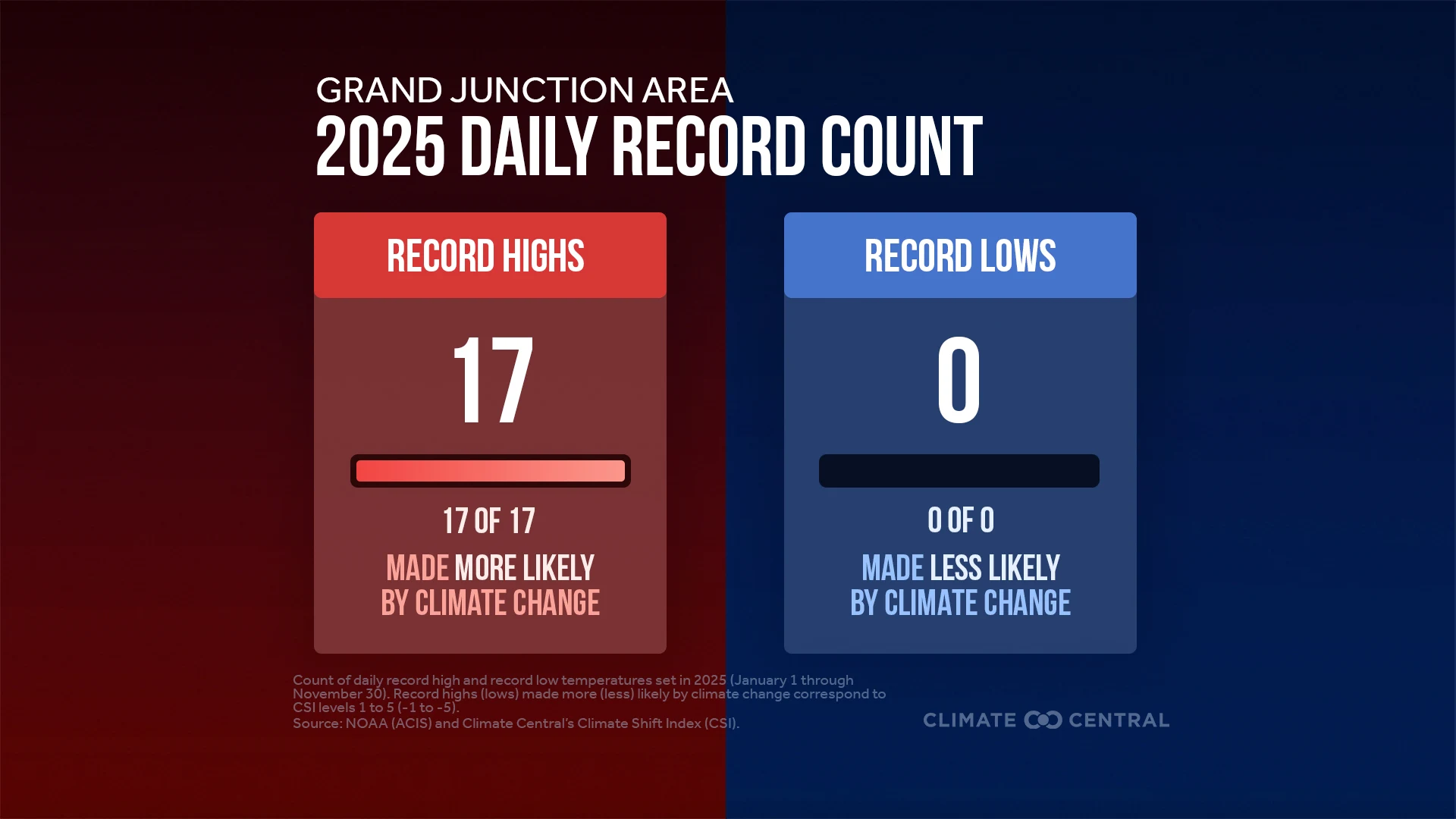
That’s also what we saw in 2025: over four times more record highs (1,313) than record lows (298) were set across 247 major U.S. cities (through November). Further analysis shows that this is no coincidence.
According to Climate Central’s Climate Shift Index, heat-trapping carbon pollution made the vast majority of 2025’s record highs (89%) more likely and record lows (73%) less likely. That’s exactly what we’d expect on an overheating planet.
Explore data and graphics showing how carbon pollution influenced 2025’s record-setting temperatures in 247 U.S. cities — 213 of which set more daily record highs than lows.
Use Climate Central’s Local Records tool to access daily-updating data and graphics on temperature records across the U.S.
These daily temperature records occur year-round. During the warmest months of the year, they contribute to the rising frequency and intensity of extreme heat — the deadliest kind of weather.
The fingerprints of human-caused climate change were also detected on dozens of record-breaking and risky extreme heat events across the globe this year. The rise in extreme heat due to climate change puts health at risk — including for pregnant people, children, visitors to U.S. National Parks, and many others.
Although no hurricanes made landfall in the U.S. during the 2025 Atlantic hurricane season, Hurricane Melissa became one of the strongest landfalling Atlantic hurricanes on record — and Earth’s strongest storm of the year — when it hit Jamaica on October 28 as a Category 5 storm.
The storm affected more than half of the country’s population, caused 45 deaths, and brought extensive damage — equivalent to 41% of the country’s GDP — to homes, water and power utilities, health services, and farms.
According to Climate Central’s Climate Shift Index: Tropical Cyclones, human-caused carbon pollution strengthened this historic and devastating storm.
Warmer oceans provide more fuel for tropical cyclones. And Hurricane Melissa rapidly intensified over ocean waters that were 1.4°C (2.5°F) warmer than average. These exceptionally warm ocean temperatures were made at least 500 times more likely because of human-caused climate change.
These unusually warm ocean temperatures, combined with overall tropical climate warming, are projected to have strengthened Melissa’s top wind speed by about 11 mph, and increased its potential damages by up to 50%.
In January 2025, Los Angeles was devastated by wildfires that caused 31 deaths, destroyed over 16,000 homes and businesses, and exposed millions to unhealthy smoke and other harmful toxins.
The Los Angeles wildfires are the country’s costliest wildfire event on record — exceeding $60 billion, or about twice as much as the previous record.
Overlapping human and natural factors resulted in this disaster. Like most U.S. wildfires (and virtually all winter fires in California), the Los Angeles fires were started by human activities. But a combination of hot, dry, windy conditions known as fire weather, along with exceptionally dry vegetation, primed the landscape for the blazes to grow and spread.
A rapid analysis by World Weather Attribution found that human-caused warming due to burning fossil fuels made fire weather conditions at the time about 6% more intense and 35% more likely.
Additional analysis from researchers at The University of California, Los Angeles and by Swain et al. (2025) indicates that a rapid wet-to-dry swing in the years leading up to the Los Angeles wildfires helped fuel the flames — by first growing and then drying out large amounts of exceptionally flammable vegetation.
This rapid wet-to-dry sequence allowed for dry vegetation to linger into the winter, when the Santa Ana winds that fanned the flames are common. This type of risk-amplifying “hydroclimate whiplash” is projected to become more common in the future as continued warming allows the atmosphere to both hold more moisture, and to pull more moisture out of soils and plants.
Heavy downpours across the central and eastern U.S. have resulted in a record-setting number of flash flood warnings issued by the National Weather Service in 2025.
In the most devastating case, torrential rainfall caused catastrophic flash flooding in the Texas Hill Country in early July, claiming at least 135 lives in one of the deadliest inland floods in U.S. history.
Analysis from NOAA indicates that hydroclimate whiplash was also at play during this deadly event. The extreme rainfall that triggered the floods followed a prolonged extreme drought (beginning in 2021) in the affected Texas counties.
Although a formal attribution analysis hasn’t yet been done for the July floods in Texas, we know that storms like these are becoming more likely in our rapidly warming world.
In another example from April 2025, extreme heavy rainfall in the Central Mississippi river valley led to catastrophic flooding and widespread damage across Mississippi, Arkansas, Missouri, Illinois, Indiana, Kentucky, Tennessee, and Alabama. A rapid analysis of this event by World Weather Attribution found that human-caused climate change made this exceptional heavy rainfall more likely and more intense.
Climate change is supercharging the water cycle, bringing heavier rainfall extremes and higher inland flood risks across the U.S. For every 1°F of warming, the air can hold 4% more moisture, increasing the chances of heavier downpours that can result in flooding.
On October 22, Climate Central launched the new U.S. Billion-Dollar Weather and Climate Disasters database with the latest data (though June 2025) and the full archive (starting in 1980).
This database, previously operated by NOAA, has been used for decades to inform the public, conduct research, insure homes and businesses at risk, and increase communities’ resilience.
With 14 billion-dollar disasters through June, 2025 is well above the long-term annual average of nine such events per year. The costliest event of 2025 (through June) was also the first: the Los Angeles wildfires. The 13 other events were all due to severe weather.
The rising frequency and costs of billion-dollar disasters reflect both the rising frequency and intensity of extreme weather and the growing number of people, homes, and businesses exposed to these hazards. Accelerated development in fire-prone areas, along coasts, and in floodplains can multiply the damage from extreme events.
In January 2026, Climate Central will release a full review of U.S. billion-dollar disasters in 2025. Sign up here to get notified of future releases.
Submit a request to SciLine from the American Association for the Advancement of Science or to the Climate Data Concierge from Columbia University. These free services rapidly connect journalists to relevant scientific experts.
Browse maps of climate experts and services at regional NOAA, USDA, and Department of the Interior offices.
Explore databases such as 500 Women Scientists, BIPOC Climate and Energy Justice PhDs, and Diverse Sources to find and amplify diverse expert voices.
Reach out to your State Climate Office or the nearest Land-Grant University to connect with scientists, educators, and extension staff in your local area.
Data on record daily high (highest maximum) and low (lowest minimum) temperature set in 2025 (January 1 through November 30) for 247 U.S. weather stations were obtained from the Applied Climate Information System, which is developed, maintained, and operated by NOAA’s Regional Climate Centers. Records over time may include station relocations, corresponding with the NOAA-supported data.
There were 1,611 total daily temperature records set in 2025 (through November 30). Of this total number of daily temperature records, 1,313 (82%) were record highs and 298 (18%) were record lows.
Note that six of the 247 stations analyzed did not set any daily minimum or maximum temperature records in 2025: Canton and Lima, Ohio; Charlottesville and Roanoke, Va.; Santa Maria, Calif.; and Twin Falls, Idaho.
Climate Central’s Climate Shift Index (CSI) was used to understand the influence of human-caused climate change (primarily caused by heat-trapping carbon pollution from burning fossil fuels like coal, oil, and gas) on each of the 1,611 total daily temperature records set in 2025 (through November 30).
CSI levels greater than or equal to CSI level 1 indicate that those temperatures were made at least 1.5 times more likely due to human-caused climate change. CSI levels less than or equal to CSI level -1 indicate that those daily temperatures were made at least 1.5 times less likely due to human-caused climate change.
The majority of daily record highs (89%) set in 2025 (through November 30) were made more likely (daily CSI levels greater than or equal to 1). The majority of daily record lows (73%) set in 2025 (through November 30) were made less likely (daily CSI levels less than or equal to -1).
The ignition source, estimated fatalities, and total structures destroyed (residential, commercial, and other) in the January 2025 Los Angeles wildfires are based on assessments from The California Department of Forestry and Fire Protection (CAL FIRE) for the Palisades and Eaton fires.
Climate Matters © 2025 by Climate Central is licensed under CC BY 4.0
This license grants permission to use, distribute, and reproduce all text, graphics, and multimedia content published on this page in any medium, provided that Climate Central is credited per the CC BY 4.0 license.
Permission to use data and other materials published on this page is granted for non-commercial uses, commercial news purposes, and educational purposes as governed by Climate Central's Terms of Use.