FloodVision
FloodVision: Making climate change visible through the power of photo-realistic images.

Climate Central communicates climate change science, effects, and solutions to the public and decision-makers.
Climate Central is an independent group of scientists and communicators who research and report the facts about our changing climate and how it affects people’s lives. We are a policy-neutral 501(c)(3) nonprofit.
Climate Central uses science, big data, and technology to generate thousands of local storylines and compelling visuals that make climate change personal and show what can be done about it. We address climate science, sea level rise, extreme weather, energy, and related topics. We collaborate widely with TV meteorologists, journalists, and other respected voices to reach audiences across diverse geographies and beliefs.
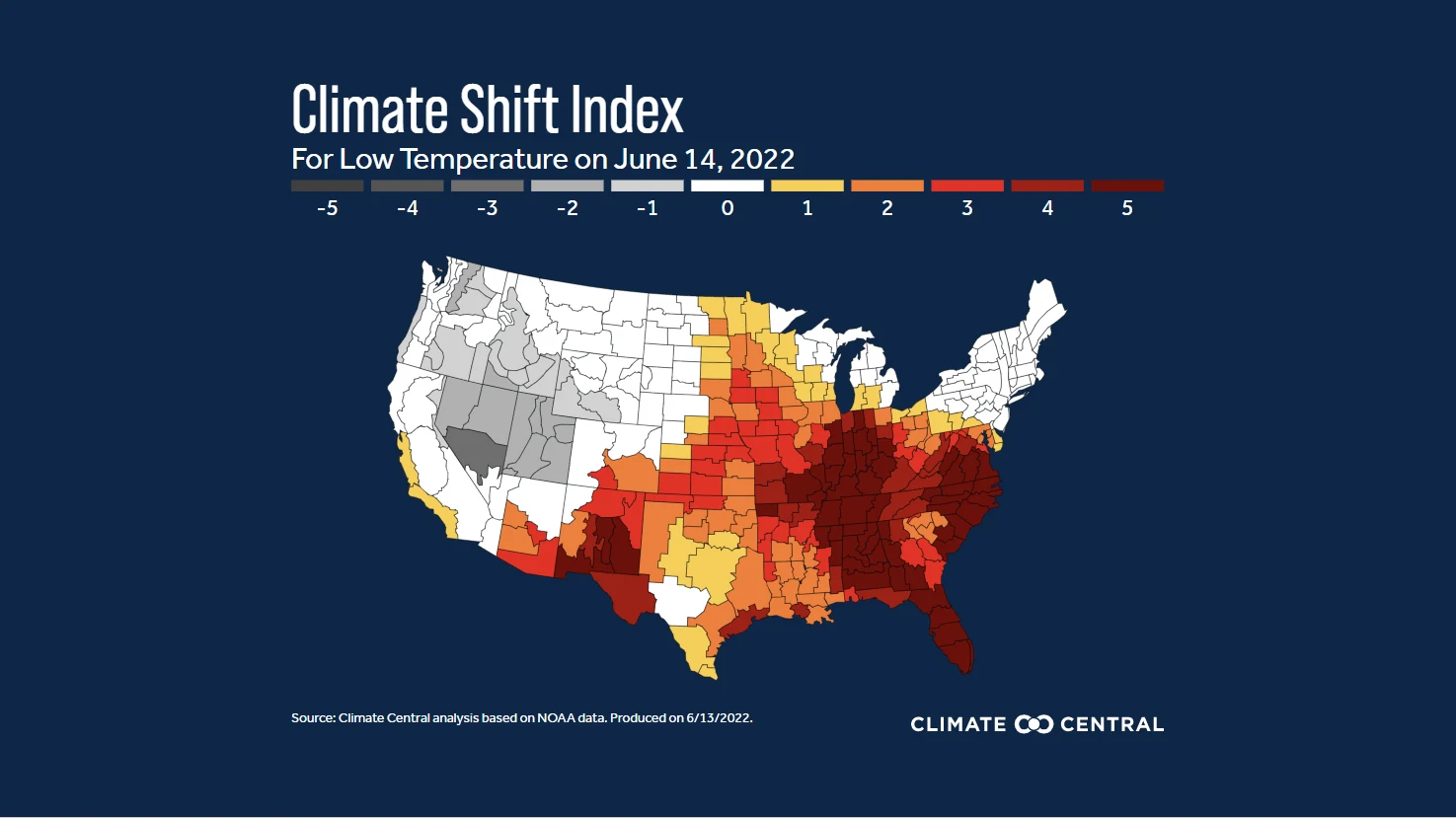
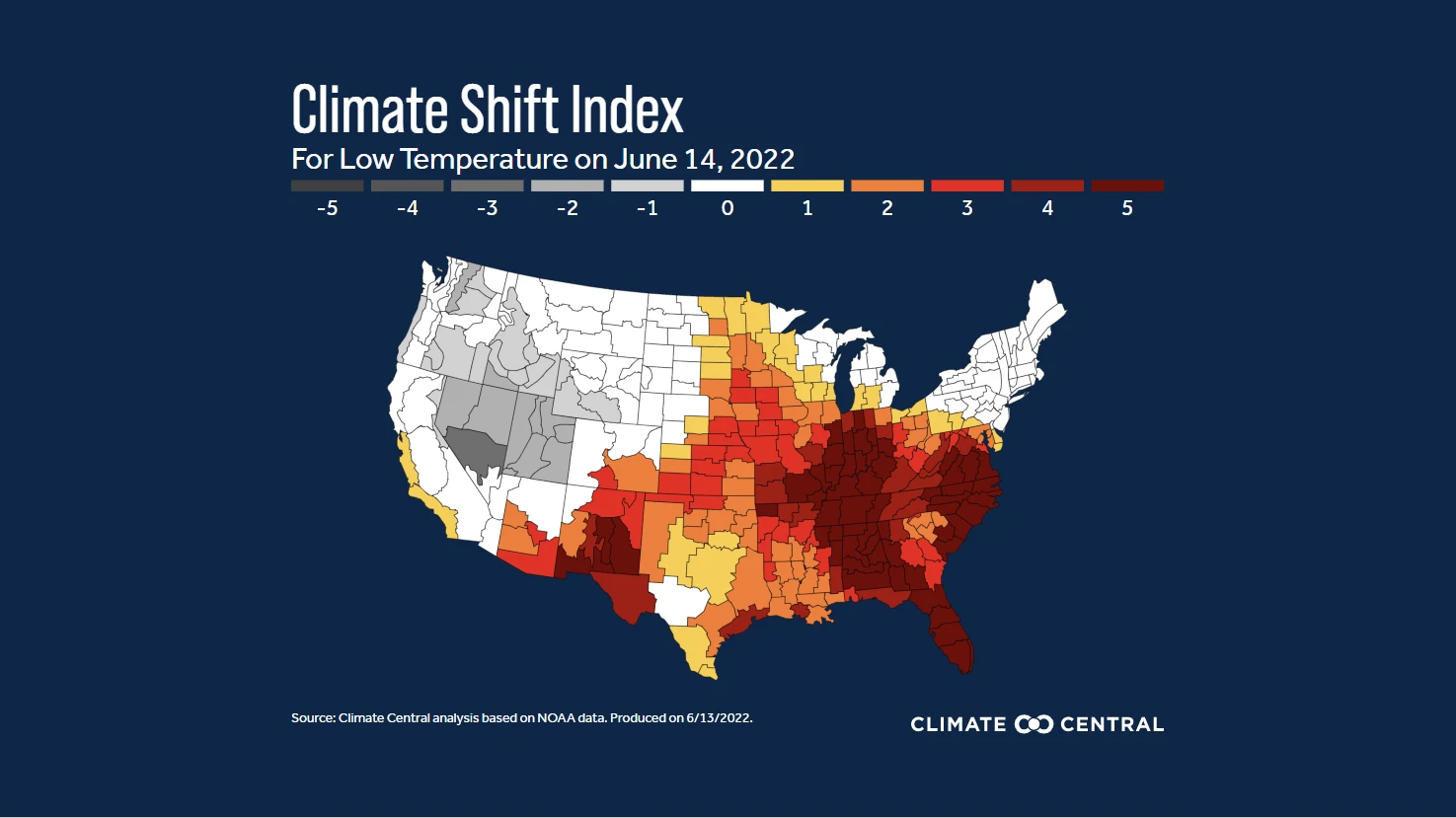
Climate Central's best-in-class global elevation data anchored visualizations and maps used at the 2021 UN Climate Conference to illustrate sea level rise projections. To date, our online maps and tools have been used more than 10 million times. Our 10-year-old Climate Matters program provides production-ready graphics and climate science reporting resources to meteorologists and journalists in 95% of U.S. media markets. Along with a small team of international experts, our scientists launched the groundbreaking World Weather Attribution, changing the narrative on links between climate change and individual extreme weather events. Our pioneering attribution work continues with the Climate Shift Index, which along with our other tools and data analyses support communication, planning and adaptation initiatives around the world.
Articles, stories, and segments using Climate Central content to communicate climate change impacts and solutions reach local audiences nearly every day
Audiences in nearly every country have seen Climate Central maps and visualizations, and read or heard commentary from our scientists
Climate Central is the only climate communications group that produces and disseminates localized and visual content weekly and at national scale; co-houses scientists, journalists, and technologists; and conducts and catalyzes original, peer-reviewed scientific research to fill critical communication gaps.
We have built strong relationships with thousands of trusted, mostly local messengers who deliver our content. Local relevance and credibility make our communications effective; the broad scale of our efforts help advance national and global conversations.
For decades, scientists have warned that our planet is facing a climate emergency that could alter life on earth for the foreseeable future, and they have called for urgent action to match the gravity of the threat. Today, there is mounting evidence that the adverse impacts of climate change are growing more frequent and severe—forcing millions of people around the world to grapple with serious consequences, year after year.
At Climate Central, we envision a world where public will to address the climate challenge is robustly deep, broad, and sustained—where it becomes a core element of culture everywhere. No generation in human history has carried a greater burden nor shared a greater opportunity to shape the future for the better. And we know what is at stake.
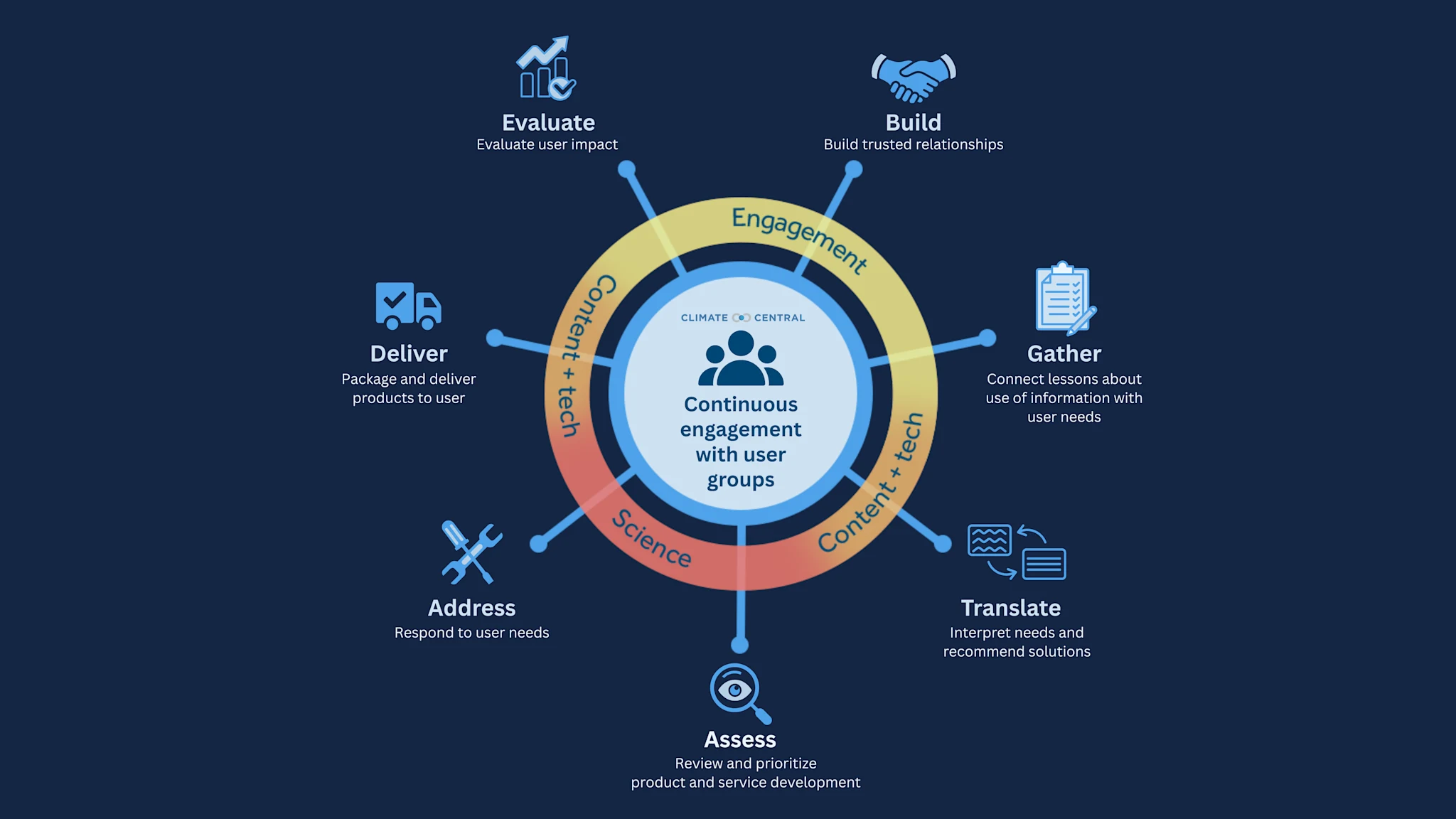
To help address this existential threat, Climate Central’s mission is to make accurate and effective climate communication ubiquitous. We employ a range of research-based communication strategies: We generate tailored local content that makes information about climate impacts and solutions immediate, accessible, and personal. We do it widely. We do it frequently. We make it visual. And to reach diverse audiences effectively, we systematically deliver this content via trusted voices and pathways. We aim to make climate a top priority issue for citizens and decision-makers at every level in private and public sectors alike.
More specifically, we use science, big data, and technology to generate thousands of local storylines and compelling visual images that make clear the impacts of climate change, the unequal burdens they pose, and what can be done about it all. To disseminate this vital information at national and global scales, we work with a large and growing network of meteorologists and journalists, as well as many other trusted voices—from government and business leaders to planners, nongovernmental organizations, and educators.
Climate Central’s research, maps, tools, and visualizations help millions of people around the world to understand the climate threats facing their communities, the most vulnerable among us, and all of humanity—and what we can all do about them. Evaluations have found that our methods increase ideologically broad acceptance of climate science and concern about climate change consequences.
Climate Central is policy- and technology-neutral. We cherish our record of scientific and journalistic integrity, effective communication, and collaboration.
Policy Neutrality — We advance no specific policy, legislation, or technology to address climate change. We are scrupulously non-advocacy and non-partisan.
Scientific and Editorial Integrity — We communicate the facts of climate change wherever they lead.
Importance of Informing the Public — We seek to reach broad audiences with scientific facts to support informed public discussion and democratic decision-making.
Effective Communication — We use an innovative mix of science and communication, scaled by technology, which defines our approach to reach and move important audiences.
Revealing Consequences — We are committed to investigating and communicating the disproportionate impacts of climate change, and to engaging with affected communities.
Collaboration — We contribute our talents and efforts alongside many other organizations working to address the great challenge of climate change.
Climate change disproportionately impacts some communities. Groups that have barely contributed to the problem often face its gravest threats and impacts and may have the fewest resources to prepare, respond, or recover.
Climate Central regularly highlights the consequences of climate change and tells the stories of the many different groups affected by it. We reaffirm our commitment to investigate and publicize the disproportionate impacts of climate change, and to increase our efforts in this area. We also reaffirm our commitment to engage with affected communities in developing and disseminating our materials, and to increase our efforts to feature experts who can speak to the needs and experiences of affected groups.
In 2008, motivated by climate scientists’ high levels of concern about the heating planet versus the low priority given by the public and decision-makers, a group of leading scientists, philanthropists and communicators established Climate Central. They aimed to bridge that gap and promote understanding and action in line with the threat. To do it, they built an organization designed to communicate the facts about climate change and its solutions accurately, widely, and effectively.
Over the years, Climate Central has grown from working with just a handful of news organizations to collaborating with hundreds and making a mark on thousands. We have evolved from creating a small number of fully produced stories to providing science-based content, tools, and training that support countless storytellers and stakeholders in media, social media, government, businesses, NGOs, and beyond. We moved from tapping only existing climate science to filling key gaps and making headlines with our own research. We have developed an advanced technology capacity to generate and disseminate tailored, local climate information at national and global scale, with high-quality graphics–all available, for free. And we have expanded from a U.S. focus at the start to embracing global initiatives today.
Climate Central took its original shape with seed funding from the Flora Family Foundation and development funds from the 11th Hour Project. The founding board members were Jane Lubchenco, Stephen W. Pacala, and Wendy Schmidt.
Climate Central has developed several high-impact major initiatives. We created Climate Matters to bring climate change into weathercasts via local voices highly trusted by Americans everywhere: TV meteorologists. In the program’s first year, we placed our content in about 50 segments; in its tenth, that number exceeded 5,000. Climate Central’s research, tools, and visuals on sea level rise have repeatedly achieved widespread global distribution and are used by millions. And Climate Central’s work developing and communicating the rapid scientific attribution of extreme weather events to climate change has accelerated a critical shift in the narrative. You can legitimately quantify the link between many individual events and climate change, and the media, leaders, and the public increasingly recognize this.
2008
Climate Central is founded.
First television segment aired on PBS NewsHour.
2009
Began research on sea level rise.
2010
Piloted an initiative to bring climate change to TV weather.
2012
Launched Climate Matters and spurred 55 TV segments, aired by a dozen participating TV meteorologists.
Made national headlines with sea level rise program research and maps. Invited to and testified in a Senate committee hearing.
2014
Led the creation of World Weather Attribution, in order to put a number on the influence of climate change on select individual extreme weather events; do it fast enough to bring results into the news cycle; and eliminate the false public narrative that individual events could not be tied to warming.
2015
Co-authored the first-ever rapid extreme weather attribution analysis.
Ahead of Paris climate talks, published sea level research and visuals reaching 5,000 news stories. Driven substantially by concerns about sea level rise, the global Paris Agreement included a more ambitious stretch goal than expected: limiting warming to below 1.5 degrees C.
2016
The U.S. National Academy of Sciences validated attribution of extreme weather events to climate change in a report. Media narratives increasingly recognized climate links to extreme events.
2017
Completed 10th rapid extreme event attribution project.
2018
Launched WeatherPower, bringing solar and wind power generation into the daily local forecast.
More than 1,000 TV segments included Climate Matters content. Climate Matters expanded beyond the TV weatherdesk to all beats and all media.
2019
Launched Partnership Journalism program, collaborating with local newsrooms nationwide to produce in-depth science-backed stories.
2019
Rewrote understanding of global sea level threats with publication of a new AI-supported assessment. Generated more media and online attention than any other peer-reviewed climate research paper from at least 2011-2021 (sources: Altmetric, Carbon Brief). More than 1 million users explored Climate Central’s associated online mapping tool.
2020
More than 1,000 TV meteorologists participating in Climate Matters–plus 800 other journalists.
2021
More than 5,000 TV segments included Climate Matters content. Climate Matters named an international Landmark initiative by Tools of Change.
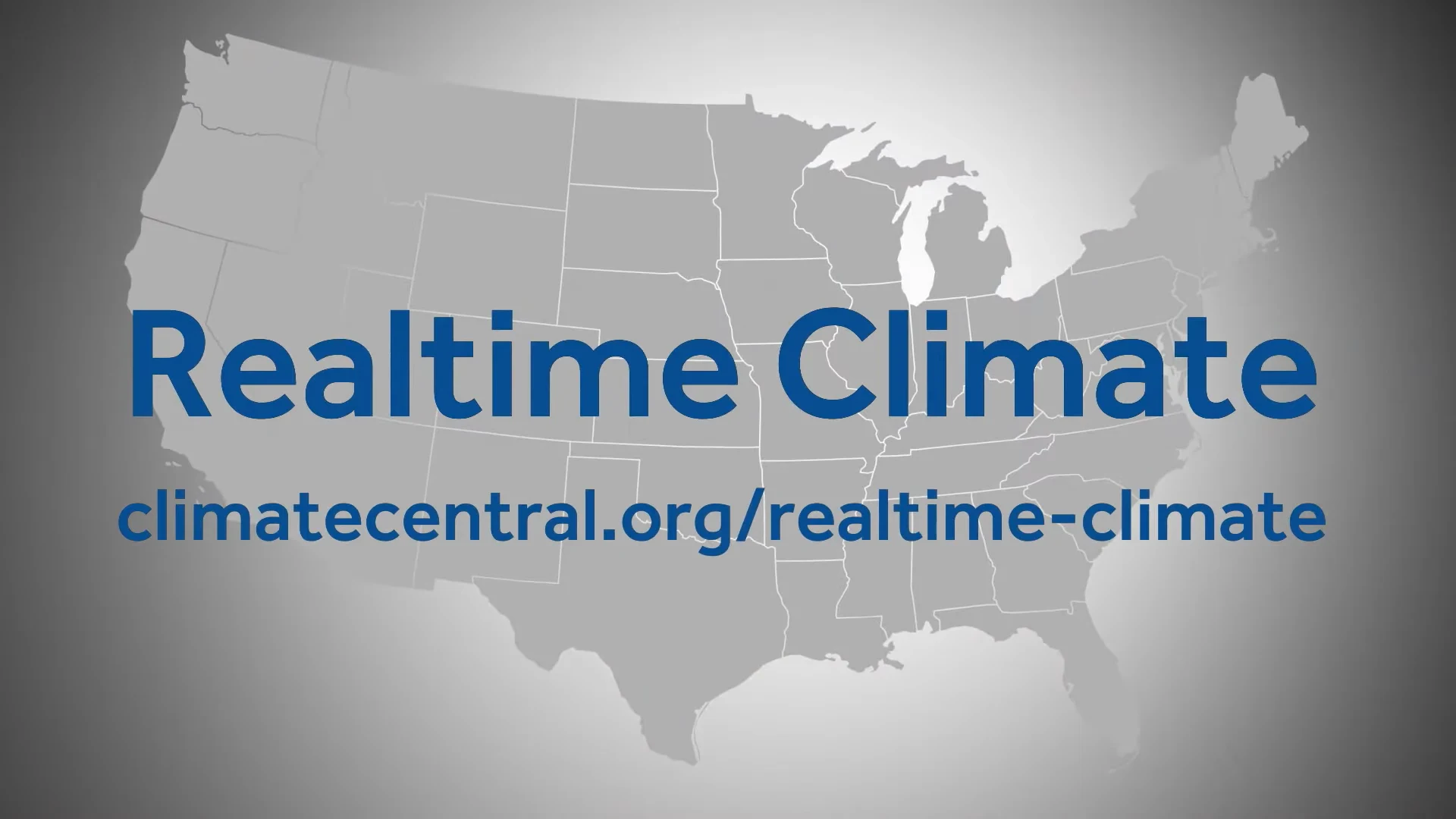
Launched Realtime Climate, a system for rapidly dispatching tailored local climate content and alerts to subscribers when local conditions warrant.
4,000 media outlets worldwide covered Picturing Our Future, Climate Central’s research and visuals that show contrasting futures under different pollution and heating scenarios—released three weeks ahead of major global climate talks in Glasgow.
2022
Climate Central began working with The Weather Company, an IBM Business, to make our climate-related content available to a larger audience via TWC’s hundreds of media product clients.
Launched the Climate Shift Index, the world’s first service for daily local temperature attribution—putting a number on the influence of climate change on observations and forecasts.